

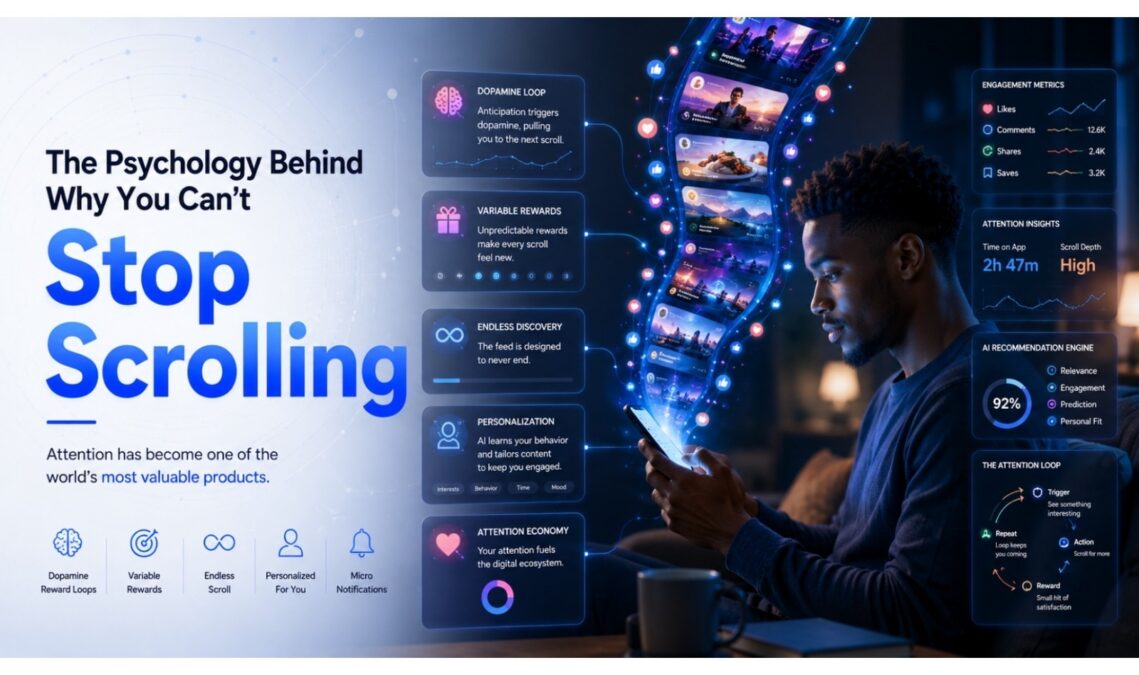
Have you ever picked up your phone to reply to one message…
…and somehow found yourself watching cooking videos, laughing at memes, reading a random comment section, and checking what someone you haven’t spoken to in five years is doing?
Then you look at the time.
Forty-five minutes are gone.
You can’t even remember what the original message was.
If that sounds familiar, you’re definitely not alone.
We’ve all had moments where we promised ourselves, “Just five minutes.”
Then those five minutes quietly turned into an hour.
It’s easy to blame ourselves.
“I need more discipline.”
“I waste too much time.”
“I should have more self-control.”
But here’s something most people don’t realize.
Many of the apps we use every day are intentionally designed to keep us engaged for as long as possible.
Not because they’re evil.
Not because someone wants to ruin your productivity.
Simply because, in today’s digital world, attention has become one of the most valuable currencies.
Let’s take a look at what’s really happening every time you tell yourself, “Just one more scroll.”
Your Brain Loves “Maybe”
Imagine someone hands you a wrapped gift.
You don’t know what’s inside.
It could be something exciting.
It could be something ordinary.
Either way, you’re curious enough to open it.
Now imagine that feeling repeating every few seconds.
That’s essentially what social media feeds are doing.
Every swipe might reveal:
A funny video.
An inspiring story.
Breaking news.
A shocking headline.
A friend’s engagement.
A football highlight.
Or… absolutely nothing interesting.
The uncertainty is what keeps us scrolling.
Our brains are naturally curious.
And curiosity is incredibly powerful.
It’s the same reason people watch “just one more episode” of a TV series before going to bed.
We want to know what comes next.
Apps simply turned that feeling into an endless experience.

Why Infinite Scroll Changed Everything
Do you remember when websites had pages?
You reached the bottom.
Clicked “Next.”
Waited for another page to load.
There was a natural stopping point.
Social media quietly removed that.
Instead of asking whether you wanted to continue, the next post simply appeared.
Then another.
Then another.
Imagine eating from a bowl that magically refills itself every time it gets close to empty.
You’d probably eat more than you planned.
That’s what infinite scrolling does.
It removes the small pause where your brain might have said,
“Okay… that’s enough for today.”
Without realizing it, stopping requires a conscious decision instead of happening naturally.
Notifications Know Exactly How to Get Your Attention
Picture this.
You’re working on something important.
Then…
Ding.
Someone liked your photo.
A friend sent a message.
A news app has breaking news.
Your shopping app has a discount waiting for you.
One notification doesn’t seem like much.
But over the course of a day, they add up.
Each one is like someone gently tapping you on the shoulder, saying,
“Hey… look over here for a second.”
Sometimes it really is important.
Most times?
Not so much.
Yet our brains have become trained to respond almost automatically.
That’s why many people unlock their phones before they’ve even thought about whether they actually need to.
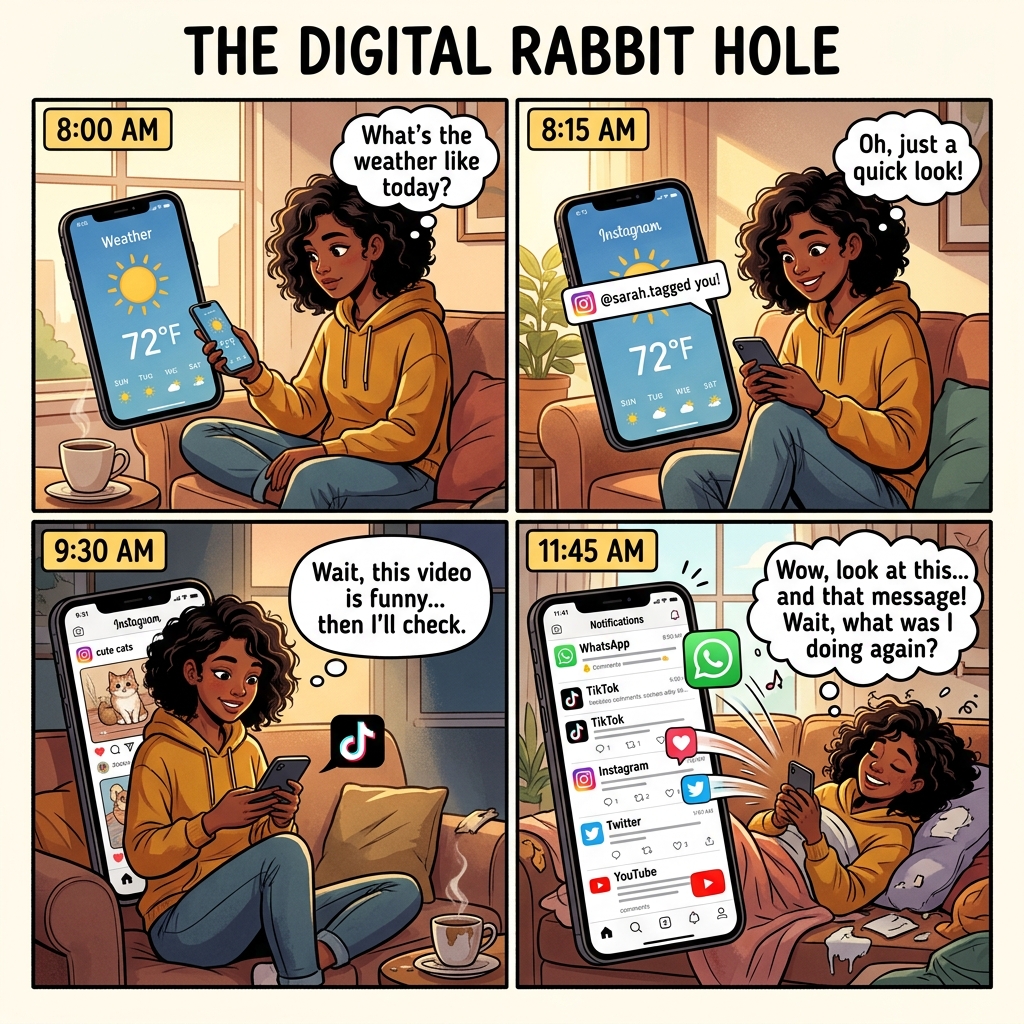
Ever Gone to Check One Thing… Then, Forgotten Why You Picked Up Your Phone?
This happens more often than people admit.
You unlock your phone to check the weather.
A notification catches your eye.
Then Instagram opens.
Someone shared a funny reel.
That reminds you to check WhatsApp.
From there, you open YouTube.
Twenty minutes later, you’re wondering:
“Wait… why did I even pick up my phone?”
It’s not because your memory suddenly disappeared.
Your attention was simply redirected several times in a row.
Modern apps are incredibly good at offering “just one more interesting thing.”
And when those moments stack together, they quietly steal far more time than we notice.
Most people don’t lose three hours at once.
They lose three minutes, sixty different times.
This Isn’t Just About Social Media
It’s easy to point fingers at Instagram, TikTok, Facebook, or X.
But the truth is, many digital products use similar psychological principles.
Shopping websites recommend products before you’ve finished viewing the first one.
Streaming platforms automatically play the next episode.
Music apps generate endless playlists.
Video platforms suggest another clip before the current one ends.
None of these features exists by accident.
Companies invest heavily in understanding user behaviour.
Not to manipulate people for the sake of it, but because keeping users engaged is directly connected to their business.
The longer people stay, the more likely they are to interact with content, see advertisements, subscribe to services, or make purchases.
Attention has become a business model.
Designers Aren’t the Villains
This might surprise you.
The designers building these apps don’t usually sit in meetings asking,
“How can we make people waste more time?”
Their goal is often much simpler.
They want products that are easy to use.
Enjoyable.
Useful.
Engaging.
If you’ve ever opened an app and immediately understood how it worked, that wasn’t luck.
Someone carefully designed that experience.
The challenge is that making an app easy to return to can also make it difficult to leave.
It’s a balancing act.
One that many technology companies continue trying to improve.
So… Is It Even Possible to Take Back Control?
Absolutely.
The goal isn’t to delete every app on your phone.
Technology isn’t the enemy.
In fact, you’re probably using technology to read this article.
The real goal is to become more intentional.
A few small changes can make a surprising difference.
Turn off notifications that don’t actually matter.
Move distracting apps away from your home screen.
Ask yourself what you’re opening your phone for before you unlock it.
Even setting aside thirty minutes to scroll guilt-free can be healthier than constantly drifting in and out of apps all day.
The point isn’t perfection.
It’s awareness.
Because it’s much easier to make good decisions when you understand what’s influencing them.

Final Thoughts: Your Attention Is More Valuable Than You Think
Technology has given us incredible things.
We can learn almost any skill online.
Talk to family across the world.
Start businesses from our bedrooms.
Access information within seconds.
None of that is the problem.
The challenge is remembering that every app is competing for something incredibly valuable:
Your attention.
And unlike money, attention is something you can never earn back once it’s spent.
So the next time you catch yourself saying,
“Just one more scroll…”
Pause for a second.
Not because scrolling is bad.
But because your attention deserves to be spent on things you choose, not just things that happen to appear on your screen.
After all, the most powerful person in today’s digital world isn’t the one with the fastest phone.
It’s the one who decides where their attention goes.

