
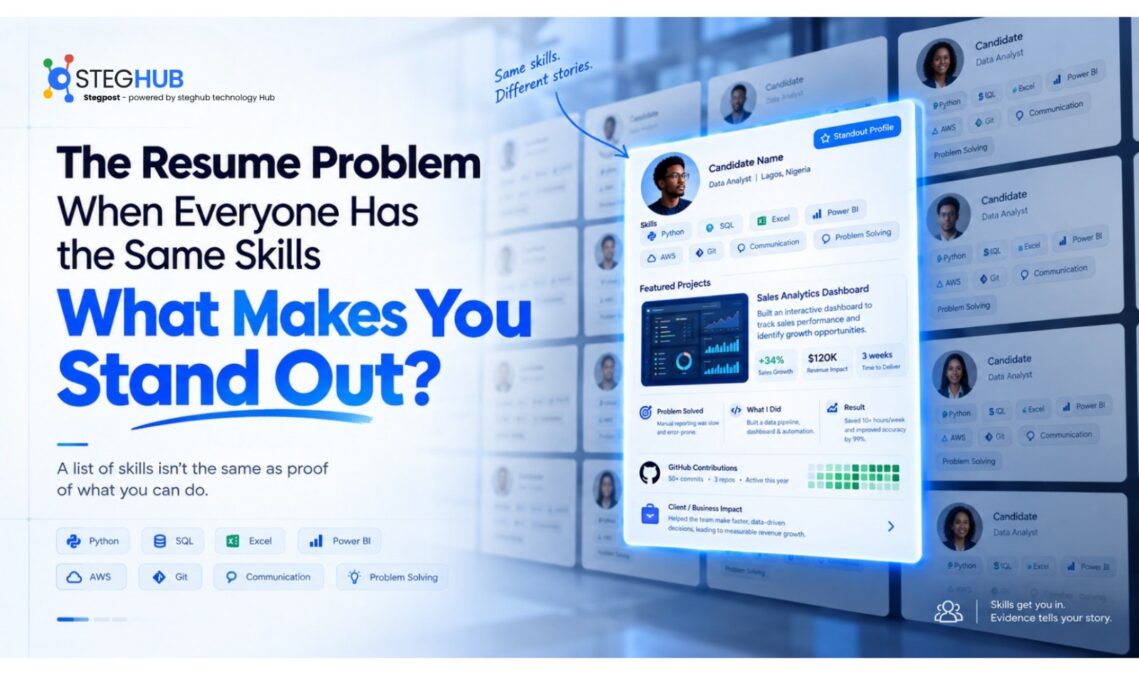
You learn Excel.
Then SQL.
Then Power BI.
Maybe Python.
You add a few projects, complete a course, collect a certificate, update your LinkedIn profile and finally rewrite your CV.
You feel ready.
Then you apply for a job and discover something strange.
The person applying for the same role knows Excel too. They know SQL. They have a Power BI project. They have a certificate. Their CV uses almost the same words as yours.
So does the next person.
And the next.
Suddenly, the skills that were supposed to make you stand out have become the skills everyone is expected to have.
That is the resume problem.
The question is no longer simply, “What skills do you have?”
It is becoming:
“What evidence do you have that those skills actually make you useful?”
[Image Prompt: A modern recruitment scene showing dozens of nearly identical digital resumes floating across large screens, with one candidate profile subtly distinguished by detailed project evidence and real-world outcomes, cinematic office lighting, realistic professional atmosphere, wide composition]
The Skills List Has Become Crowded
There was a time when putting a particular technical skill on your CV could immediately make you interesting.
Today, depending on the role, seeing words like Excel, SQL, Python, Agile, Jira, Power BI, AWS, Git or data analysis may not tell an employer very much.
Not because those skills are unimportant.
Because the employer may see them dozens or hundreds of times.
Imagine a company hiring for a junior data analyst position.
Candidate A says:
SQL, Excel, Power BI, Data Analysis.
Candidate B says:
SQL, Excel, Power BI, Data Analysis.
Candidate C says:
SQL, Excel, Power BI, Data Analysis.
All three may genuinely know those tools.
But the recruiter still has a problem.
Who can actually do the work?
The resume has listed the ingredients, but it has not necessarily shown what the person can cook.
And this is where many job seekers misunderstand what a CV is supposed to accomplish.
A resume is not simply a catalogue of everything you have learned.
It is evidence.
Knowing a Tool Is Not the Same as Using It
There is an important difference between saying:
“I know Power BI.”
and saying:
“I built a Power BI dashboard that helped identify monthly sales trends across five product categories.”
The first statement tells someone you have encountered the technology.
The second begins to tell a story.
What did you do?
Why did you do it?
What problem were you solving?
What happened as a result?
The same applies to almost every technical skill.
Knowing Python is one thing.
Using Python to clean a messy dataset and automate a repetitive reporting process is another.
Knowing Jira is one thing.
Using Jira to organise a project backlog, track sprint progress and coordinate tasks is another.
Knowing AWS is one thing.
Deploying and managing an application in an AWS environment is another.
The difference is not necessarily the technology.
It is the application of the technology.
And employers increasingly have ways of testing that difference.
Your Portfolio Is Your Resume Talking Back
A resume can make a claim.
A portfolio can provide evidence.
That is why projects matter.
Not because every person needs a beautifully designed website with fifteen projects.
But because projects allow someone to see how you think.
Consider two candidates.
One says:
Completed a data analytics certification.
Another says:
Analysed a public dataset, cleaned inconsistent records, identified three major trends, built an interactive dashboard and presented the findings as recommendations for a hypothetical business.
The second candidate has given the employer something to investigate.
They can ask:
Why did you choose that dataset?
How did you clean it?
Why did you choose those visualisations?
What did you discover?
What would you do differently?
Suddenly, the conversation is no longer about whether the person remembers the definition of a technical term.
It is about how they approach problems.
That distinction can be powerful.
But Here Is Where Portfolios Also Go Wrong
Once people hear that portfolios matter, another problem appears.
Everyone starts building portfolios.
Soon, you see the same projects everywhere.
The same weather app.
The same to-do list.
The same sales dashboard.
The same Netflix-style interface.
The same beginner Python projects.
There is nothing inherently wrong with these projects. They can be useful for learning.
The problem comes when the project exists only because the person needs something to put on their CV.
A project should tell you something about the person who built it.
What were they curious about?
What problem did they notice?
What decisions did they make?
What went wrong?
What did they improve?
A simple project with thoughtful reasoning can tell a better story than a complicated project that the candidate cannot explain.
The goal is not to impress someone with complexity.
It is to demonstrate usefulness.

The Most Interesting Part of Your CV Might Not Be a Skill
Think about the difference between these two statements:
“Proficient in project management.”
and:
“Coordinated a six-person project team, tracked deliverables across weekly sprints, identified delays and reorganised task priorities to keep the project moving.”
The second statement contains a skill too.
But it also contains behaviour.
That matters.
Because companies do not hire people simply because they possess software.
They hire people who can use those tools while communicating, making decisions, handling uncertainty, working with others and solving problems.
Technology is often only one part of the job.
Imagine two people who both know Agile.
One understands the ceremonies.
The other knows how to recognise when a team is stuck, ask the right questions, communicate blockers and help the team move forward.
They both “know Agile.”
But their usefulness may look very different.
This is why your CV should not only answer:
“What do I know?”
It should also answer:
“What can I do with what I know?”
Your Experience May Be Bigger Than Your Job Title
There is another reason people struggle to stand out.
They think experience only counts when it comes from formal employment.
It doesn’t.
A person may have worked on school projects, freelance assignments, volunteer initiatives, personal products, internships, community programmes or collaborative projects.
Those experiences can demonstrate useful capabilities.
Suppose someone has never held the title “Project Manager.”
But they organised a small team, created a delivery schedule, assigned responsibilities, tracked progress and handled communication between different people.
That experience tells a story.
It may not be equivalent to managing a large corporate programme.
But it is still evidence of behaviour associated with project management.
The important thing is to represent it honestly.
Don’t turn a classroom project into “three years of professional experience.”
Don’t give yourself a job title you never held.
Instead, explain what you actually did.
That can be much more credible.
The Story Behind the Skill Matters
Two people can have identical technical skills and still present completely different professional identities.
One might say:
“I am a software developer with knowledge of JavaScript and React.”
Another might say:
“I enjoy building simple digital tools that remove repetitive tasks for small businesses.”
Neither statement is automatically better.
But the second gives you something to remember.
It tells you what the person is interested in solving.
That matters because standing out is not always about being dramatically more skilled than everyone else.
Sometimes it is about being more clearly understood.
If a recruiter reads your CV and cannot explain what kind of problems you are capable of solving, the list of technologies may not help much.
Your career begins to become more memorable when your skills form a pattern.
Perhaps you are the person who enjoys turning messy information into clear decisions.
Perhaps you like automating repetitive processes.
Perhaps you are interested in making complicated digital products easier to use.
Perhaps you enjoy organising teams and making projects move.
The tools may change.
The underlying problem-solving interest can remain.
Employers Are Looking for Signals
Hiring someone is uncertain.
A CV cannot completely eliminate that uncertainty.
An employer is essentially asking:
“If we bring this person into the organisation, what evidence suggests they will be able to contribute?”
Every part of your professional profile can become a signal.
A certificate signals structured learning.
A portfolio signals practice.
A previous job can signal workplace experience.
A strong project explanation can signal problem-solving ability.
A recommendation can signal that another person has worked with you and found you reliable.
A well-written CV can signal that you can communicate clearly.
None of these signals guarantees anything.
But together, they create a picture.
That is why adding another ten skills to your CV may not be as useful as strengthening the evidence behind the five skills you already have.
The Problem With Trying to Look Like Everyone Else
There is a strange contradiction in job hunting.
People are told to tailor their CVs to job descriptions.
That’s sensible.
But sometimes candidates take this so far that their resumes begin to sound like copies of the job advertisement.
Every keyword appears.
Every technical term is included.
Every sentence is carefully optimised.
And somehow, the person disappears.
A recruiter may see:
Results-driven professional with strong analytical, problem-solving, communication and leadership skills…
But what does that actually tell them?
Almost nothing.
Compare that with a specific example of something the person built, improved, organised, analysed or solved.
Specificity creates credibility.
Instead of saying you are a “problem solver,” show the problem you solved.
Instead of saying you are “detail-oriented,” describe the situation where your attention to detail mattered.
Instead of saying you are a “team player,” explain what you contributed to a team.
Don’t simply describe your qualities.
Give them somewhere to live.
You Don’t Need to Be the Most Experienced Person in the Room
This is particularly important for people entering technology.
You may look at a job description asking for two years of experience and think:
“I have no chance.”
Sometimes the experience requirement is genuinely important.
But sometimes what the employer needs is evidence that you can operate beyond the classroom.
That is where practical exposure becomes valuable.
You can work on real projects.
You can collaborate with other people.
You can solve realistic problems.
You can contribute to open-source projects.
You can volunteer your technical skills.
You can build something for a small business or community.
You can document what you learned.
The goal is not to manufacture experience.
It is to create opportunities to practice being useful.
Because there is a big difference between learning about work and doing work.
The Resume Should Lead Somewhere
One of the easiest ways to improve a resume is to stop thinking about it as the final destination.
It should lead somewhere.
A project should lead to a GitHub repository, case study, dashboard or demonstration.
A professional experience should lead to a conversation about what you actually accomplished.
A certification should lead to evidence of how you applied what you learned.
A skill should lead to an example.
The more important claims on your CV should have something behind them.
Think of it like a trail.
You don’t want the recruiter to arrive at:
“I know data analysis.”
and have nowhere else to go.
You want them to be able to follow the trail:
I learned data analysis → I applied it → I worked with messy information → I found something interesting → I communicated the result.
Now there is a story.
And stories are easier to remember than lists.

What Actually Makes Someone Stand Out?
There is no single trick.
And that is probably good news.
Because if there were one trick, everyone would copy it.
Standing out usually comes from the combination of several things:
You understand your field.
You can actually use your skills.
You have evidence of applying them.
You can explain your decisions.
You can communicate clearly.
You understand the problems businesses or users are trying to solve.
You can work with other people.
And perhaps most importantly, you can show that you are still capable of learning.
That combination is much harder to fake than a long skills section.
Your CV Should Make Someone Curious
A strong resume does not have to answer every question.
Sometimes its job is to create the right questions.
“Why did she build this?”
“How did he solve that?”
“What did they learn from this project?”
“What happened after they introduced that process?”
“Can they explain this clearly?”
Those questions can lead to an interview.
And an interview gives you the opportunity to provide the context that a two-page document cannot.
So perhaps the goal of a resume isn’t actually to prove that you are the best candidate.
It is to provide enough credible evidence for someone to want to learn more about you.
That changes how you approach it.
Instead of asking:
“What else can I add to my CV?”
you might start asking:
“What evidence is missing?”
That is a much better question.
The People Who Stand Out Aren’t Always the Ones With the Most Skills
Technology careers can make it tempting to keep collecting.
Another certification.
Another programming language.
Another tool.
Another course.
Another badge.
There is nothing wrong with learning.
But there comes a point where collecting skills produces diminishing returns.
You can know twenty tools and still struggle to explain what you can actually contribute.
Meanwhile, someone with five well-developed skills and strong evidence of applying them may be easier for an employer to understand.
The difference is not necessarily intelligence.
It is depth, application and evidence.
Your career does not become more valuable simply because your skills section becomes longer.
Sometimes, it becomes more valuable because the connection between your skills and real problems becomes clearer.
The New Question for Job Seekers
The job market will continue to change.
Tools will change.
Job descriptions will change.
Some technologies will become less important while others become essential.
But one question is likely to remain useful:
“What can I show that proves I can be useful?”
Not what course you completed.
Not how many certificates you collected.
Not how many technologies you can name.
What can you show?
Maybe you built something.
Maybe you improved something.
Maybe you analysed something.
Maybe you organised something.
Maybe you solved something.
Maybe you helped someone else solve something.
That is where the resume starts becoming more than a list of qualifications.
It becomes a record of evidence.
And when everyone appears to have the same skills, evidence may be what gives those skills meaning.
Because knowing the same things as everyone else is not necessarily the problem.
The real question is what you have done with what you know.