


Have you ever noticed that your best ideas never seem to show up when you’re staring at your screen?
You’re sitting at your desk.
You’ve opened the document.
The cursor is blinking.
You’ve got coffee.
You’ve got time.
And somehow… nothing.
Then later that evening, while washing dishes, taking a walk, or lying in bed trying to sleep, the solution suddenly appears out of nowhere.
The email you’ve been struggling to write.
The project you’ve been overthinking.
The idea you’ve been searching for all day.
Just like that.
If this happens to you often, you’re not weird.
You’re human.
And there’s a reason your best thinking doesn’t always happen during working hours.
Your Brain Wasn’t Designed To Be “On” All Day
Modern work has led many of us to believe that productivity means constant activity.
Answer the email.
Join the meeting.
Reply to the message.
Attend the call.
Update the spreadsheet.
Repeat.
The problem is that being busy and thinking deeply are two very different things.
Most workdays are filled with reactions.
Responding.
Updating.
Attending.
Checking.
However, great ideas often require additional elements.
Space.

And space has become surprisingly rare.
The Shower Effect Is Real
Let’s talk about something almost everyone has experienced.
You’re stuck on a problem all day.
Nothing works.
You give up.
Then later, while taking a shower, the answer suddenly appears.
Why?
Because your brain finally relaxed.
When you’re actively forcing yourself to solve a problem, your mind can become narrow and rigid.
But when you’re doing something simple—walking, cooking, showering, driving—your brain starts making unexpected connections.
That’s often where creativity lives.
Not in pressure.
In freedom
The Most Productive Person Isn’t Always The Most Creative
We’ve all met someone who seems incredibly productive.
Their calendar is packed.
Their inbox is empty.
Their task list is organized.
They’re constantly moving.
But movement alone doesn’t create innovation.
Imagine a chef who spends the entire day cleaning the kitchen but never creates a new recipe.
Or a writer who organizes notes for eight hours but never writes a sentence.
Productivity matters.
But creativity requires thinking time.
And thinking time often looks unproductive from the outside.
Some Of Your Best Work Happens In Silence
A lot of workplaces celebrate visible work.
Meetings.
Updates.
Reports.
Presentations.
But some of the most valuable work happens quietly.
The strategy that saves a project.
The idea that improves a process.
The insight that solves a customer problem.
Those moments usually don’t arrive during your fifteenth notification of the day.
They arrive when your mind has room to breathe.
Why Being Constantly Busy Can Hurt Your Best Thinking
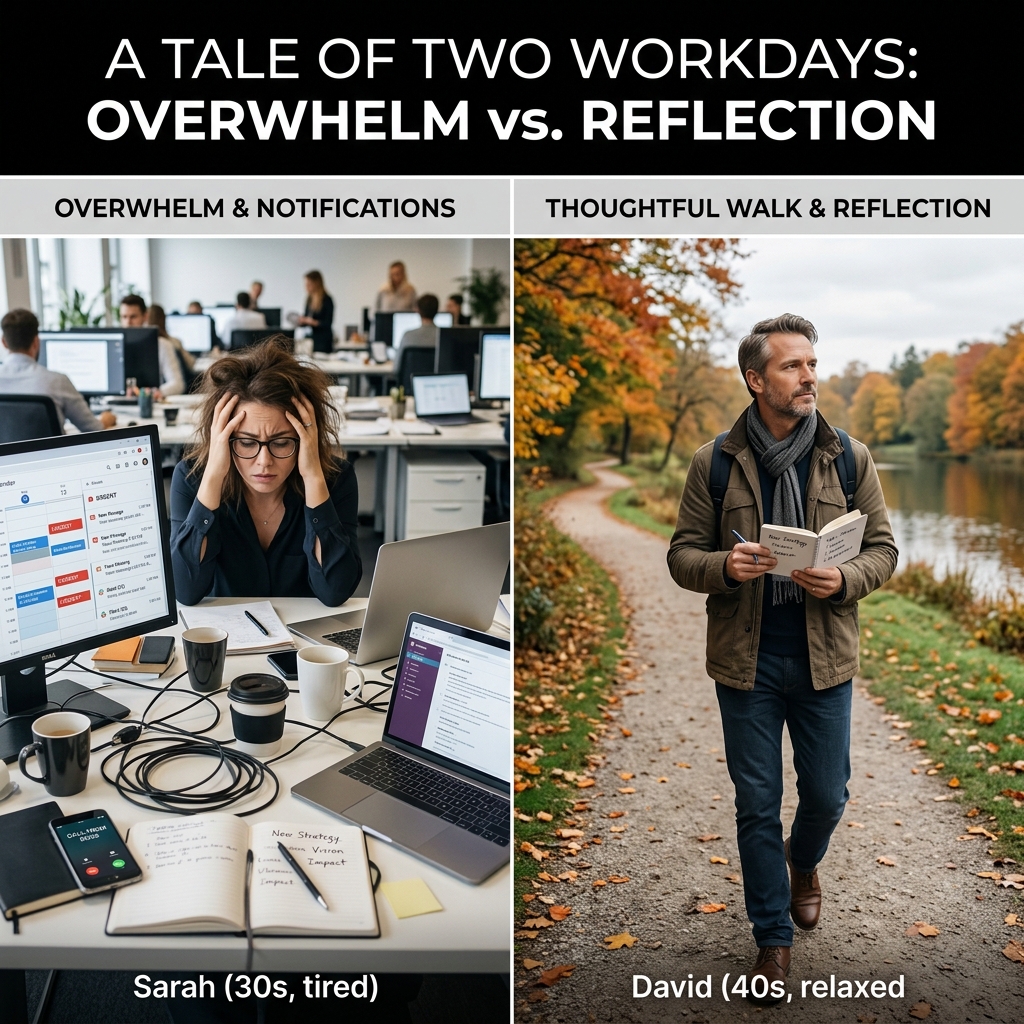
Let’s imagine two professionals.
The first spends eight hours jumping between meetings, emails, and messages.
The second spends six hours working but takes time to walk, think, reflect, and process ideas.
Who do you think is more likely to come up with a breakthrough solution?
The answer isn’t always obvious.
Because our brains aren’t machines.
They need recovery time.
The same way muscles need rest after exercise.
Mental performance works similarly.
We Don’t Schedule Thinking Time Anymore
This might be one of the biggest workplace mistakes today.
We schedule meetings.
We schedule deadlines.
We schedule presentations.
But we rarely schedule time to think.
And yet, some of the most important decisions in our careers require exactly that.
Thinking.
Not reacting.
Not responding.
Not rushing.
Just thinking.
The irony is that many people feel guilty when they’re not visibly busy.
As if thinking doesn’t count as work.
But some of the most valuable work you’ll ever do happens entirely inside your head.
The Solution Isn’t Working Less
Let’s be clear.
This isn’t an argument against hard work.
It’s an argument for balanced work.
The goal isn’t to spend less time working.
The goal is to spend more time creating space for quality thinking.
Sometimes that means taking a walk.
Sometimes it means stepping away from your screen.
Sometimes it means letting a problem sit for a while instead of forcing an answer.
Counterintuitive?
Maybe.
Effective?
Absolutely.
How To Create More Room For Better Ideas
You don’t need a complete lifestyle change.
Small adjustments help.
Try things like:
- Take short walks without your phone.
- Blocking time for focused work without notifications.
- Keeping a notebook nearby for unexpected ideas.
- Permitting yourself to step away when you’re stuck.
- Spending less time consuming information and more time processing it.
You might be surprised how much clarity appears when your brain gets a little breathing room.

Final Thoughts: Stop Forcing Every Answer
Some of the best ideas in history didn’t arrive during meetings.
They didn’t appear during endless email chains.
They didn’t show up because someone stared harder at a screen.
They arrived because someone had space to think.
So the next time you are stuck on a problem, don’t immediately assume you need to work harder.
Maybe you need to step back.
Take a walk.
Grab a coffee.
Wash the dishes.
Do something that gives your mind room to wander.
Because sometimes your best work isn’t waiting inside your laptop.
It’s waiting for a moment when your brain finally gets a chance to breathe.

