

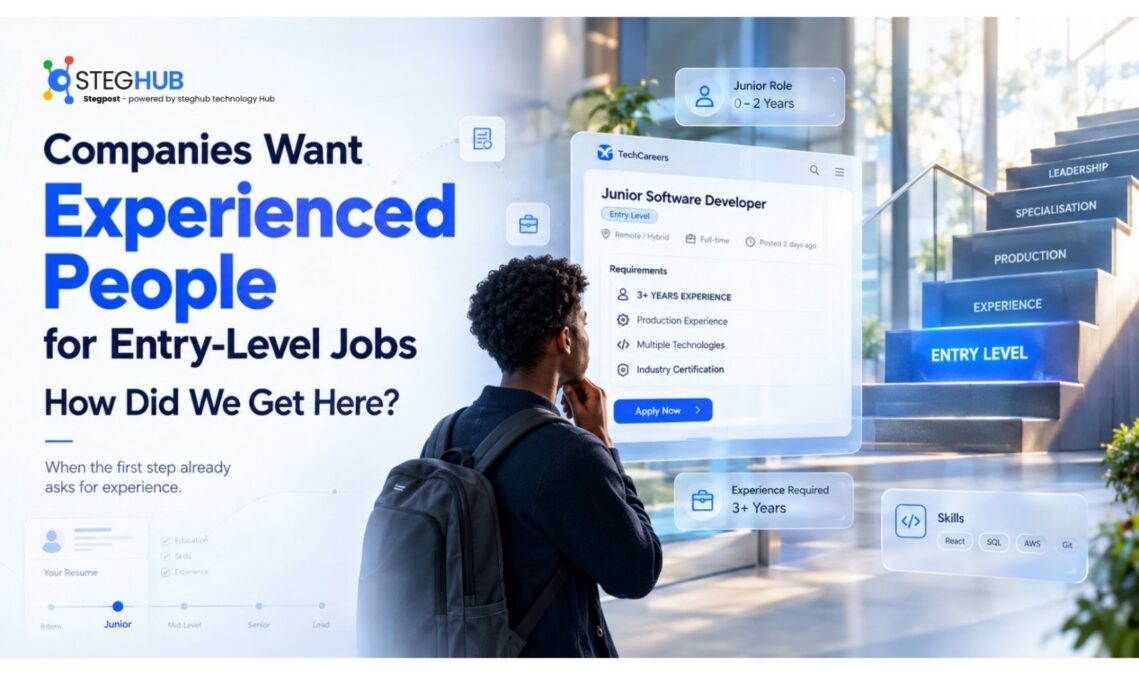
You find a job advertised as “Entry-Level.”
You get excited.
You read the requirements.
Bachelor’s degree.
Relevant certification.
Good communication skills.
Knowledge of the tools.
And then you reach the next line.
“2–3 years of experience required.”
You stop scrolling.
You read it again.
Two to three years.
For an entry-level position.
You haven’t even had your first real opportunity, and the job is already asking you to prove that you have done the job before.
So you start wondering:
If every company wants experience, where exactly are beginners supposed to get it?
It is one of the strangest contradictions in the modern job market.
Companies want people who can contribute quickly.
Candidates want an opportunity to prove they can contribute.
And somewhere between those two things, the traditional idea of an “entry-level” job has started to change.
What “Entry Level” Used to Mean
An entry-level position traditionally meant something fairly straightforward:
You are new to the profession.
You probably understand the basics.
You may have studied the subject.
But you still need to learn how the work actually happens inside an organization.
That learning was part of the job.
A company hired someone with potential, trained them, gave them supervision, allowed them to make relatively low-risk mistakes, and gradually gave them more responsibility.
The employee gained experience.
The company developed talent.
It was not charity.
The company benefited from having someone who could eventually become a productive member of the team.
That model still exists.
But in many industries, the expectations have shifted.
Now employers may want candidates who already understand the tools, workflows, communication standards and pace of the workplace.
They want someone who can arrive and contribute quickly.
The training period has become shorter.
And the responsibility for becoming “job-ready” has increasingly moved toward the candidate.

Why Are Companies Doing This?
The simplest answer is that hiring is expensive.
A company does not only pay someone’s salary.
There is the time spent writing the job description.
Reviewing applications.
Interviewing candidates.
Onboarding.
Training.
Supervision.
Access to tools and systems.
The time senior employees spend helping a new hire understand the work.
And there is the possibility that the person leaves after a few months.
From the employer’s perspective, hiring someone who already knows how to do the work can reduce some of those costs.
Imagine you have two candidates.
One understands the basic theory but has never worked on a real project.
The other has already spent two years solving similar problems in a professional environment.
If you need someone productive quickly, the second candidate may appear less risky.
This doesn’t necessarily mean the second person is more talented.
It means the employer has more evidence about what they can do.
And hiring decisions are often made under uncertainty.
Experience becomes a shortcut for reducing that uncertainty.
The Problem With Using Experience as a Shortcut
Experience is useful.
But it is not the same thing as competence.
Someone can have three years of experience doing something badly.
Someone else can have one year of experience doing meaningful, challenging work and become extremely capable.
Someone can have five years on a CV but have worked on the same narrow task repeatedly.
Another person can have no formal employment history but have built projects, contributed to open-source software, completed serious internships, volunteered on real initiatives or solved practical problems for actual users.
The CV may make the first person look more experienced.
The underlying ability may be more complicated.
This is why the phrase “years of experience” can sometimes be an imperfect measurement.
It is easy to count.
It is much harder to measure what someone actually learned during those years.
The Experience Paradox
This creates a particularly frustrating loop for young professionals.
You need experience to get a job.
You need a job to get experience.
You apply without experience.
The employer chooses someone with experience.
You apply again.
Same result.
Eventually, you may start collecting certificates.
Another course.
Another certification.
Another online program.
Another tutorial.
Another badge for LinkedIn.
But the problem remains.
Because knowledge and experience are not identical.
You can know how a technology works without knowing how to use it to solve a messy problem for a real organization.
You can understand project management principles without ever having to coordinate five people who disagree about a deadline.
You can learn data analysis without having to explain to a manager why the numbers in their report do not mean what they think they mean.
You can study software development without experiencing the reality of maintaining code someone else wrote six months ago.
The workplace introduces friction that textbooks cannot fully reproduce.
That is what employers are often looking for when they ask for experience.
But Who Is Supposed to Give You That Experience?
This is where the system becomes complicated.
If companies stop providing meaningful opportunities for beginners, other institutions have to fill the gap.
Universities try.
Bootcamps try.
Training academies try.
Internships try.
Apprenticeships try.
Personal projects try.
Freelancing tries.
Open-source communities try.
And increasingly, people are building their own experience before they ever receive a formal job title.
That is a major change.
The first version of your professional experience may no longer come from your first employer.
It may come from what you build before anyone hires you.
[Image Prompt: A young technology professional working on a realistic team project in a modern workspace, with project boards, Git repositories, analytics dashboards and collaboration tools visible on screens, other teammates participating remotely, realistic Nigerian tech environment, cinematic documentary photography.]
This Is Where the Portfolio Became So Important
A CV says:
“I know how to do this.”
A portfolio can say:
“Here is evidence.”
That distinction matters.
A junior data analyst might not have two years of corporate experience.
But they could have built dashboards from public datasets.
They could have analyzed customer behaviour.
They could have created reports and explained their findings.
They could show how they approached a problem.
A junior developer might not have worked for a major software company.
But they could have built applications.
They could have contributed to an open-source project.
They could have deployed something people can actually use.
A project manager might not have held the official title.
But perhaps they coordinated a community project involving multiple people, deadlines, budgets and deliverables.
None of these automatically equals professional employment.
But they create evidence.
And evidence can reduce the gap between “I have never done this” and “I can demonstrate that I know how to do this.”
The Meaning of “Experience” Is Changing
Technology is making this especially visible.
You can now build things that previously required an entire company.
A person can launch a website without a web-development team.
Create an application using low-code tools.
Analyze large datasets using modern software.
Automate repetitive business processes.
Build an online store.
Create content for a global audience.
Deploy software to the internet.
Use AI tools to accelerate research, coding, design and operations.
That doesn’t mean tools have eliminated the need for expertise.
They haven’t.
But they have lowered the cost of experimentation.
And that gives beginners an opportunity that previous generations did not have to the same extent:
You can create evidence of what you can do before someone gives you permission to do it professionally.
That is powerful.
But We Shouldn’t Pretend Personal Projects Are the Same as Jobs
There is an important distinction here.
A personal project can demonstrate initiative and technical ability.
It does not automatically reproduce the experience of working inside an organization.
A real workplace has customers.
Managers.
Budgets.
Deadlines.
Security requirements.
Internal politics.
Compliance.
Existing systems.
Team dependencies.
Unexpected problems.
And consequences.
A person can build an impressive application alone and still struggle when asked to maintain a large production system with ten other engineers.
That is why internships, apprenticeships, volunteer projects, contract work and junior roles still matter.
The goal should not be to convince employers that personal projects are identical to professional experience.
The goal is to create enough practical exposure that the jump into professional work becomes smaller.
The Rise of the “Job-Ready” Candidate
This is where the language has changed.
You increasingly hear companies talk about job-ready talent.
The phrase sounds harmless.
But it carries an interesting assumption.
It suggests that the person arriving at the company’s door should already be prepared to operate in the workplace.
Companies certainly have a legitimate need for capable employees.
But if everyone expects candidates to arrive fully formed, someone has to provide the environment where that development happens.
Otherwise, we create a market where employers compete for already-developed workers while fewer organizations invest in developing beginners.
And eventually, the supply of experienced workers becomes harder to replenish.
This is not just a candidate problem.
It can become a talent pipeline problem for companies too.
The Cost of Never Training Beginners
Imagine a company where nobody wants to hire junior employees.
Everyone wants mid-level and senior professionals.
At first, that seems efficient.
Why spend time training someone when you can hire a person who already knows what they are doing?
But five years later, where do the next generation of experienced professionals come from?
They have to come from somewhere.
Every senior professional was once a beginner.
Every experienced engineer once had their first project.
Every manager once attended their first meeting where they were responsible for something important.
Every specialist once had a point where they knew less than they know today.
Experience has to be created.
It does not appear spontaneously.
That means organizations that invest in developing junior talent are not simply helping individuals.
They are helping maintain their own future talent pipeline.
And Then There Is the Economic Reality
The pressure on entry-level workers is particularly complicated in countries where large numbers of young people are entering the labour market.
There may be many graduates competing for a limited number of formal positions.
That creates a difficult environment.
Employers can become more selective because they have more applicants.
Applicants respond by collecting more qualifications.
Employers raise the requirements.
Applicants collect more qualifications.
Eventually, a degree is no longer enough.
Then a certification isn’t enough.
Then a portfolio isn’t enough.
Then the employer wants experience too.
The entry point keeps moving.
This can create what economists sometimes call credential inflation: qualifications that once differentiated candidates become increasingly common, so candidates pursue additional qualifications simply to remain competitive.
The result is a strange situation where people can spend years preparing for work without actually getting enough opportunity to experience it.
AI May Complicate This Even Further
There is another development worth watching.
Artificial intelligence is increasingly capable of handling certain tasks that junior employees historically performed.
Writing basic code.
Summarizing information.
Creating first drafts.
Analyzing datasets.
Generating documentation.
Answering routine questions.
Automating repetitive workflows.
This does not mean AI will simply eliminate entry-level jobs.
But it can change what those jobs look like.
If a company previously hired five junior employees to handle routine tasks and new AI tools allow a smaller team to automate some of that work, the company may expect fewer people to perform a broader range of responsibilities.
That could make the first step into some careers more demanding.
At the same time, it could create new opportunities for people who know how to work effectively with these tools.
The lesson for beginners isn’t simply “learn AI.”
It is more useful to understand the problem underneath that advice:
Learn how to create value with the tools that modern workplaces actually use.

So What Counts as Experience Now?
Maybe the better question isn’t:
“How many years have you worked?”
Maybe it is:
“What have you actually done?”
Have you solved problems?
Have you worked with other people?
Have you handled deadlines?
Have you communicated with stakeholders?
Have you built something?
Have you analyzed real information?
Have you managed a project?
Have you dealt with failure?
Have you improved something?
Have you worked with the tools used in the industry?
Have you received feedback and changed your approach?
These questions tell us more about capability than a number alone.
Years of experience can still matter.
But the quality and relevance of those years matter too.
The First Job Is Still Important
For all the emphasis on self-learning, portfolios and independent projects, there is something that should not be forgotten:
Beginners still need real opportunities.
A person cannot build every kind of professional experience alone.
At some point, someone has to take a chance on them.
That might happen through:
An internship.
An apprenticeship.
A graduate trainee programme.
A junior position.
A contract.
A structured mentorship.
A supervised project.
A professional community.
An entry-level role with real development opportunities.
The important thing is not simply getting someone through the door.
It is giving them meaningful work once they arrive.
Because an entry-level employee who spends six months doing nothing but repetitive administrative tasks may leave with six months of employment but very little meaningful experience.
The title alone does not create development.
The work does.
Maybe We Need to Redefine What “Entry Level” Means
Perhaps the answer is not to eliminate experience requirements completely.
Companies have legitimate reasons for wanting people who can contribute.
Instead, we might need clearer distinctions.
Entry level could mean:
You have foundational knowledge.
You have demonstrated practical ability.
You can learn quickly.
You need supervision.
You are still developing professional judgment.
That is very different from:
“You must already be capable of performing this job independently.”
The second description sounds much closer to a mid-level role.
When companies use “entry level” to describe positions that require substantial prior experience, candidates understandably become confused.
The title says one thing.
The requirements say another.
The Beginner’s Advantage
There is also something young professionals sometimes underestimate.
Being inexperienced is not the same as being incapable.
A beginner has something valuable:
room to learn.
They may not know the company’s systems.
They may not understand every workflow.
They may need guidance.
But they can also bring curiosity, adaptability and a willingness to learn without years of habits built around doing things a certain way.
That doesn’t guarantee success.
But it is valuable.
The strongest early-career candidates are not necessarily the people who pretend they already know everything.
They are often the people who can say:
“I don’t know this yet, but here is what I have done, here is what I understand, and here is how I would approach learning the rest.”
That is a much more credible position than trying to manufacture experience on a CV.
The Real Problem Isn’t That Companies Want Experience
Companies will probably continue to value experience.
And they should.
Experience can reduce uncertainty.
It can improve productivity.
It can demonstrate that someone has operated in real environments.
The deeper problem is what happens when experience becomes the only acceptable proof of potential.
Because then the system begins filtering out the very people who need the opportunity to demonstrate that potential.
The solution is unlikely to come from one side alone.
Candidates can build practical portfolios.
Training institutions can provide more realistic project environments.
Companies can create stronger internship and apprenticeship pathways.
Hiring managers can look beyond years of experience.
Technology can make practical learning more accessible.
And professionals can help beginners enter industries without requiring them to already have a decade of experience.
Everyone Experienced Was Once “Unqualified”
There is something almost funny about the experience paradox.
The person with five years of experience was once applying for their first job.
They probably had a CV that looked thin.
They probably had someone take a chance on them.
Someone gave them a project.
Someone explained something they didn’t understand.
Someone corrected their mistake.
Someone trusted them with responsibility before they had completely earned it.
That is how professional experience is created.
One opportunity at a time.
So when the next job advertisement says “Entry Level — 2 years experience required,” it is understandable to feel frustrated.
But don’t let that requirement convince you that your career cannot begin until you have already had one.
Build evidence where you can.
Work on real projects.
Develop practical skills.
Learn the tools.
Document what you have done.
Seek internships, apprenticeships and opportunities to work with real teams.
And keep looking for employers willing to invest in people who are still becoming professionals.
Because experience is valuable.
But somebody has to give people the chance to earn it.
And every experienced professional in the room once needed exactly that chance.

