

You finish a technology course.
You pass the final assessment.
A certificate arrives in your inbox.
You update your LinkedIn profile.
You add the certificate to your CV.
Then you start applying for jobs.
And suddenly, you discover something nobody quite explained during the course:
The certificate may have helped you learn the skill, but it doesn’t automatically prove that you can use it at work.
So you build a portfolio.
You create a dashboard.
You deploy an application.
You document a project.
You add the link to your CV.
Then another problem appears.
The job description says:
“2+ years of experience required.”
Now you have a certificate.
You have projects.
But you don’t have the thing the employer says they want most.
Experience.
So what actually matters?
Certificates?
Portfolios?
Experience?
The uncomfortable answer is that they are not really competing with one another.
They prove different things.
And understanding what each one proves may be more useful than trying to find a single winner.
A Certificate Says You Learned Something
Let’s start with the certificate.
A certificate can be useful.
It can show that you completed a structured programme, passed an assessment, learned a particular subject or met the requirements of a recognized certification.
For someone entering technology from another field, that can be especially valuable.
Imagine someone who spent several years working in administration and decides to move into data analysis.
Their CV may have no obvious technology experience.
A relevant certification gives an employer some evidence that this person has deliberately studied the field.
It tells a story:
“I didn’t randomly apply for this role. I have invested time in learning the fundamentals.”
That’s useful.
But a certificate has a limitation.
It mostly tells an employer what you studied.
It doesn’t necessarily show what you can do with that knowledge in a messy, real-world environment.
And that difference becomes important very quickly.
A Certificate Isn’t a Magic Ticket
The technology industry has developed an enormous certification ecosystem.
Cloud certifications.
Cybersecurity certifications.
Project management certifications.
Data certifications.
Agile certifications.
Programming certifications.
Platform certifications.
Vendor certifications.
There is nothing inherently wrong with any of them.
The problem begins when collecting certificates becomes a substitute for developing capability.
Someone can spend six months collecting credentials and still struggle when asked:
“Here’s a messy dataset. What would you do with it?”
Or:
“Here’s a production issue. How would you investigate it?”
Or:
“Here’s a project that is already behind schedule. How would you get it back on track?”
The workplace rarely asks:
“How many courses have you completed?”
It asks:
“Can you solve this problem?”
That is where the portfolio becomes useful.

A Portfolio Says, “Look What I Can Do”
A portfolio is evidence.
Instead of saying:
“I know data analysis.”
You can show a dashboard.
Instead of saying:
“I know software development.”
You can show an application.
Instead of saying:
“I understand project management.”
You can show how you planned and executed a project.
Instead of saying:
“I understand DevOps.”
You can demonstrate a deployment pipeline, infrastructure setup, monitoring workflow or automation project.
This changes the conversation.
The employer no longer has to rely entirely on your claim.
There is something they can inspect.
That doesn’t mean every portfolio project will impress an employer.
It doesn’t need to.
The value is that it gives your skills somewhere to live outside your CV.
But a Portfolio Has Its Own Problem
A portfolio can demonstrate capability.
It cannot perfectly reproduce professional experience.
Imagine two candidates.
Candidate A has built six impressive personal projects.
Candidate B has worked for two years on a production system used by thousands of customers.
The two candidates have evidence of capability.
But their experiences are different.
Candidate B has probably encountered things that are difficult to simulate alone:
Changing requirements.
Tight deadlines.
Team disagreements.
Legacy systems.
Security concerns.
Customer complaints.
Code reviews.
Stakeholder pressure.
Production failures.
Internal processes.
Unexpected problems.
That context matters.
A portfolio can demonstrate that you can build.
Professional experience demonstrates how you operate when other people, systems and consequences are involved.
That is why employers continue to value experience.
Then There Is the Word Everyone Wants: Experience
Experience sounds straightforward.
But what exactly counts as experience?
This is where things become interesting.
Does an internship count?
Yes.
Does freelance work count?
Usually.
Does contract work count?
Yes.
Does volunteering on a real project count?
It can.
Does working on a project for a small business count?
Absolutely, if you actually did meaningful work.
Does an apprenticeship count?
It can be highly valuable.
Does a personal project count?
It demonstrates practical ability, but it isn’t the same thing as professional employment.
Does a training programme involving real-world projects count?
It can provide practical exposure, though it should be represented honestly rather than presented as employment experience.
In other words, experience is broader than a job title.
The important question is what you actually did.
The Difference Between Doing and Knowing
This is one of the biggest gaps between education and employment.
You can know the theory behind something without being comfortable doing it.
Think about driving.
Reading a driving manual can teach you road signs, traffic rules and how a car works.
But you don’t become an experienced driver simply because you passed the written test.
You need to drive.
You need to make decisions.
You need to park badly a few times.
You need to learn how traffic behaves.
You need to deal with unexpected situations.
Technology works similarly.
You can learn what a database is.
Then you can work with one.
You can learn what a deployment pipeline is.
Then you can build one.
You can study project management.
Then you can manage a project where three people miss their deadlines and the client changes the requirements halfway through.
That transition from knowing to doing is where professional capability develops.
So Which One Matters More?
It depends on where you are in your career.
For someone with no technology background, a relevant certificate can help establish foundational knowledge.
For someone trying to demonstrate what they can actually do, a strong portfolio can provide evidence.
For someone applying for a mid-level role, professional experience may carry significantly more weight.
And for someone competing for a specialized or senior position, employers may want evidence of increasingly complex problems solved in real organizations.
So the answer changes depending on the stage.
There isn’t one universal hierarchy.
But there is something close to a progression:
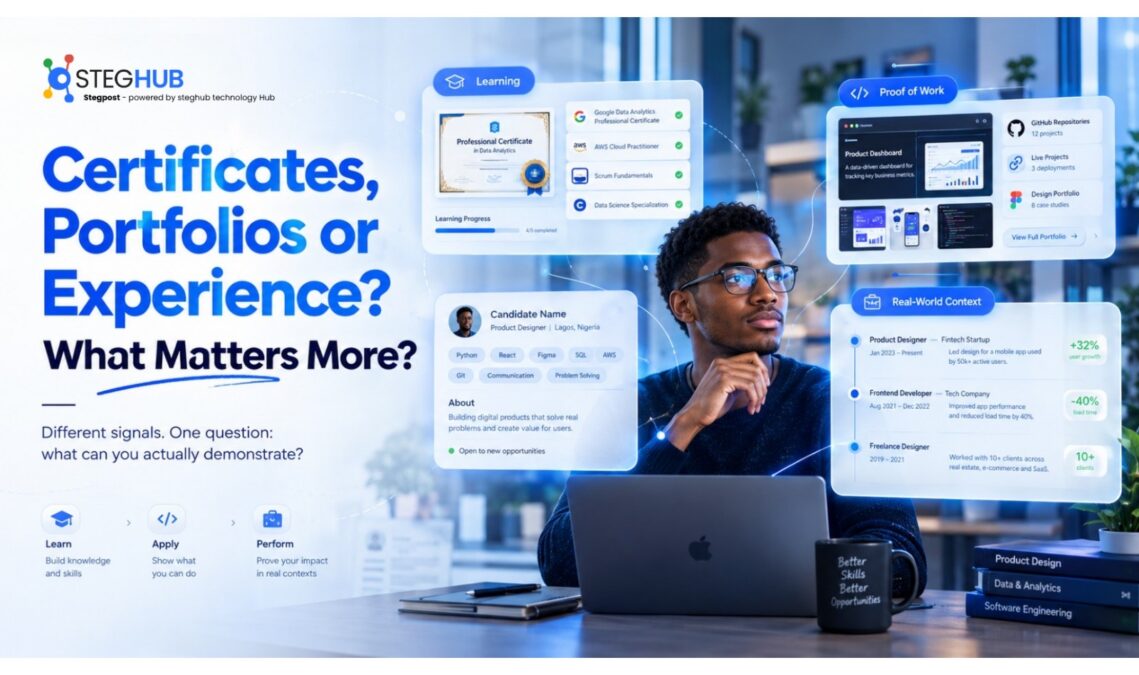
Learn → Practice → Demonstrate → Apply → Build experience.
Certificates can support the learning.
Projects can support the practice.
Portfolios can demonstrate the work.
Professional opportunities create experience.
And each stage strengthens the next.
The Early-Career Candidate Has a Different Problem
Suppose you are applying for your first technology job.
You probably don’t have years of experience.
So trying to compete with someone who already has three years of professional experience purely on the basis of experience is difficult.
Your strategy has to be different.
You need to make your other evidence stronger.
A certificate can show commitment.
A portfolio can show capability.
A well-written CV can connect your previous experience to the new role.
Projects can demonstrate practical thinking.
Internships and apprenticeships can provide workplace exposure.
Volunteer work can create evidence of collaboration.
Freelance projects can introduce you to real clients.
Together, these things can make a candidate much easier to evaluate.
This is especially important for career switchers.
Your previous career may not have been in technology, but you probably didn’t start from zero.
A project manager moving into technology already understands coordination.
A finance professional moving into data may understand numbers and business decisions.
A recruiter moving into people analytics understands hiring processes.
A customer-service professional moving into technology understands communication and users.
The trick is learning how to translate previous experience into the language of the new field.

Employers Are Looking for Evidence
Think about hiring from the employer’s perspective.
A CV is essentially a collection of claims.
“I can analyze data.”
“I know Python.”
“I understand cloud infrastructure.”
“I can manage projects.”
“I understand Agile.”
“I can work with stakeholders.”
The hiring manager has to decide:
How much should I believe?
That is where evidence becomes powerful.
A certificate provides one type of evidence.
A portfolio provides another.
An interview provides another.
A technical assessment provides another.
References provide another.
Professional experience provides another.
A good hiring process combines several pieces.
No single item tells the entire story.
This Is Why Your LinkedIn Profile Isn’t Enough
Having “Data Analyst” in your LinkedIn headline doesn’t make you a data analyst.
Having “DevOps Engineer” in your bio doesn’t prove that you can manage production infrastructure.
Having ten certificates under your name doesn’t automatically make you more employable.
Your online profile is useful.
But it is a presentation layer.
Eventually, someone needs evidence underneath it.
What have you built?
What problems have you solved?
What tools have you used?
What happened when something went wrong?
What did you learn?
What can you explain?
Those questions reveal much more.
A Good Portfolio Doesn’t Need to Be Huge
There is also a misconception that you need twenty projects.
You don’t.
Three thoughtful projects can be more useful than fifteen shallow ones.
The important thing is what the project demonstrates.
For example, a data analyst portfolio could include:
A business dashboard showing meaningful insights.
An analysis of customer behaviour.
A project where messy data was cleaned, analyzed and turned into a recommendation.
A project manager could demonstrate:
A project plan.
A risk register.
A delivery timeline.
Stakeholder communication.
A retrospective showing what changed during execution.
A DevOps candidate could demonstrate:
Infrastructure automation.
CI/CD pipelines.
Monitoring.
Containerization.
Cloud deployment.
Security practices.
The project doesn’t have to be enormous.
It needs to show thought.
Don’t Build Projects Just to Have Something to Show
This is another trap.
You can tell when a portfolio project exists only because someone said:
“You need a portfolio.”
The candidate copies a tutorial.
Changes the colours.
Changes the project name.
Uploads it to GitHub.
Then struggles to explain how anything works.
That creates the opposite of what a portfolio is supposed to achieve.
A strong project should make you more capable, not simply make your CV longer.
Ask:
Why did I build this?
What problem does it solve?
What decisions did I make?
What went wrong?
What would I improve?
What did I learn?
Could I explain this to someone who knows more than me?
If you can answer those questions, the project becomes much more valuable.
Experience Is Not Just About Time
Another mistake is assuming that experience is measured only in years.
Imagine someone has worked for four years but performed essentially the same simple task every day.
Now imagine someone else has worked for eighteen months across several challenging projects.
Who has more experience?
There isn’t enough information to answer.
The number of years alone doesn’t tell us.
Quality matters.
Complexity matters.
Responsibility matters.
Exposure matters.
Learning matters.
That is why candidates should learn to describe experience through outcomes and responsibilities, not just dates.
Instead of saying:
“Worked as a data analyst for two years.”
Explain what you actually did.
What data did you work with?
What decisions did your analysis support?
What tools did you use?
What changed because of your work?
That is much more informative.
And This Is Where Soft Skills Sneak In
Technology careers are not built entirely around technical ability.
You can be excellent at a technical skill and still struggle professionally if you cannot communicate your thinking.
Imagine a developer who solves a complex problem but cannot explain the solution to the product team.
Or a data analyst who creates an accurate report but cannot explain what the findings mean to a business manager.
Or a project manager who knows every project-management framework but cannot keep stakeholders aligned.
Technical ability gets you into the conversation.
Communication, collaboration, judgment and reliability often determine what happens after that.
Your certificate may prove you studied something.
Your portfolio may prove you built something.
Your experience may show that you can operate in a real environment.
Your behaviour shows people what it is like to work with you.
All four matter.
Technology Is Making Proof Easier
There is a fascinating change happening because of modern technology.
It is becoming easier to show your work publicly.
GitHub repositories.
Live websites.
Interactive dashboards.
Online case studies.
Design portfolios.
Project-management boards.
Technical blogs.
Open-source contributions.
Recorded demonstrations.
Documentation.
Personal websites.
These tools give people a way to create a public trail of what they know and can do.
That is particularly valuable for people who have not yet had traditional employment.
Instead of saying:
“Please believe I can do this.”
You can increasingly say:
“Here is what I built. Here is how I built it. Here is what I learned.”
That doesn’t eliminate the need for professional experience.
But it can make the first opportunity easier to reach.
[Image Prompt: A modern laptop displaying a polished technical portfolio with GitHub repositories, a live application, analytics dashboard and project case studies, while a hiring manager reviews it on another screen, realistic Nigerian professional setting, sophisticated technology editorial photography, daylight, clean composition.]
The Best Candidates Often Have a Story
A strong technology candidate isn’t just a collection of certificates.
They have a story.
Maybe they started with no technical background.
They learned the fundamentals.
They completed a structured programme.
They built several projects.
They worked on a real client problem.
They received feedback.
They improved.
They gained an internship.
They worked on a team.
They took on more responsibility.
Now they are ready for the next level.
That story is powerful because it shows progression.
And progression is what employers ultimately want to see.
They want to know:
Can this person learn?
Can this person apply what they learn?
Can this person improve?
Can this person handle increasing responsibility?
Certificates, portfolios and experience can all contribute to answering those questions.
What Should You Focus on First?
If you are starting from scratch, don’t obsess over collecting credentials.
Learn the fundamentals.
Then practice.
Build something.
Break something.
Fix it.
Build another thing.
Work with other people.
Get feedback.
Document what you did.
Create a portfolio.
Then look for opportunities to work in real environments.
If a relevant certification genuinely adds credibility to the path you are pursuing, pursue it.
But don’t let the certificate become the destination.
The destination is capability.
The certificate is one possible piece of evidence.
There Is No Shortcut Around Being Useful
This may be the simplest way to think about the entire debate.
A company ultimately pays people because they create value.
They solve problems.
Build things.
Analyze information.
Manage work.
Reduce risk.
Improve systems.
Support customers.
Make decisions.
The question behind every credential is therefore:
Can this person actually do useful work?
A certificate can suggest that you have learned.
A portfolio can demonstrate that you have practiced.
Experience can show that you have operated in real conditions.
But none of these should become an identity in themselves.
You are not your certificates.
You are not your GitHub profile.
You are not the number of years on your CV.
They are evidence of what you have learned and what you have done.
And evidence becomes more convincing when the pieces support one another.
The Real Career Advantage Is the Combination
Imagine a candidate with:
Relevant foundational knowledge.
A few strong practical projects.
A portfolio that clearly explains those projects.
Some real-world exposure.
Good communication skills.
And enough experience to show that they can operate in a professional environment.
That combination tells a much stronger story than any single certificate could.
The certificate gets context.
The project gets evidence.
The experience gets credibility.
The interview brings everything together.
That is why the question shouldn’t really be:
“Should I get a certificate, build a portfolio, or gain experience?”
It should be:
“What evidence do I currently have, and what evidence am I missing?”
If you have certificates but nothing practical to show, build.
If you have projects but no workplace exposure, seek real opportunities.
If you have experience but your CV doesn’t communicate what you actually accomplished, document it better.
If you have experience but your skills are becoming outdated, learn.
You are not choosing one forever.
You are building the pieces of a professional profile.
The Job Market Doesn’t Need Perfect Beginners
One of the most discouraging ideas in technology is that you need to become “fully job-ready” before anyone will give you a chance.
You don’t.
Nobody starts a technology career knowing everything.
The goal is not to arrive as a finished product.
It is to arrive with enough foundation, evidence and practical ability that an employer can see the potential for you to contribute and grow.
That is why practical learning matters.
That is why projects matter.
That is why internships and apprenticeships matter.
That is why good training should go beyond lectures and certificates.
And that is why employers should look beyond the easiest signals when evaluating early-career candidates.
A certificate can tell someone you studied.
A portfolio can show someone you practiced.
Experience can show someone you operated.
But your ability to keep learning is what connects all three.
Because technology will keep changing.
The tools you learn today will evolve.
The platforms will change.
The job titles will change.
The workflows will change.
And eventually, the certificate that helped you get your first opportunity will become just another line on your CV.
What will remain is the thing it was supposed to help you build in the first place:
the ability to do useful work.

