


In many workplaces, there is an unspoken expectation that competent people should always know what they’re doing.
When a question is asked in a meeting, people rush to respond. When a new idea is proposed, someone quickly offers an opinion. Silence can feel uncomfortable.
But something interesting happens in high-performing teams: people are surprisingly comfortable admitting uncertainty.
They say things like, “I’m not sure yet,” or “Let’s look into that.”
This may sound simple, but it changes how teams operate.

What Happens When People Pretend to Know
Imagine a planning meeting where a new feature is being discussed. One developer doesn’t fully understand the requirement but assumes it will become clearer later.
Instead of asking for clarification, they stay quiet.
Work begins. Days later, it becomes clear that the feature was interpreted differently by different people. Now the team has to rework part of the project.
This situation happens more often than teams realize.
Not because people lack skill — but because they hesitate to ask questions.
Curiosity Is a Strength, Not a Weakness
The best teams treat questions as a sign of engagement, not incompetence.
When someone pauses a conversation to say, “Can we clarify this part?” it often saves hours of confusion later.
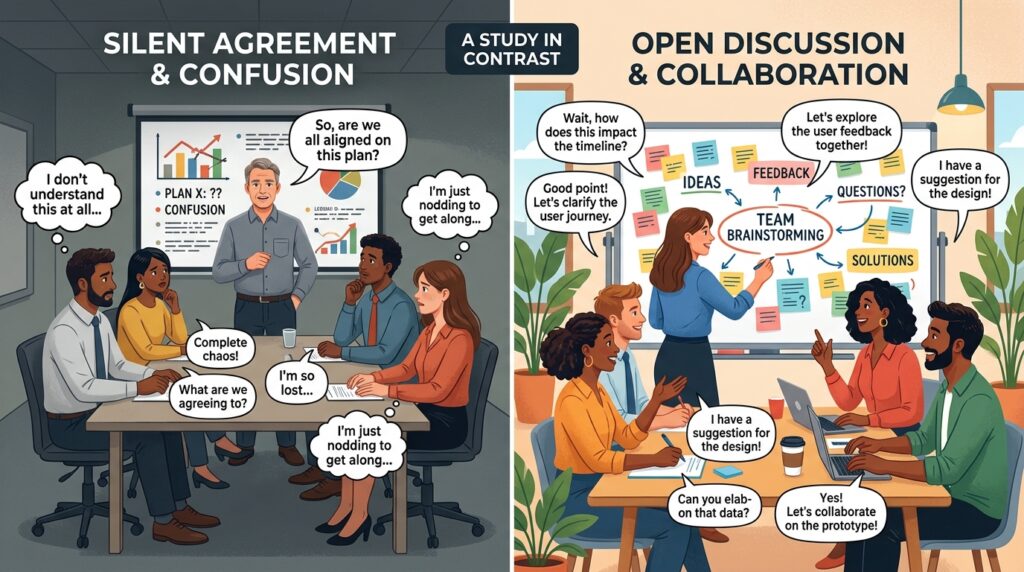
Consider the difference between the two environments.
In one team, asking questions feels risky. People worry about looking uninformed.
In another team, curiosity is welcomed. Questions lead to better ideas, clearer plans, and stronger collaboration.
The difference is psychological safety.

The Cost of Assumptions
Assumptions are expensive.
A misunderstood requirement can lead to days of unnecessary development. A missed detail can delay a product release. A silent confusion can ripple through multiple teams.
But a simple question early in the process can prevent all of that.
Strong teams understand that clarity is more valuable than appearing confident.
They encourage people to pause discussions, challenge assumptions, and explore uncertainties together.
Building a Culture Where Questions Are Welcome
Creating this kind of environment starts with leadership behavior.
When leaders admit they don’t know something, it signals that learning is acceptable. When managers ask thoughtful questions instead of expecting perfect answers, curiosity spreads through the team.
Over time, people become more comfortable speaking up.
Meetings become more productive. Decisions become better informed. And fewer mistakes slip through unnoticed.
Final Thoughts
No one has all the answers, especially in fast-moving industries.
The strongest teams are not the ones that pretend to know everything. They are the ones who learn quickly because people feel safe asking questions.
Sometimes the smartest thing you can say in a meeting is simply:
“I’m not sure yet. Let’s figure it out.”
That moment of honesty often leads to better ideas, better solutions, and better teamwork.

