

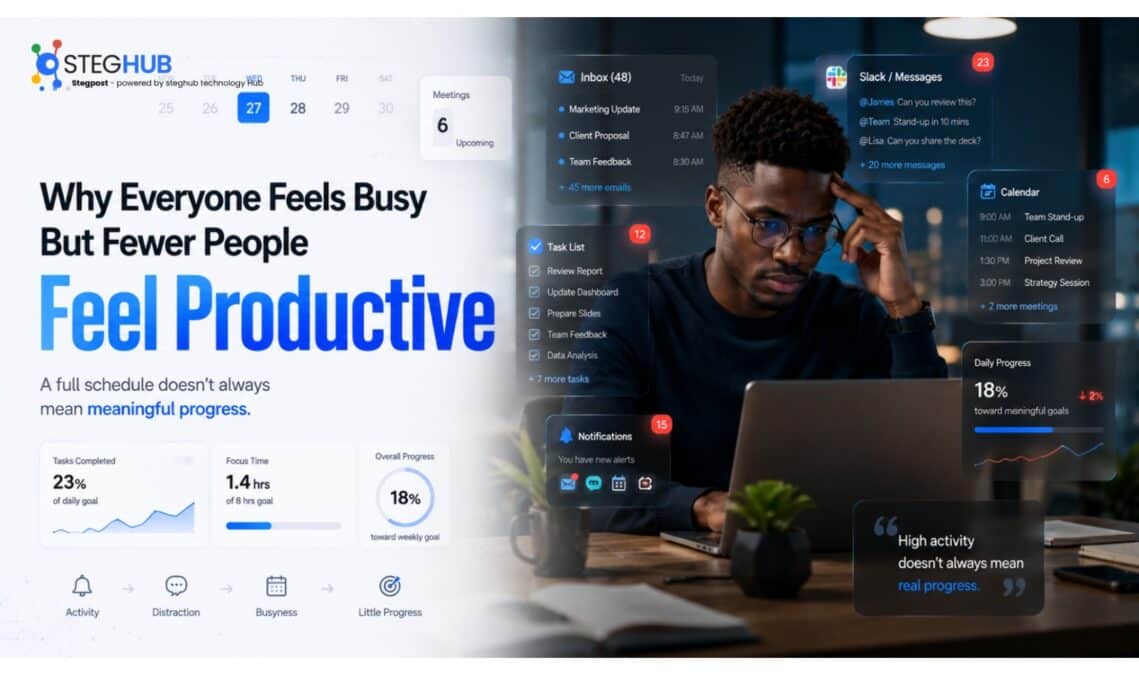
Have you ever reached the end of a workday, completely exhausted, only to realize you barely touched the thing that actually mattered?
Your inbox is cleaner.
You’ve attended four meetings.
Responded to dozens of messages.
Checked several things off your to-do list.
Yet somehow, the most important task is still sitting there waiting for you tomorrow.
If that sounds familiar, you’re not alone.
A lot of people aren’t struggling with productivity.
They’re struggling with the illusion of productivity.
And there’s a difference.

Being Busy Feels Like Progress
That’s what makes this so tricky.
When you’re constantly moving, it feels like you’re getting things done.
Your calendar is packed.
Notifications keep coming in.
People need your attention.
There’s always another email, another message, another “quick question.”
The day feels full.
The problem?
Full doesn’t always mean productive.
Think about running on a treadmill.
You’re moving the entire time.
You’re putting in effort.
You’re sweating.
But you’re not actually getting anywhere.
Work can feel exactly the same.
/
The Small Tasks Are Winning
Here’s something many workers experience.
You start your day with one important goal.
Maybe it’s finishing a report.
Maybe it’s learning a new skill.
Maybe it’s finally tackling that project you’ve been postponing.
Then reality happens.
A message comes in.
Then another.
Someone schedules a meeting.
A colleague needs help.
An email looks urgent.
Before you know it, the day is over.
The important work never happened.
Not because you were lazy.
Because the small tasks quietly took over.
Why Checking Things Off Feels So Good
There’s a reason people spend an hour organizing folders instead of starting a difficult project.
The brain loves completion.
Answering five emails feels satisfying.
Rearranging your task list feels productive.
Updating a spreadsheet feels like progress.
But these things are often easier than the work that actually moves your career, business, or project forward.
It’s like spending two hours cleaning your kitchen because you don’t want to start writing an assignment.
The kitchen looks amazing.
The assignment still exists.
Meetings Are Not Always Work
Let’s talk about meetings for a second.
Not all meetings are bad.
Some are necessary.
Some save time.
Some help teams align.
But we’ve all experienced those meetings that could have been an email.
Or the meeting about preparing for another meeting.
Or the meeting where ten people attend but only two people actually need to be there.
When your day becomes a collection of meetings, it’s easy to feel busy without creating much value.

The Difference Between Motion and Progress
Imagine two professionals.
Person A spends eight hours answering messages, attending meetings, and reacting to requests.
Person B spends four focused hours completing a major project that creates long-term impact.
At the end of the day, Person A may feel busier.
But Person B may have made more meaningful progress.
That’s the trap.
We often measure effort instead of outcomes.
What Productive People Do Differently
One thing I’ve noticed about highly productive people is that they protect their attention.
They’re not necessarily smarter.
They’re not always working longer hours.
They simply understand that attention is limited.
They know that if everything is urgent, nothing is truly important.
So they make decisions.
They prioritize.
They focus.
And sometimes they deliberately ignore things that can wait.
That last part is harder than it sounds.
A Simple Question That Changes Everything
Before starting any task, try asking yourself:
“If I complete this today, will it actually move me forward?”
Not just keep you occupied.
Move you forward.
Because those are two very different things.
Sometimes the answer will surprise you.
Final Thoughts: Busy Is Not the Goal
Somewhere along the way, many of us started treating busyness like a badge of honor.
“I’m so busy.”
“My calendar is packed.”
“I barely had time to breathe today.”
But being busy was never the goal.
Making progress was.
The next time you finish a long day, don’t ask:
“How much did I do?”
Ask:
“Did I spend time on what actually matters?”
Because a productive day isn’t measured by how exhausted you are.
It’s measured by how much closer you are to the things you’re trying to achieve.


