

You buy a brand-new phone.
It’s incredibly fast.
Apps open instantly.
Web pages load in seconds.
Everything feels smooth.
For the first few months, using it is a joy.
Then, little by little, something changes.
Apps take longer to open.
The battery doesn’t last as long.
The keyboard occasionally freezes.
You tap an icon… and wait.
At first, you think it’s just your imagination.
Then one day, someone says,
“That’s how they get you to buy a new phone.”
You’ve probably heard that theory before.
Some people believe tech companies intentionally slow down older devices to force customers into upgrading.
Others argue it’s simply the natural result of technology evolving.
So… who’s right?
The answer is a little more complicated than either side makes it sound.
Let’s take a look at what really happens behind the scenes.
Imagine Carrying the Same Backpack for Five Years
Think about the first day of school.
Your backpack contains a notebook, a pen, and maybe a bottle of water.
It’s light.
Easy to carry.
Now imagine adding just one small item every week.
Another notebook.
A charger.
A water bottle.
A jacket.
A calculator.
A lunchbox.
None of those things seems heavy on its own.
But after a few years?
That same backpack feels very different.
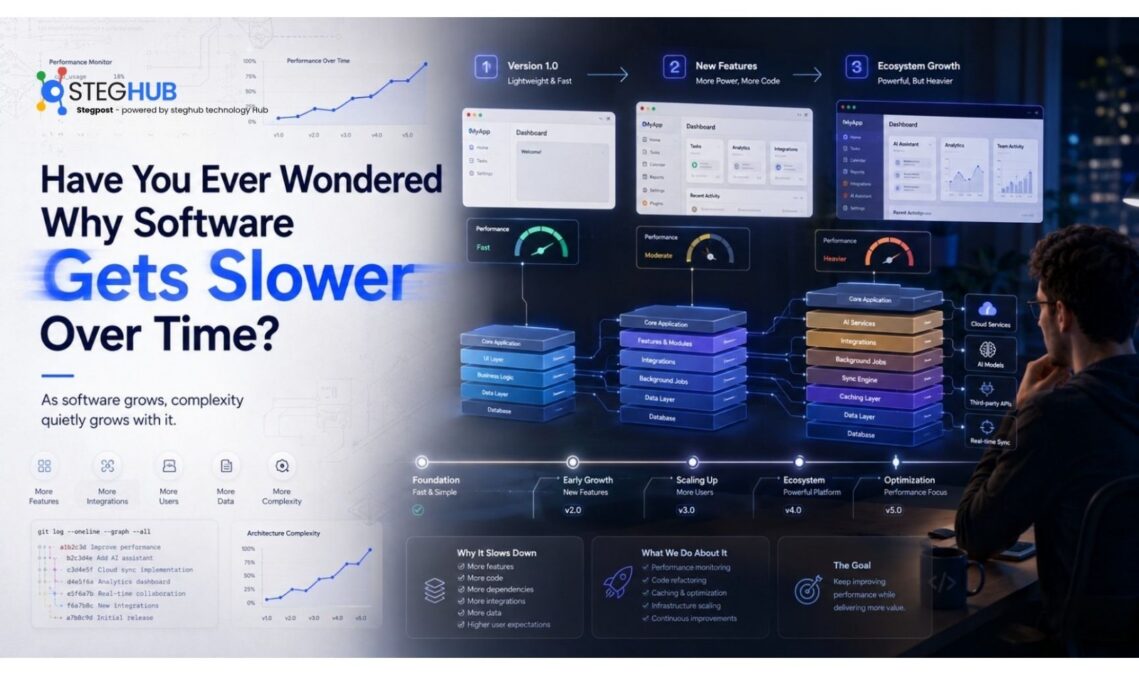
Software works in a surprisingly similar way.
Every update adds something.
A new feature.
A security improvement.
A design refresh.
Support for newer technologies.
Individually, they don’t seem like much.
But over time, they increase the amount of work your device has to do.

Apps Keep Growing While Your Device Stays the Same
Think about your favourite messaging app.
Five years ago, it probably did one main thing.
Send messages.
Today?
You can make video calls.
Share your live location.
Create communities.
Edit messages.
React with emojis.
Send HD photos.
Transfer documents.
Share your screen.
Use AI features.
The app has become much more powerful.
But your phone’s processor hasn’t magically become faster.
It’s still working with the hardware you bought years ago.
Imagine asking a small neighborhood café to suddenly serve an entire stadium.
The café didn’t become worse.
The demand simply became much bigger.
Security Comes at a Cost
One thing many people don’t think about is security.
Every year, new cyber threats appear.
Hackers discover new vulnerabilities.
Scammers develop new tricks.
To keep users safe, software companies constantly release security updates.
These updates are incredibly important.
But they also add more work for your device.
It’s similar to adding more locks and security cameras to a building.
The building becomes safer.
But opening and closing everything takes a little longer than before.
Most people would happily trade a tiny bit of speed for better protection.
Even if they don’t always notice that’s what’s happening.
It’s Not Just the Software
Let’s imagine two friends buy the exact same laptop.
Five years later, one laptop feels much slower than the other.
How?
The first person has hundreds of unused apps.
Thousands of downloaded files.
A desktop full of random documents.
Dozens of browser tabs open every day.
The second person regularly removes unused software, clears storage, updates their system, and restarts their device.
Same laptop.
Different habits.
Technology, like a car, performs better when it’s looked after.
Software isn’t always the only thing slowing things down.
Sometimes we accidentally make life harder for our own devices.\

The Internet Has Changed Too
Here’s something people rarely consider.
Many apps don’t work alone anymore.
They constantly communicate with cloud services.
Sync files.
Check notifications.
Load online content.
Verify accounts.
Connect with AI systems.
Five years ago, an app may have performed most of its work directly on your phone.
Today, it’s often working together with servers all over the world.
That creates incredible convenience.
But it also means there are more moving parts involved every time you tap your screen.
Technology has become more connected.
And connected systems naturally become more complex.
Do Companies Intentionally Slow Down Devices?
This is probably the question you’ve been waiting for.
The truth?
It’s not as simple as saying “yes” or “no.”
There have been well-known cases where companies adjusted device performance to manage issues like aging batteries, and those decisions sparked major public debates.
But in most everyday situations, software doesn’t become slower because someone secretly wants you to buy a new phone.
It becomes more demanding because it keeps evolving.
Developers build for today’s technology.
Not the hardware that existed seven or eight years ago.
Eventually, older devices have to work much harder to keep up.
It’s a bit like asking a ten-year-old computer to edit modern 8K videos.
The computer isn’t broken.
The world around it has simply moved forward.
Why New Devices Feel So Fast
When you upgrade to a new phone or laptop, it often feels incredible.
Not just because it’s new.
But because today’s hardware was designed with today’s software in mind.
Faster processors.
More memory.
Better graphics.
Improved batteries.
Everything is built to handle modern applications more efficiently.
It’s similar to replacing an old bicycle with a brand-new one.
The road hasn’t changed.
The ride has.
What Can You Do to Keep Your Device Running Smoothly?
The good news is that you don’t always need a brand-new device.
A few simple habits can make a noticeable difference.
Delete apps you no longer use.
Free up storage space.
Keep your software updated.
Restart your phone occasionally instead of leaving it running for weeks.
Review which apps are constantly running in the background.
Think of it like maintaining your home.
You don’t wait until everything breaks before cleaning or repairing it.
Small habits often prevent bigger problems later.
Final Thoughts: Slow Doesn’t Always Mean Broken
Technology changes incredibly fast.
Every year, apps become smarter.
Features become more advanced.
Security becomes stronger.
Expectations become higher.
As software grows, it naturally asks more from the devices running it.
That doesn’t mean your phone is suddenly “bad.”
It means it’s trying to keep up with a digital world that’s moving faster every year.
The next time your laptop takes a little longer to start or your favourite app feels heavier than it used to, remember this:
Behind every update is a long list of improvements, security fixes, new features, and evolving technology.
Sometimes the slowdown isn’t a sign that something went wrong.
It’s simply the cost of progress.
And while no device lasts forever, understanding why technology changes helps us make smarter decisions instead of believing every myth we hear online.

