

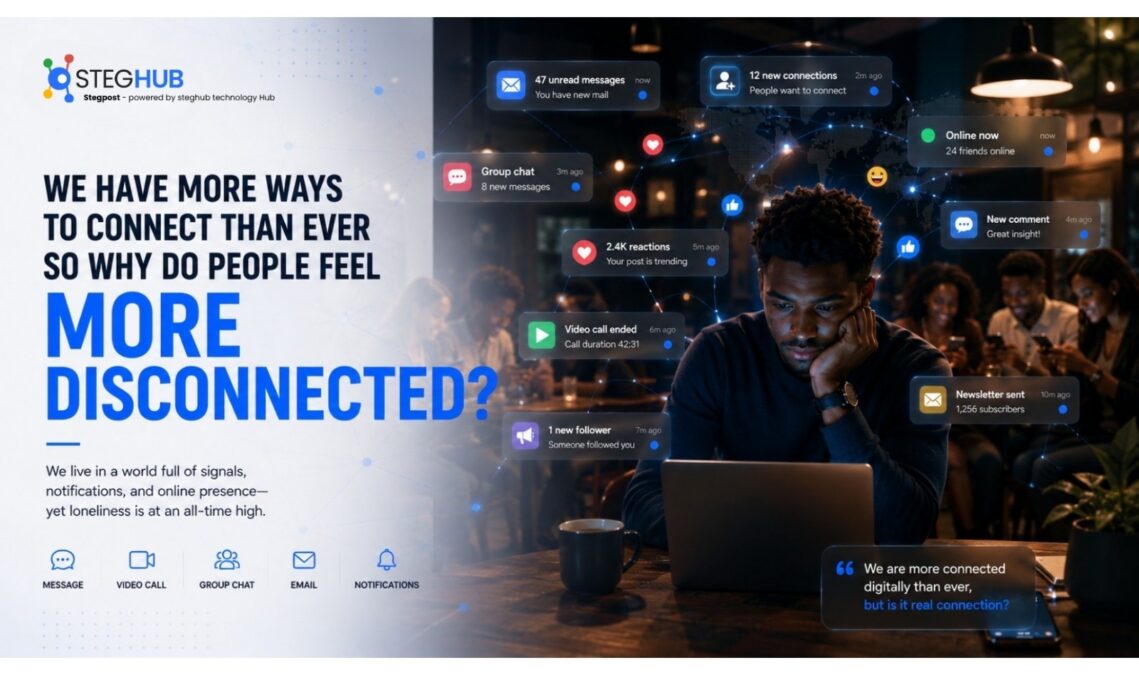
Your phone is probably within reach right now.
If it isn’t in your hand, it’s on the table beside you. Or charging somewhere nearby.
With it, you can send a message to someone on the other side of the world in seconds.
You can join a video call without leaving your room. Watch what an old friend is doing through their social media updates. React to a stranger’s opinion. Join an online community filled with people who share your interests.
At almost no point in human history have we had this many ways to reach one another.
And yet, there is a strange contradiction sitting right in the middle of all of it.
Many people feel more disconnected than ever.
How can that be?
How can someone have hundreds of contacts, multiple group chats, thousands of followers, and still feel like there is nobody they can really talk to?
The answer may have less to do with how much technology connects us and more to do with what kind of connection technology is actually designed to create.
Because being connected is not always the same thing as feeling connected.
Your Phone Can Put You in a Room With Thousands of People
Imagine walking into a massive building.
Inside are thousands of people.
Every conversation you could possibly imagine is happening somewhere.
One group is discussing football. Another is talking about career problems. Someone is sharing a personal story. Somewhere else, an argument has been going on for three hours.
You can walk from group to group.
Listen.
Speak.
React.
Leave whenever you want.
That sounds a little like the internet.
Social media platforms, messaging apps, online communities, gaming platforms, video calls, and professional networks have created something extraordinary: a world where physical distance is no longer the biggest barrier to communication.
You don’t need to live in the same city to maintain a friendship.
You don’t need to attend the same university to learn from someone.
You don’t even need to know someone personally before starting a conversation.
Technology has made communication easier.
But easier communication has created a new question.
If access to people is no longer the problem, what is?
More Communication Doesn’t Always Mean More Connection
Think about the difference between these two situations.
In the first, someone sends you:
“Happy birthday 🎉”
You receive twenty of those messages.
In the second, one person calls and says:
“I know this year has been difficult for you. How are you really doing?”
Both are forms of communication.
But they don’t feel the same.
One acknowledges your existence.
The other demonstrates attention.
This is an important difference.
Technology is very good at helping us reach people.
But meaningful connection often requires something more difficult to scale:
Time.
Attention.
Presence.
Understanding.
A person can like your post without knowing what is happening in your life.
You can respond to someone’s story without having a real conversation with them.
You can spend an entire evening interacting with people online and still feel emotionally alone afterward.
The problem isn’t necessarily that the interaction wasn’t real.
It’s that not every interaction creates closeness.
Technology Made Communication Frictionless
Before smartphones and the internet, staying in touch often required effort.
You had to call at the right time.
Write a letter.
Visit someone.
Plan a meeting.
Even finding someone could be difficult.
Today, much of that friction has disappeared.
You can send a message while standing in a queue.
React to someone’s update without saying anything.
Share a photo with hundreds of people at once.
Join a meeting from another continent.
Technology has removed many of the barriers that once made communication slow and difficult.
But friction sometimes had an unexpected benefit.
It made some interactions more intentional.
If you travelled across town to visit someone, you were making time for them.
If you called someone, you were often prepared to have an actual conversation.
Today, because communication is always available, it can also become easier to postpone meaningful communication.
“I’ll reply later.”
“I’ll call them next week.”
“I saw their update, so I know they’re okay.”
Sometimes, technology gives us the feeling that we are keeping up with people when we are actually only keeping up with information about them.
And those are not the same thing.
We Know More About People We Don’t Actually Know
Think about how much you can know about a person you’ve never met.
You may know where they travelled last month.
What did they eat yesterday?
Their career update.
Their relationship status.
Their opinion on a trending topic.
Their new hairstyle.
The fact that they started going to the gym.
And yet, if you met them in person, you might have very little idea who they actually are.
Social platforms have created a strange form of familiarity.
We see people repeatedly.
We recognize their faces.
We know pieces of their lives.
And our brains can sometimes interpret that repeated exposure as a form of relationship.
But seeing someone’s updates is not the same as knowing them.
It’s the difference between standing outside a house and looking through the windows versus actually being invited inside.
One gives you information.
The other gives you access.
The Algorithm Is Part of the Conversation Now
There’s another character involved in modern communication.
The algorithm.
When you open many digital platforms, you aren’t simply seeing everything your friends or contacts are doing.
Software is helping decide what you see.
It may prioritize content that is likely to hold your attention.
Content that makes you laugh.
Content that makes you curious.
Content that makes you angry.
Content that keeps you scrolling.
This creates an interesting shift.
In many cases, technology isn’t just carrying the conversation.
It is organizing the conversation.
It decides what appears first.
Whose update do you see?
What disappears beneath hundreds of other posts.
What becomes visible.
And what doesn’t.
This doesn’t mean algorithms are intentionally trying to make people disconnected.
They are tools designed around particular goals.
But the goals of a platform and the emotional needs of a person are not always identical.
A system optimized for engagement may not necessarily be optimized for meaningful relationships.
Being Reachable All the Time Can Be Surprisingly Exhausting
There was a time when being unavailable was normal.
If you weren’t home, someone simply couldn’t reach you.
If you were travelling, you might be completely disconnected for hours.
Today, many people carry a communication device that follows them almost everywhere.
Messages.
Emails.
Group chats.
Work notifications.
Family conversations.
Social media.
Professional networks.
The result is that communication can begin to feel less like a choice and more like a continuous background activity.
Someone messages.
You see it.
You feel the pressure to respond.
Someone else follows up.
Another notification appears.
A group chat becomes active.
You haven’t spoken to anyone in person all day, but you’ve spent hours communicating.
And sometimes, instead of feeling socially fulfilled, you feel tired.
That’s because social interaction and social energy aren’t unlimited resources.
Technology has made communication easier to initiate.
It hasn’t removed the emotional effort involved in maintaining relationships.
Why Group Chats Can Still Feel Lonely
A group chat can have fifty people.
Messages can be moving constantly.
Memes.
Jokes.
Arguments.
Announcements.
Voice notes.
Someone is always saying something.
But imagine going through a difficult period and realizing that none of those fifty people actually know.
You are present in the group.
You are technically connected.
But you may not feel seen.
This is another difference technology has made more visible.
Proximity is not intimacy.
And digital proximity isn’t intimacy either.
Being included in a conversation does not automatically mean feeling understood within it.
Sometimes, meaningful connection requires smaller spaces.
Longer conversations.
The ability to say something without turning it into content.
The ability to be quiet without disappearing.
The ability to explain something complicated without reducing it to a reaction, emoji, or short message.

The Internet Solved Distance, But Not Loneliness
This may be one of the most important things to understand.
Loneliness isn’t simply the absence of people.
You can feel lonely in a crowded room.
You can feel disconnected inside a large family.
You can have hundreds of online contacts and still feel like nobody understands you.
The internet solved an extraordinary problem: distance.
You can now communicate across countries almost instantly.
But emotional connection involves different problems.
Trust.
Shared experiences.
Vulnerability.
Time.
Attention.
Reciprocity.
Technology can support these things.
A video call can maintain a friendship across continents.
An online community can help someone find people who understand a niche interest.
A message can arrive at exactly the moment someone needs encouragement.
Digital connection can be deeply meaningful.
The problem isn’t that technology cannot create real relationships.
Clearly, it can.
The question is whether the way we use technology sometimes gives us the appearance of connection without the experience of it.
We Are Turning More of Our Lives Into Content
There is another change happening quietly.
Before social media, many experiences simply happened.
You went somewhere.
You ate something.
You celebrated.
You struggled.
You told a few people about it.
Now, there is often another possibility.
Post it.
Photograph it.
Record it.
Share it.
Watch the reactions.
This can be fun.
It can help people share important moments.
But it can also change how we experience those moments.
Sometimes, instead of asking:
“Who do I want to share this experience with?”
we ask:
“How will this look when I share it?”
That shift is subtle.
But important.
A moment can move from being something you experience to something you publish.
And when life becomes more visible, privacy can begin to feel like an absence.
If nobody saw it, did it happen?
Of course it did.
But digital culture can sometimes make us feel as though experiences need an audience to feel complete.
The Future of Connection May Be More Intentional, Not More Digital
It would be easy to conclude that technology is the problem.
That would be too simple.
Technology has allowed families separated by continents to stay in touch.
It has helped people find communities they may never have found locally.
It has created friendships, businesses, support networks, and professional relationships.
The answer isn’t necessarily to abandon technology.
The more interesting question is:
What should technology optimize for?
More messages?
More time spent?
More notifications?
Or better conversations?
Imagine communication tools designed around helping people maintain meaningful relationships rather than simply increasing activity.
Imagine platforms that give people more control over what they see.
Imagine digital spaces where conversation wasn’t constantly competing with advertisements, trending topics, and engagement metrics.
Some of the next big questions in technology may not be about making communication faster.
It may already be fast enough.
The challenge could be making digital communication feel more human again.
AI May Make the Question Even More Interesting
We’re also entering a period where not every digital interaction will necessarily involve another human.
AI systems can already hold conversations.
They can respond instantly.
They can remember context.
They can simulate particular communication styles.
This raises an interesting question.
If someone feels heard by an AI system, does that count as a connection?
The answer may depend on what we mean by connection in the first place.
An AI can provide interaction.
It can provide information.
It may even provide a sense of conversation.
But human relationships involve something more complex.
Another person’s experiences.
Another person’s perspective.
Their unpredictability.
Their ability to care independently of being programmed to respond.
As AI becomes more present in everyday communication, we may become more conscious of the difference between having someone respond to us and having someone genuinely relate to us.
Maybe the Problem Isn’t That We Are Too Connected
Perhaps we’re connected in the wrong ways.
We have optimized for speed.
Reach.
Convenience.
Visibility.
Scale.
But meaningful human relationships don’t always scale neatly.
You can’t turn a thousand followers into a thousand close friends.
You can’t replace years of trust with constant notifications.
You can’t automatically create intimacy by putting more people into the same digital space.
Connection requires participation.
Not just presence.
Attention.
Not just access.
Understanding.
Not just information.
And perhaps that’s why the contradiction exists.
We have built extraordinary systems for finding each other.
Now we’re still learning how to be with each other inside those systems.

Final Thoughts: Connection Was Never Just About Being Reachable
Technology has given us something previous generations could barely imagine.
You can carry your friends, family, colleagues, communities, entertainment, work, and the wider world inside a device that fits into your pocket.
That’s extraordinary.
But being reachable is not the same as being understood.
Seeing someone is not the same as knowing them.
Receiving a reaction is not the same as receiving attention.
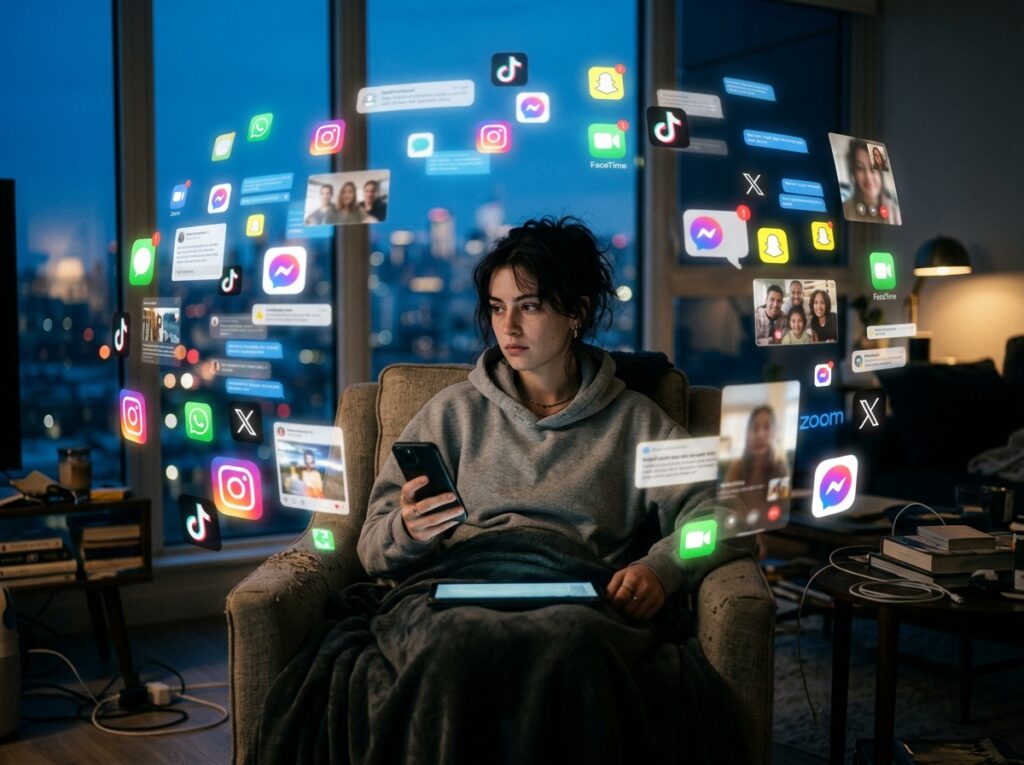
And a full notification screen is not proof that you are emotionally connected to the people around you.
Perhaps the next evolution of technology won’t be about giving us even more ways to communicate.
Perhaps it will be about helping us recognize which connections actually matter.
Because in a world where almost everyone is only one message away, the rarest thing may no longer be access to people, it may be the feeling that someone is truly present when you need them.

