

There is a familiar moment that happens when you’re trying to change something about your life.
You decide that this time will be different.
You create a plan.
You imagine the person you’re about to become.
You may even feel genuinely excited.
Tomorrow, you tell yourself, you’ll start.
Tomorrow arrives.
And somehow, the thing you were so determined to do yesterday feels much harder than expected.
The workout requires getting dressed, leaving the house, and finding the energy.
The course requires opening your laptop after a long day.
The project requires figuring out where to begin.
The book requires concentration you don’t seem to have.
So you postpone it.
Then you feel guilty.
And eventually, you come to a familiar conclusion:
“I just need to be more motivated.”
But what if motivation isn’t always the problem?
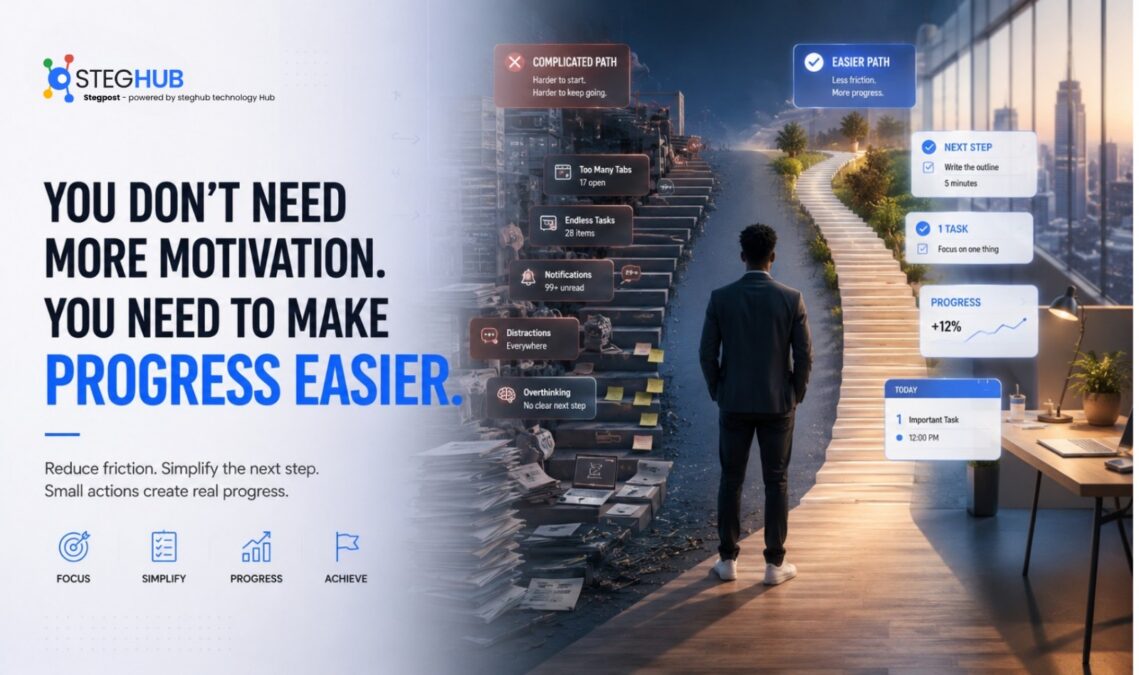
What if the problem is that you’re making progress unnecessarily difficult?
Motivation Is a Terrible Thing to Depend On Every Day
Motivation feels powerful because it creates movement.
On a good day, you can suddenly do everything you have been postponing.
You clean your room.
Reply to emails.
Start the project.
Watch the course.
Plan the week.
Go for a walk.
You wonder why you haven’t been living like this all along.
Then a few days pass.
The excitement disappears.
Work becomes stressful.
You get tired.
Something unexpected happens.
And suddenly, the plan that looked so easy when you were motivated now feels almost impossible.
This is where many people misunderstand progress.
They believe consistency means feeling motivated consistently.
It doesn’t.
Very few people feel excited about doing the same difficult thing every day.
The people who make progress aren’t always the people with more motivation.
Often, they are simply the people who have made the next step easier.
Think About How Much Effort It Takes Just to Begin
Imagine you want to study every evening.
Your laptop is somewhere.
The charger is somewhere else.
You haven’t decided what to study.
You have five different courses open.
You aren’t sure which one matters most.
Your phone is beside you.
Notifications are coming in.
You sit down.
Twenty minutes pass.
You still haven’t started.
The actual studying may only require an hour.
But getting to the point where you can begin required dozens of small decisions.
What should I study?
Where should I start?
How long should I study?
Should I finish this first?
Maybe I’ll start later.
Progress often becomes difficult long before the actual work begins.
The hidden problem is friction.
Friction is everything that makes a useful action harder to start or continue.
And sometimes, reducing friction is more powerful than increasing motivation.

Make the First Step Almost Too Easy
If your goal is to exercise, don’t begin by telling yourself you need to transform your entire lifestyle.
Start by making it easier to put on your shoes.
If you want to read more, don’t begin with the pressure of finishing a book every week.
Put the book somewhere you can easily reach.
If you’re learning a new skill, don’t begin every session by asking what you should learn.
Decide beforehand.
Open the lesson.
Save the link.
Prepare the workspace.
The goal isn’t to trick yourself into doing less.
The goal is to remove unnecessary barriers between you and the thing you already want to do.
There is a major difference between:
“I need to study for three hours tonight.”
and:
“I’ll open the lesson and spend ten minutes understanding where I stopped.”
The first statement demands energy before you’ve even begun.
The second creates movement.
And movement often creates more movement.
The Problem With Waiting Until You Feel Ready
Many goals live permanently in the future because people are waiting for the right internal feeling.
When I’m more disciplined.
When I’m less tired.
When I’m more confident.
When I have more time.
When I finally feel motivated.
But progress often works in the opposite direction.
You don’t always feel ready before beginning.
Sometimes, you begin before feeling ready.
Then familiarity makes the task easier.
Little progress makes you more confident.
Understanding reduces uncertainty.
And eventually, something that once required enormous effort becomes part of your normal routine.
Think about learning to drive.
At first, everything requires conscious effort.
The mirrors.
The pedals.
The steering.
The traffic.
The signs.
With experience, much of that becomes easier.
Not because you suddenly wake up one morning with extraordinary motivation.
But because repeated practice reduced the difficulty.
Progress can work the same way.
Stop Designing Goals for Your Best Days
This may be one of the most useful changes you can make.
Don’t build your routine around the version of you who wakes up early, feels energized, has no interruptions, and suddenly wants to change their life.
Build it around an ordinary day.
The tired version of you.
The busy version.
The distracted version.
The version that gets home later than expected.
The version that doesn’t feel particularly inspired.
Ask:
What can I realistically do on that day?
Maybe your best day allows you to study for three hours.
That’s great.
But perhaps your normal routine should only require thirty minutes.
Your best days can produce extra progress.
Your ordinary days are what produce consistency.
A plan that works only when life is going perfectly isn’t really a plan.
It’s a wish.
Technology Can Help or Make Progress Harder
Modern technology gives us extraordinary access to learning and opportunity.
You can learn software development from your room.
Study data analysis.
Learn a language.
Build a business.
Take a professional course.
Watch lectures.
Read books.
Access experts.
The problem is that access can also create too many choices.
You search for a course and find fifty.
You search for advice and receive conflicting opinions.
You open one platform and discover three new tools you “need.”
Suddenly, you’re researching how to start instead of starting.
Sometimes the most productive decision isn’t finding a better tool.
It’s choosing one and continuing.
Technology has made information abundant.
That means focus has become part of the work.
Make Progress Visible
Motivation can be unreliable.
Evidence is different.
There is something powerful about being able to see that you’ve moved.
One completed lesson.
One finished chapter.
One week of practice.
One project that didn’t exist last month.
One application submitted.
One improvement.
Progress is often difficult to feel while it’s happening because the changes are small.
But small changes become easier to trust when you can see them.
Imagine walking ten kilometres.
If you keep looking at the final destination, the journey may feel endless.
But if you can see that you’ve already covered three kilometres, something changes.
You’re not finished.
But you’re moving.
And sometimes, that is enough to continue.
Make It Easier to Return After You Stop
Eventually, you will miss a day.
Perhaps several.
That doesn’t mean the goal is over.
One of the biggest mistakes people make is designing routines that only work perfectly.
Miss a workout.
The entire fitness plan feels ruined.
Skip studying.
You feel like you’ve lost momentum.
Stop writing for a week.
You convince yourself you’ve become inconsistent.
But stopping isn’t always the real problem.
Sometimes the real problem is making it emotionally difficult to return.
You don’t need to start again from zero.
You just need to continue from where you are.
A good system doesn’t assume you will be perfect.
It assumes you will occasionally be human.

Final Thoughts: Make the Right Thing Easier
You may not need another motivational video.
You may not need a perfect morning routine.
You may not need to become a completely different person before making progress.
Perhaps you simply need to ask a better question.
Not:
“How can I become motivated enough to do this?”
But:
“Why is this currently so difficult to begin?”
Then remove one obstacle.
Prepare something beforehand.
Make the task smaller.
Reduce the decisions.
Choose a realistic version.
Create a clear next step.
Motivation can get you started.
But systems help you continue.
And sometimes, the biggest difference between the person who keeps postponing progress and the person who makes it isn’t that one wants it more.
It’s that one has made taking the next step easier.

