


Think about the last thing you searched for on Google.
Maybe it was a recipe.
A nearby restaurant.
A football score.
A scholarship opportunity.
Or perhaps you wanted to know why your phone battery keeps draining so quickly.
You typed a few words.
Pressed Enter.
And within a second…
Millions of results appeared.
Simple.
Or at least, that’s what it looks like.
What most people don’t realize is that those few seconds are some of the busiest moments on the internet.
Behind that single search is an invisible race involving billions of web pages, powerful computers, advertisers, and intelligent algorithms, all working at incredible speed.
By the time you’ve blinked, that race is already over.
Imagine Walking Into the World’s Largest Library
Picture yourself walking into the biggest library ever built.
Not thousands of books.
Not millions.
Billions.
Now imagine asking the librarian,
“Can you show me the best books about cloud computing?”
You expect an answer almost immediately.
The librarian doesn’t just hand you every book with the word cloud in it.
Instead, they quickly figure out:
Which books are the most useful?
Which ones are the most up-to-date?
Which authors are trustworthy?
Which books answer your exact question?
Google works in much the same way.
Its job isn’t simply to find information.
Its job is to find the most relevant information as quickly as possible.
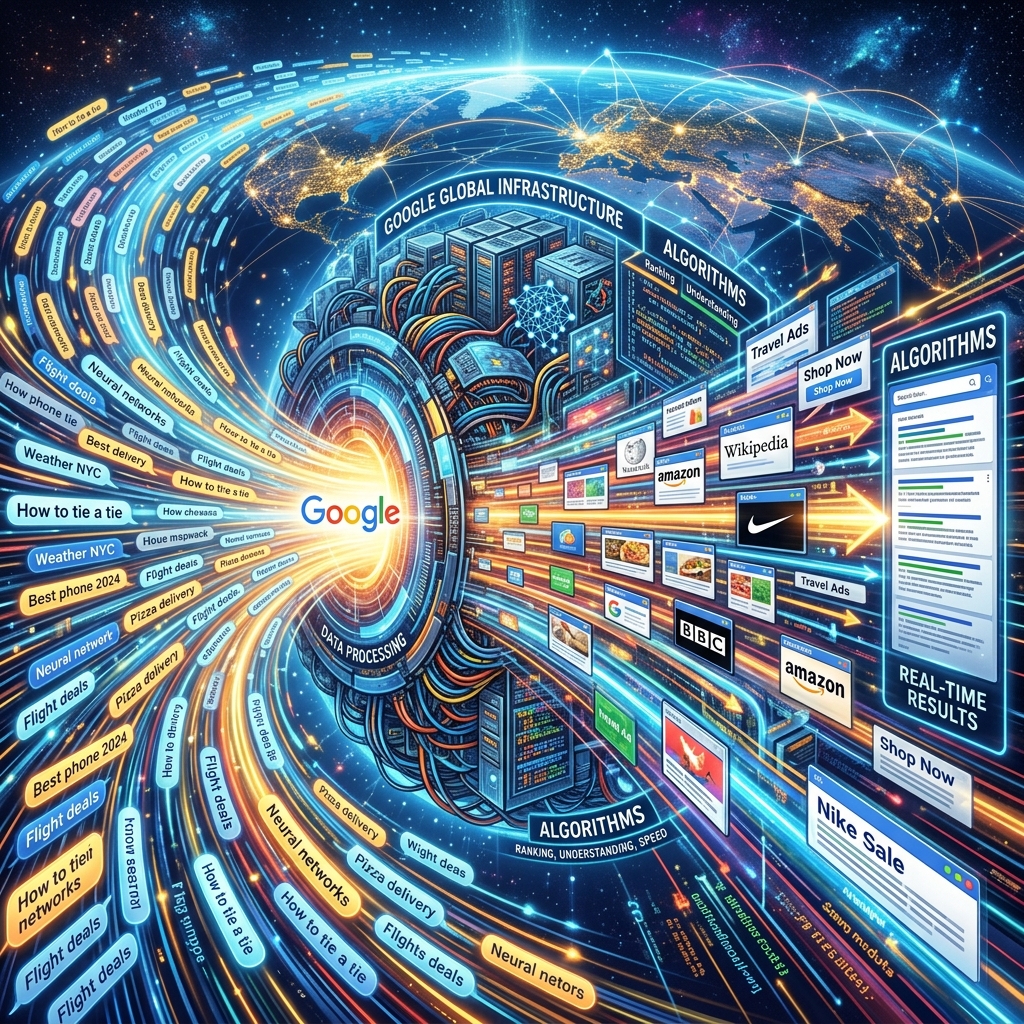
Billions of Pages Are Quietly Competing
The moment you press Search, something remarkable happens.
Websites across the internet begin competing for attention.
Not by changing themselves in that instant.
But by being evaluated against one another.
Google asks questions like:
Does this page answer the user’s question?
Is the information reliable?
How quickly does the website load?
Does it work well on mobile devices?
Is it secure?
Has it earned trust from other websites?
Each page is allowed to prove its value.
Only a handful make it to the first page.
The rest may never be seen.
It’s a bit like applying for a job with millions of applicants.
Everyone wants the top spot.
Only a few earn it.
Speed Matters More Than You Think
Here’s something fascinating.
People often judge Google by how accurate it is.
But engineers also obsess over something else.
Speed.
Imagine ordering coffee.
If the café serves the perfect cup… but it takes thirty minutes, you’d probably leave.
Now imagine another café serving great coffee in under a minute.
Most people would choose the faster option.
Google knows that every fraction of a second matters.
That’s why enormous amounts of technology work together to deliver results almost instantly.
From powerful data centers to intelligent indexing systems, everything is designed to reduce waiting time.
Because on the internet, even a small delay can change how people use a service.
Not Every Result Earned Its Place the Same Way
Take a closer look at the next time you search.
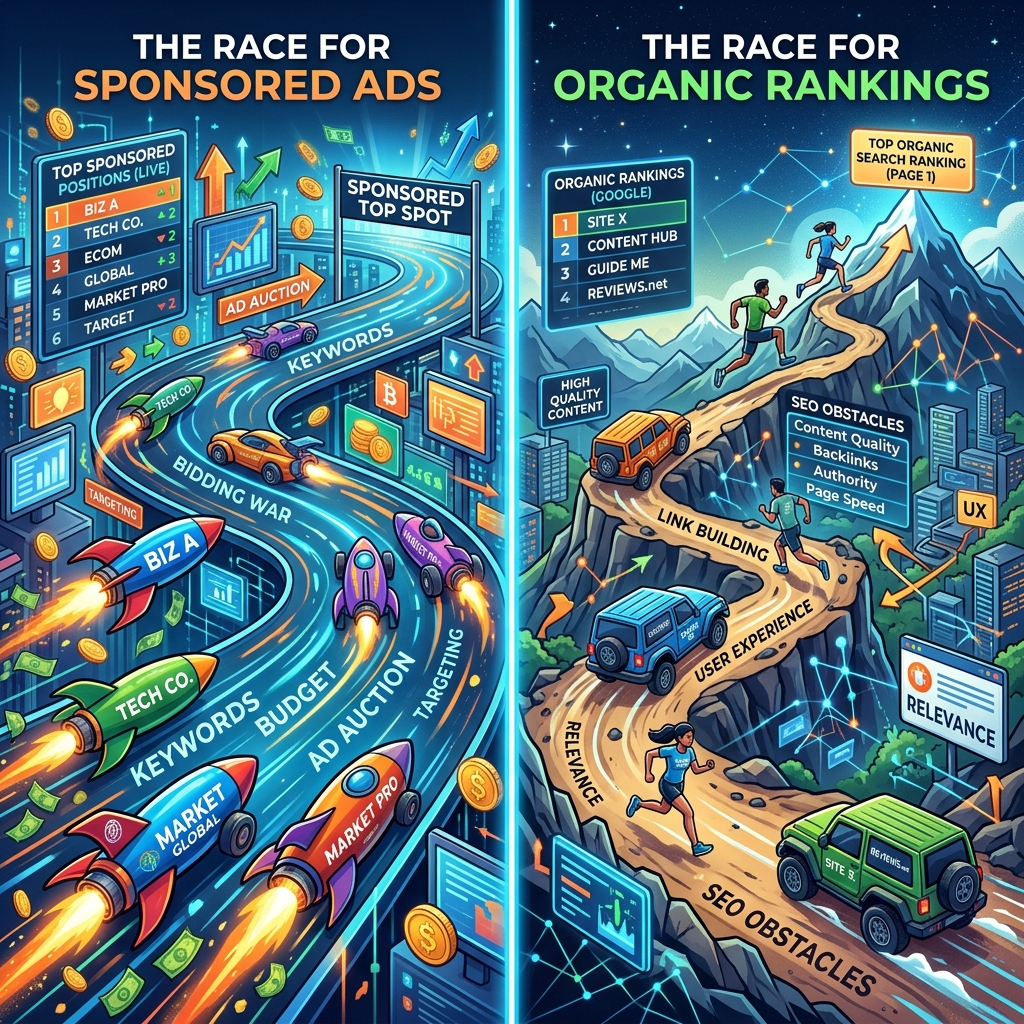
You’ll probably notice that some results are marked Sponsored.
Those are advertisements.
Businesses pay for the opportunity to appear for certain searches.
But here’s something important.
The rest of the results aren’t there because someone paid for them.
They’re there because Google’s systems believe they’re the most relevant answers to your search.
So in reality, two different races happen at once.
One determines which advertisements appear.
The other determines which websites earn their position organically.
Both happen in moments.
Most users never notice the difference.
Every Search Helps Google Learn
Have you ever searched for something…
Clicked the first result…
And immediately returned to Google because it wasn’t helpful?
That tiny action says something.
Now imagine millions of people doing the same thing every day.
Search engines constantly study patterns like these.
Not to learn personal secrets.
But to understand whether they’re giving people useful results.
If certain pages consistently satisfy users, they become stronger candidates for future searches.
If they disappoint people repeatedly, they may gradually lose visibility.
In other words, every search helps improve the next one.
It’s Not Just Websites Competing
Here’s something many people overlook.
Businesses compete to be discovered.
Content creators compete for readers.
News organizations compete for visibility.
Online stores compete for customers.
Universities compete for applicants.
Even local restaurants compete to appear when someone searches,
“Best restaurant near me.”
Google Search isn’t simply a tool.
It’s one of the world’s largest digital marketplaces for attention.
Every day, countless organizations are trying to earn a place in front of the people searching for exactly what they offer.
All of This Happens Before You Finish Reading This Sentence
Let’s put it into perspective.
While you’ve been reading this article…
Millions of searches have happened around the world.
Students have searched for learning resources.
Parents have searched for schools.
Travellers have searched for flights.
Doctors have searched for research.
Developers have searched for coding solutions.
Business owners have searched for customers.
Every one of those searches triggered the same invisible race.
Different questions.
Different answers.
The same extraordinary process.
All happening in fractions of a second.

Final Thoughts: Every Search Is More Extraordinary Than It Looks
Typing a few words into Google feels effortless.
We’ve done it so many times that it’s easy to forget just how remarkable it really is.
Behind every search is an incredibly complex system designed to organize one of the largest collections of information ever created.
It’s evaluating relevance.
Measuring quality.
Balancing speed.
Ranking billions of pages.
Running advertising auctions.
Protecting users from harmful content.
And delivering answers—all before you have time to reach for your cup of coffee.
The next time you press Enter, remember this:
You’re not simply searching the internet.
You’re triggering one of the fastest and most sophisticated digital processes ever built.
A race so quick…
…that by the time you see the first result, the finish line has already been crossed.

