


When people talk about the future of technology, the conversation is usually dominated by AI, robotics, apps, or the next viral startup.
Everyone wants to know which AI tool will replace tasks, which platform will become the next unicorn, or which new technology will change the world.
But behind all those exciting innovations is a much less glamorous industry quietly powering everything:
Cloud infrastructure.
It doesn’t usually trend on social media.
It rarely appears in flashy headlines.
Most people never think about it when they stream a movie, send a message, use ChatGPT, book a flight, or pay for something online.
Yet without cloud infrastructure, much of the modern internet would simply stop working.
In many ways, the real gold rush of the digital age is not happening in the apps we see.
It’s happening in the infrastructure that makes those apps possible.
Every Modern Digital Service Lives Somewhere
Imagine opening Netflix.
You press Play, and the movie starts almost instantly.
Where is that movie actually stored?
Not inside your television.
Not inside your phone.
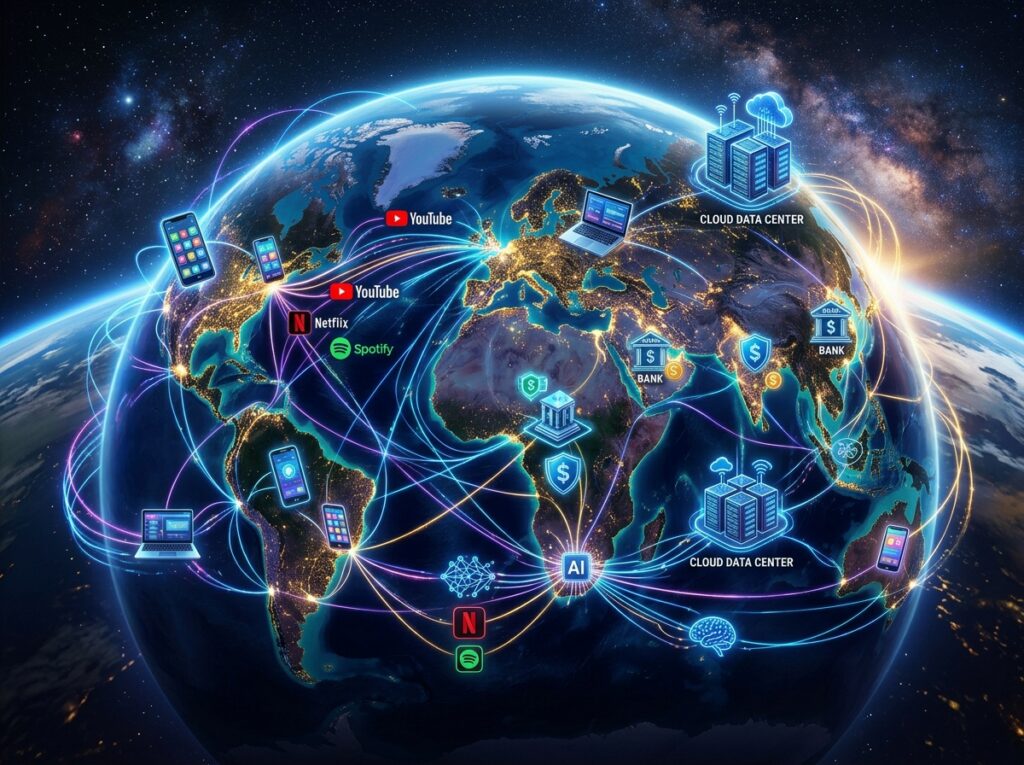
It is stored in massive data centers filled with thousands of servers.
The same is true for:
- WhatsApp messages
- Google searches
- Instagram photos
- Banking transactions
- Online shopping orders
- Video calls
- AI tools like ChatGPT
- Cloud storage services like Google Drive and Dropbox
Whenever you use these services, your device is communicating with computers located in data centers that may be hundreds or even thousands of miles away.
That network of servers, storage systems, databases, and networking equipment is what we call cloud infrastructure.
Why This Became a Massive Opportunity
Years ago, if a company wanted to launch a digital product, it often had to buy its own physical servers.
That meant:
- Purchasing expensive hardware
- Renting space in a server room
- Installing cooling systems
- Maintaining networking equipment
- Hiring specialists to manage everything
Imagine opening a small bakery and being forced to build your own power station before selling a single loaf of bread.
That was essentially what many businesses faced in the early days of the internet.
Cloud computing changed the game.
Instead of buying the entire infrastructure, companies could rent computing power, storage, and databases on demand.
Need ten servers today? Rent them.
Need one hundred during a big sales event? Add them instantly.
Need fewer next month? Scale back down.
This flexibility allowed startups to grow much faster and enabled large companies to operate more efficiently.
AI Is Making Cloud Infrastructure Even More Valuable
This is the part many people miss.
AI models are incredibly demanding.
Training and running them requires enormous amounts of:
- Computing power
- Graphics processing units (GPUs)
- Storage
- Networking bandwidth
- Electricity
- Cooling infrastructure
Every time someone generates an image, asks an AI assistant a question, or uses an AI-powered application, powerful servers are working behind the scenes.
The more AI adoption grows, the more demand there is for the infrastructure supporting it.
It’s similar to a gold rush in the 1800s.
Many people focused on finding gold.
But some of the most profitable businesses were the ones selling shovels, tools, transportation, and supplies to the miners.
Today, AI companies may be the miners.
Cloud infrastructure providers are selling the digital shovels.

The Internet Has Become Infrastructure
Think about what happens when a major cloud provider experiences an outage.
Suddenly, multiple apps stop working.
Websites become unavailable.
Payment systems fail.
Business operations are disrupted.
This happens because many different companies rely on the same underlying cloud infrastructure.
In other words, cloud platforms have become something much bigger than hosting services.
They are now part of the critical infrastructure of the digital economy, similar to:
- Electricity grids
- Water systems
- Transportation networks
- Telecommunications infrastructure
When cloud systems work, nobody notices.
When they fail, entire industries feel the impact.
The Career Opportunity Most People Are Overlooking
Because AI gets most of the attention, many people are rushing to learn prompt engineering or AI tools.
Those skills are valuable.
But there’s another massive opportunity hiding in plain sight.
Cloud infrastructure needs people who can:
- Design cloud architectures
- Manage servers and networks
- Automate deployments
- Monitor system performance
- Secure cloud environments
- Optimize costs
- Build reliable backup and recovery systems
This is where roles like Cloud Engineers, DevOps Engineers, Site Reliability Engineers (SREs), Infrastructure Engineers, and Cloud Security Specialists become incredibly important.
The demand for these skills continues to grow because every digital business depends on infrastructure, whether it’s a fintech startup, a healthcare platform, an e-commerce store, or an AI company.
Why This Matters Beyond Big Tech Companies
You might think cloud infrastructure is only relevant to companies like Amazon, Microsoft, or Google.
In reality, it affects almost every modern business.
A small online store may use cloud hosting.
A school may store student records in the cloud.
A hospital may run digital health systems on cloud platforms.
A logistics company may track deliveries through cloud-based applications.
Cloud infrastructure is no longer a “tech company thing.”
It has become a business thing.
Understanding how it works is increasingly valuable even for people who are not deeply technical.

The Invisible Foundation of the Future
Here’s the simplest way to think about it.
When people admire a skyscraper, they usually notice the glass walls, the lighting, and the impressive height.
They rarely think about the foundation buried deep underground.
But without that foundation, the skyscraper cannot stand.
AI, streaming platforms, fintech apps, social networks, and digital services are the skyscrapers of the modern internet.
Cloud infrastructure is the foundation beneath them.
And as those skyscrapers become taller, smarter, and more demanding, the foundation becomes even more important.
Final Thoughts: The Quiet Industry Powering Everything Else
The next time you hear people talking about the future of technology, pay attention to what’s happening behind the scenes.
Every AI breakthrough.
Every viral app.
Every online payment.
Every video stream.
Every cloud document.
Every digital service you use today depends on infrastructure that most users never see.
That’s why the biggest opportunity in tech may not always be the most visible one.
The companies building cloud platforms, data centers, networking systems, automation tools, and cloud security solutions are constructing the roads, bridges, and power stations of the digital world.
The apps may capture the headlines.
The AI tools may capture the excitement.
But the infrastructure quietly captures something even more important:
The foundation of the entire modern internet.
And that is why the new gold rush is happening in cloud infrastructure.

