


For a long time, many people believed that working in tech meant one thing:
You had to know how to code.
If you couldn’t build a website from scratch, write Python scripts, or solve complex algorithms, it felt like the tech industry wasn’t for you.
That belief is still surprisingly common today.
Students hesitate to explore tech careers because they think they need a computer science degree.
Professionals from other industries assume it’s “too technical.”
Even talented people with strong communication, organizational, or analytical skills often rule themselves out before they even begin.
But here’s the reality:
The modern tech industry is no longer built by developers alone.
In fact, some of the fastest-growing roles in tech involve understanding people, solving business problems, organizing systems, analyzing information, designing experiences, or managing operations—not writing thousands of lines of code every day.
The tech world has grown far beyond the stereotype of a programmer sitting alone in a dark room surrounded by monitors.
Building a Digital Product Is Like Building a House
Imagine someone says,
“We’re building a new hospital.”
Would you expect the bricklayer to do everything?
Of course not.
You’d need:
- Architects
- Engineers
- Electricians
- Interior designers
- Project managers
- Safety inspectors
- Procurement teams
- Administrators
- Maintenance staff
A successful building is the result of many different specialties working together.
Technology products are exactly the same.
When you use a banking app, a healthcare platform, or an online marketplace, you’re interacting with the work of dozens of different professionals—not just the developers who wrote the code.

The Invisible Roles Behind Every App You Use
Think about a simple food delivery app.
Someone had to decide what problem the app should solve.
Someone designed the screens so customers could order easily.
Someone analyzed delivery data to improve performance.
Someone wrote the help articles and support documentation.
Someone managed the rollout of new features.
Someone ensured restaurants and delivery riders could use the system effectively.
Only part of that work involved writing code.
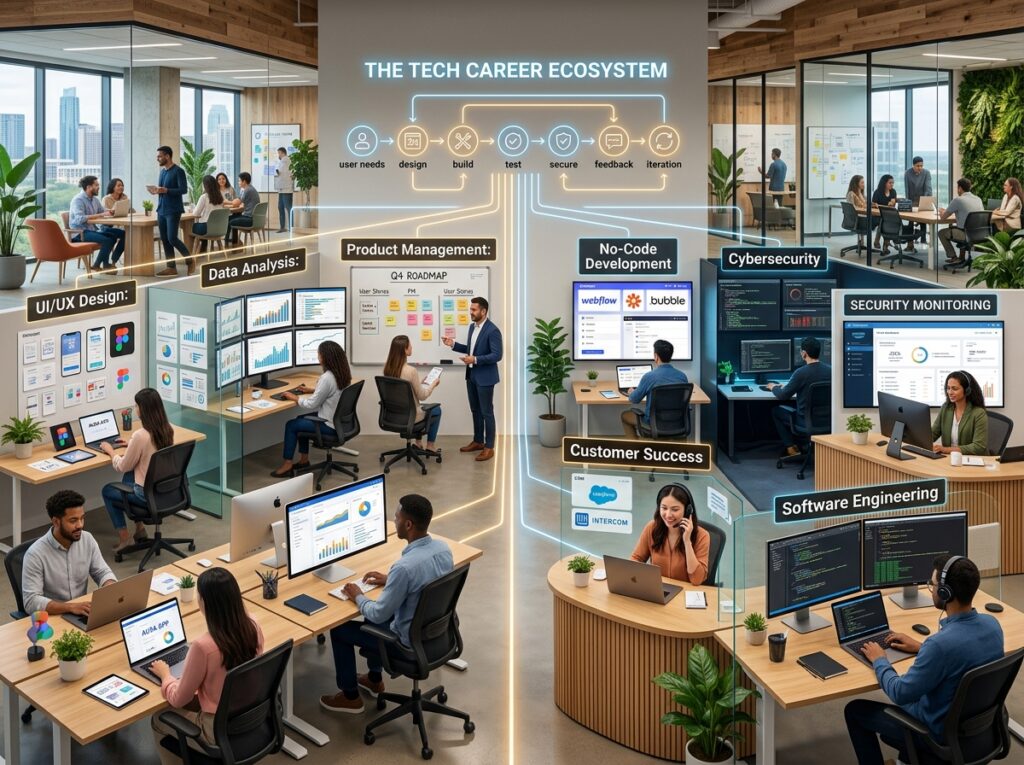
This is why roles such as these have become increasingly important:
- Product Managers – decide what gets built and why
- UI/UX Designers – make products easy and enjoyable to use
- Data Analysts – turn raw data into useful insights
- Project Coordinators – keep teams organized and projects moving
- Technical Writers – create clear documentation and guides
- Customer Success Specialists – help users get value from products
- Operations Professionals – improve internal systems and workflows
- No-Code and Automation Builders – create business solutions without traditional software development
These roles exist because technology is ultimately about people, not just machines.
The Rise of the “Bridge” Professional
One of the biggest changes happening in tech is the growing demand for people who can connect technical teams with business teams.
Developers may understand how to build a feature.
Business leaders understand what customers need.
Someone has to translate between those two worlds.
For example:
- A hospital wants a system that reduces patient waiting time.
- Developers need clear requirements to build it correctly.
- Product and operations professionals help convert the real-world problem into a workable technical solution.
This ability to translate problems into solutions is becoming one of the most valuable skills in the industry.
And it’s a skill that people from many different backgrounds can develop.
No-Code Tools Changed the Entry Barrier
Another reason tech is no longer only for developers is the rise of no-code and low-code platforms.
Tools like Bubble, Glide, Softr, Airtable, Zapier, Make, and n8n allow people to build:
- Internal business tools
- Client portals
- Marketplaces
- CRMs
- Automation workflows
- Mobile apps
- Dashboards
- Booking systems
You still need logical thinking and problem-solving skills, but you don’t always need to become a traditional software engineer to create useful digital products.
This has opened doors for entrepreneurs, operations professionals, virtual assistants, project coordinators, educators, healthcare workers, and many others who understand real business problems and want to solve them with technology.

What Employers Are Starting to Value More
Here’s something interesting happening across the industry.
Many employers are realizing that technical skills alone are not enough.
They also need people who can:
- Communicate clearly
- Work with different teams
- Understand customer needs
- Learn new tools quickly
- Manage projects effectively
- Think critically
- Adapt to changing technology
A brilliant developer who cannot collaborate with others may struggle on a large product team.
Meanwhile, someone with moderate technical knowledge but excellent communication and organizational skills can become incredibly valuable in product, operations, customer success, or project management roles.
The industry is increasingly rewarding collaboration and adaptability, not just technical depth.
So, Do You Need to Learn Coding at All?
This is the question many readers are probably asking.
The honest answer is:
It depends on the role you want.
If you want to become a software engineer, backend developer, mobile app developer, or machine learning engineer, then yes—coding is essential.
But if you’re interested in:
- Product management
- UI/UX design
- Data analysis
- Project coordination
- Technical support
- Customer success
- Digital operations
- Automation and no-code development
- Tech consulting
- Documentation and training
…then coding may be helpful, but it is not always the primary skill that gets you hired.
Understanding how technology works is often more important than being able to build every piece of it yourself.
The Bigger Opportunity Most People Are Missing
The biggest mistake aspiring tech professionals make is assuming there is only one door into the industry.
In reality, tech is not a single profession.
It’s an ecosystem.
Just as a hospital needs doctors, nurses, administrators, pharmacists, accountants, IT staff, and operations managers, the tech industry needs a wide range of specialists working together.
The question is no longer:
“Can I become a developer?”
A better question is:
“What problem can I help solve using technology?”
That shift in thinking opens far more opportunities than most people realize.
Final Thoughts: The Tech Industry Needs More Than Coders
Developers remain incredibly important.
Modern technology would not exist without them.
But the industry has matured.
Today’s digital products require designers, analysts, communicators, coordinators, strategists, operators, educators, and problem-solvers working alongside engineers.
The most successful tech companies are rarely built by programmers alone.
They’re built by diverse teams combining technical expertise with human understanding.
So if you’ve ever felt curious about the tech space but hesitated because you don’t see yourself as “a coder,” remember this:
The modern tech industry is not looking for one type of person.
It’s looking for people who can learn, adapt, collaborate, and help solve meaningful problems.
And that means there has never been a better time for people from different backgrounds to find their place in tech.

