

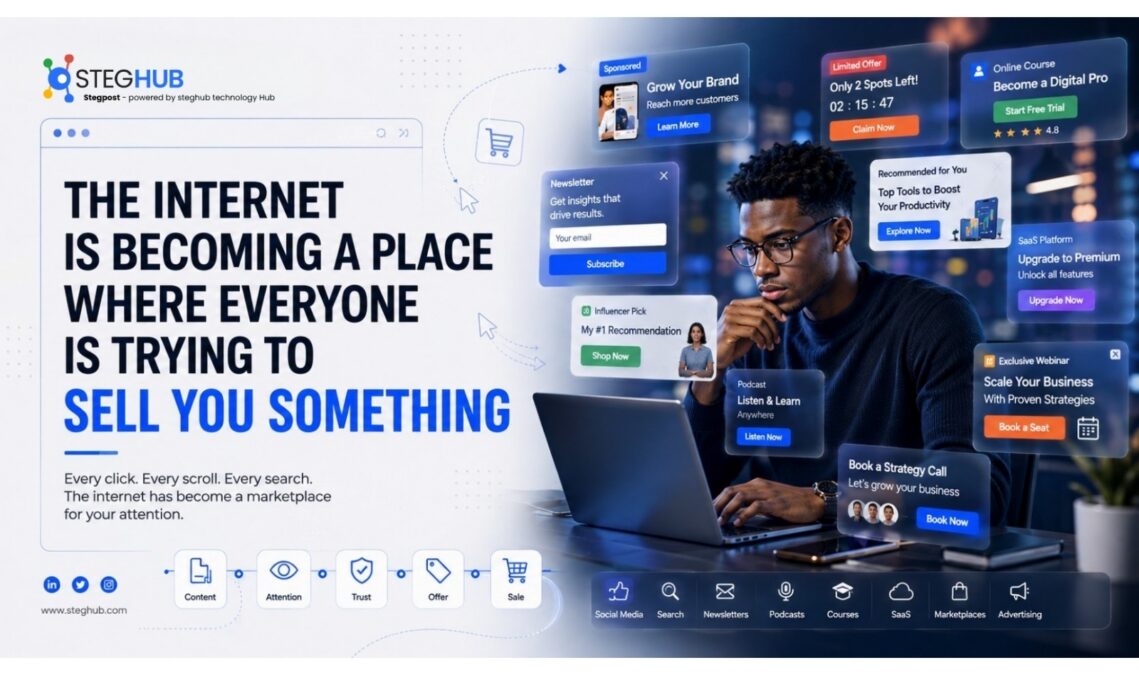
There was a time when you could open the internet just to look for something.
You searched for information.
You watched a video.
You read an article.
You joined a forum because people there were genuinely interested in the same thing you were.
Of course, businesses existed online. Advertising existed too.
But increasingly, the internet feels like a place where almost every interaction has the potential to become a transaction.
You open a video.
Someone is promoting a course.
You scroll through social media.
Someone is selling a product, a service, a community, or a personal brand.
You search for advice.
Half the results are designed to guide you toward buying something.
You read a useful thread.
At the end, there is a link to a newsletter.
The newsletter leads to a product.
The product leads to a premium community.
The community leads to coaching.
And somewhere along the way, you may forget what you originally came online to find.
This isn’t necessarily a complaint about people making money on the internet.
The internet has created genuine opportunities for people to build businesses, reach customers, and earn a living without needing a physical shop or a massive advertising budget.
The more interesting question is this:
What happens when nearly everyone online is also trying to sell something?
The Internet Turned Everyone Into a Potential Storefront
You no longer need to rent an office before starting a business.
You can sell a product from your bedroom.
Offer consulting services from your LinkedIn profile.
Build an audience on social media.
Teach a course.
Launch a newsletter.
Create digital products.
Sell templates.
Start a community.
Promote affiliate links.
Build a personal brand around almost any professional skill.
The barriers to starting have fallen dramatically.
That is, in many ways, a good thing.
A graphic designer can find clients without opening a design agency.
A developer can sell a small software product without building a large company.
A teacher can reach students outside their physical classroom.
A writer can build an audience without waiting for a publishing company.
The internet gave individuals something that was once expensive to acquire:
Distribution.
You no longer need to own a television station, newspaper, or billboard to get people’s attention.
You can publish something today and potentially reach thousands of people tomorrow.
But once everyone gains access to distribution, another problem appears.
Everyone is competing for the same attention.
Attention Became the Currency Behind the Screen
Imagine walking through a large market.
Every shop owner is calling your name.
“Come and look.”
“Special offer.”
“You need this.”
“Don’t miss this.”
“Only three spaces left.”
“Last chance.”
At some point, you stop listening.
The internet can feel increasingly similar.
Your attention has become incredibly valuable because almost every digital business needs some of it before it can sell you anything.
Before you buy a product, someone usually needs you to:
See them.
Remember them.
Trust them.
Click something.
Sign up.
Reply.
Book a call.
Or eventually make a purchase.
This is why so much of the internet is designed around capturing and holding attention.
Headlines are optimized.
Thumbnails are optimized.
Notifications are optimized.
Content is optimized.
The goal is often simple:
Don’t let the person scroll past.
But when every platform, creator, company, and entrepreneur is competing for attention, the online world can begin to feel noisy.

Even “Free” Advice Often Has Somewhere It Wants to Take You
You’ve probably seen this pattern before.
A creator shares:
“Five things I learned after growing my business.”
The post is useful.
You keep reading.
Then comes the final line:
“If you want the full framework, join my newsletter.”
You join the newsletter.
A few days later, you receive an email about a workshop.
The workshop introduces a paid course.
The course leads to a private community.
The community offers one-on-one coaching.
None of this is automatically dishonest.
In fact, this is a perfectly reasonable business model.
Providing free information can help people demonstrate expertise before asking someone to pay for a more valuable service.
The problem isn’t necessarily the sales process.
The problem appears when every piece of information begins to feel like the first step of a funnel.
You start wondering:
Is this person sharing because they genuinely have something interesting to say?
Or is this post is designed to move me toward a purchase?
Sometimes, of course, the answer is both.
And that’s where things become complicated.
The Personal Brand Became a Business Infrastructure
A few years ago, the phrase “personal brand” sounded like something mainly associated with celebrities or major public figures.
Today, almost anyone can build one.
Developers.
Designers.
Founders.
Consultants.
Marketers.
Writers.
Students.
Career coaches.
Recruiters.
Even people who haven’t yet decided exactly what they are selling.
The logic is straightforward.
Build an audience first.
Build trust.
Become recognizable.
Then, when an opportunity appears, you already have people’s attention.
Your social media profile becomes more than a profile.
It becomes a landing page.
Your posts become marketing.
Your expertise becomes content.
Your personality becomes part of the product.
And sometimes, even ordinary moments of life become part of the brand.
You went to an event?
Content.
You learned a lesson?
Content.
You made a mistake?
Content.
You changed careers?
Content.
You had a difficult experience?
Potentially content too.
The line between living a life and creating material from your life can begin to blur.
When Every Conversation Has a Hidden Pitch
Think about how many online messages begin with something that appears friendly.
“Hey, I came across your profile and really liked what you’re doing.”
You reply.
They ask a few questions.
Then comes the pitch.
Sometimes it happens so quickly that you can almost predict it.
The internet has made business networking easier, but it has also made people more suspicious of genuine interaction.
A compliment can feel like a sales script.
A connection request can feel like the beginning of an outreach sequence.
A casual question can feel like market research.
This creates an unfortunate side effect.
When sales language becomes too common, even genuine conversations can start to feel transactional.
You may genuinely want to connect with someone.
But they have been approached by fifty other people who wanted to “connect” before trying to sell them something.
Trust becomes more difficult.
Not because selling is wrong.
But because people have learned to recognize when a conversation is pretending not to be a sales conversation.
The Algorithm Rewards What Gets a Reaction
The problem becomes even more interesting when algorithms enter the picture.
Many platforms are not simply places where content appears chronologically.
Software helps determine what gets visibility.
And content that gets attention often has certain characteristics.
It is surprising.
Emotional.
Controversial.
Useful.
Entertaining.
Provocative.
Or designed to create curiosity.
This creates pressure.
If you’re trying to sell something online, you first need people to notice you.
If you’re trying to get people to notice you, you need content that performs.
So businesses and creators begin learning the language of the algorithm.
The perfect hook.
The controversial opinion.
The curiosity gap.
The personal story.
The unexpected statistic.
The “nobody is talking about this” opening.
And soon, even the way people communicate begins to change.
A normal thought becomes a post.
A post becomes content.
Content becomes distribution.
Distribution becomes leads.
Leads become customers.
The internet conversation becomes part of the sales system.
There Is Nothing Wrong With Selling. The Problem Is the Exhaustion.
Let’s be clear.
People need to make money.
Businesses need customers.
Creators need sustainable ways to support their work.
If nobody could sell anything online, many of the services, products, and communities people use every day wouldn’t exist.
The issue isn’t commercial activity.
It’s commercial saturation.
Imagine listening to your favourite song.
Now imagine someone interrupting it every thirty seconds to recommend another product.
Eventually, the problem isn’t the product.
It’s the interruption.
The same thing can happen online.
When every video ends with a promotion, every article contains an affiliate link, every conversation turns into a pitch, and every useful piece of information leads toward an offer, people can experience something like digital sales fatigue.
They don’t necessarily hate businesses.
They simply become tired of constantly being treated as potential customers.

The Most Valuable Thing Online May Become Trust
When everyone is trying to sell something, trust becomes more valuable.
Think about the people you actually pay attention to online.
It’s usually not only because they have the best graphics.
Or the most aggressive sales strategy.
Or the loudest promises.
Often, it’s because you believe them.
You trust that their recommendation isn’t random.
You trust that they understand what they’re talking about.
You trust that they won’t disappear immediately after receiving payment.
You trust that they aren’t hiding everything behind exaggerated marketing.
In a crowded digital marketplace, trust becomes a competitive advantage.
And interestingly, trust is often built through the opposite of aggressive selling.
Honesty.
Consistency.
Useful information.
Clear communication.
Admitting limitations.
Not pretending every product is for everyone.
The internet may be full of people trying to capture attention.
But attention without trust is increasingly fragile.
People Are Learning to Detect the Funnel
Internet users are becoming more sophisticated.
They recognize:
“Comment ‘GUIDE,’ and I’ll send you my free resource.”
“Only five spots available.”
“I wasn’t going to share this, but…”
“Nobody tells you this about making money online.”
“Here’s how I made $10,000 in one week.”
Some of these approaches may work.
Some are legitimate.
Some are manipulative.
But the important point is that users are beginning to recognize the patterns.
The internet has taught people how digital marketing works simply by exposing them to it repeatedly.
This creates an arms race of sorts.
As people become better at recognizing sales tactics, marketers develop more subtle tactics.
The marketing becomes more sophisticated.
The audience becomes more skeptical.
And the cycle continues.
Eventually, authenticity itself becomes a marketing strategy.
Which creates an interesting question:
What happens when everyone is trying to look authentic too?
AI Could Make the Internet Even More Commercial
Now add artificial intelligence to the picture.
AI can help businesses generate advertisements faster.
Write marketing emails.
Create social media content.
Personalize product recommendations.
Build customer service systems.
Generate landing pages.
Analyze consumer behavior.
Create variations of the same campaign.
A small business can now produce marketing material that previously might have required an entire team.
This creates enormous opportunities.
But it may also mean the volume of promotional content increases.
If creating content becomes cheaper and faster, the internet could become even more crowded.
The challenge may no longer be:
“How do I create enough content?”
It may become:
“How do I create something people actually want to pay attention to?”
And perhaps more importantly:
“How do I build a relationship that doesn’t feel automated?”
Maybe We Need to Separate Value From the Pitch
One of the healthiest changes online may come from being more transparent.
Sometimes you are sharing an idea because it’s useful.
Sometimes you are promoting a product.
Sometimes you’re doing both.
There is nothing wrong with being clear about that.
The problem begins when everything pretends to be one thing while secretly being another.
A sales message disguised as friendship.
An advertisement disguised as an unbiased recommendation.
A personal story designed entirely to create emotional pressure.
A countdown timer that restarts tomorrow.
The internet doesn’t necessarily need less business.
It may need more honest business.
People are surprisingly willing to buy when they understand what they’re buying and why it might be useful.
What they increasingly resist is feeling manipulated into it.
The Future Internet Might Become More Selective
As digital spaces become noisier, people may start creating smaller circles of trust.
Private communities.
Smaller group chats.
Paid newsletters.
Invite-only spaces.
Curated networks.
Platforms with fewer advertisements.
Places where people know that not every interaction is designed to produce a sale.
This doesn’t mean the public internet will disappear.
But it could mean people become more selective about where they spend their attention.
The open internet gave us access to almost everything.
The next challenge may be filtering.
Not finding information.
Finding information worth trusting.
Not finding people.
Finding people worth listening to.
Not finding products.
Finding products worth buying.
Final Thoughts: When Everyone Is Selling, What Makes Someone Worth Listening To?
The internet has done something remarkable.
It has made entrepreneurship accessible to people who previously had very few ways to reach customers.
A student can build an audience.
A freelancer can find clients.
A small business can compete globally.
A creator can turn knowledge into a sustainable career.
Those are real opportunities.
But there is a trade-off.
When everyone has a storefront, everywhere can start to feel like a marketplace.
The article you read may lead to a product.
The person who messages you may have a pitch.
The video you watch may be part of a campaign.
The advice you receive may be the first step of a funnel.
And as the internet becomes increasingly commercial, the people and businesses that stand out may not be the ones shouting the loudest.
They may be the ones who understand something simple:
People don’t mind being sold to nearly as much as they mind feeling like every interaction was only ever designed to sell them something.

