

A few years ago, if someone told you that a single tool could help write emails, summarize meetings, analyze data, generate images, create presentations, and even build websites, you probably would have laughed.
Today, that tool is sitting in a browser tab.
And whether we like it or not, it’s changing the way people work.
That’s why one of the biggest fears in workplaces right now sounds something like this:
“What if AI takes my job?”
It’s a fair question.
But it might not be the right one.
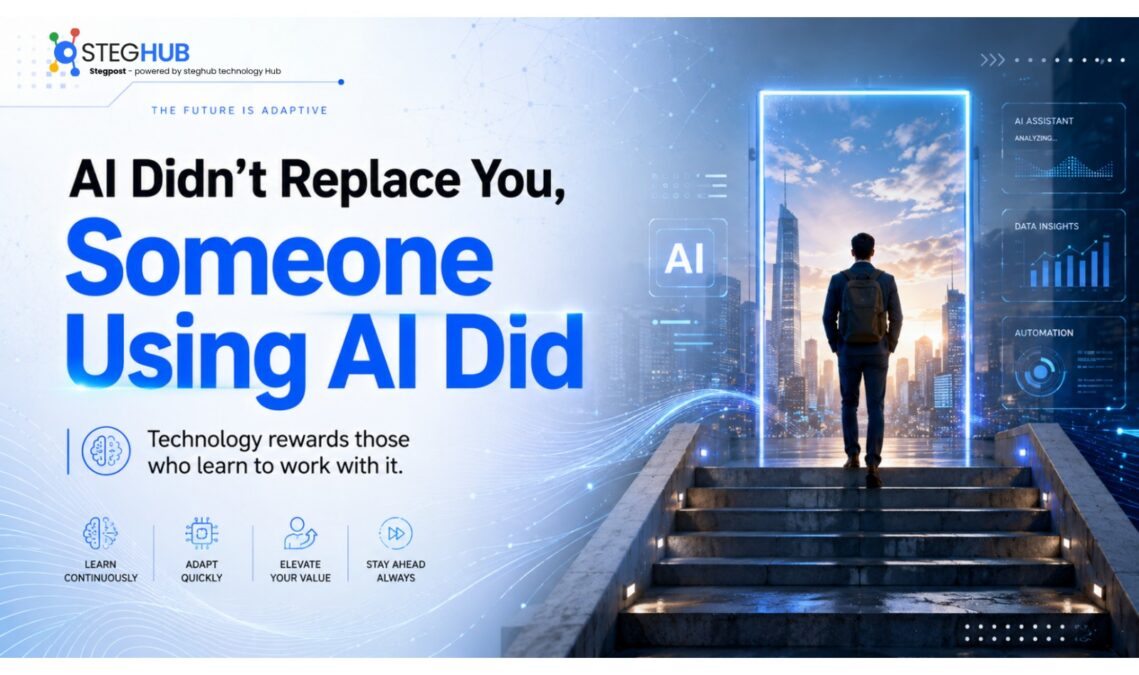
Because in many cases, AI isn’t replacing people.
People who know how to use AI are replacing people who don’t.
The Calculator Didn’t Kill Mathematics
Think about it.
When calculators became common, accountants didn’t disappear.
Mathematicians didn’t disappear.
Teachers didn’t disappear.
What changed was the expectation.
People were no longer valued for doing calculations slowly by hand.
They were valued for solving bigger problems.
AI is creating a similar shift.
The value isn’t in spending three hours doing something a tool can do in three minutes.
The value is knowing what to do with those three minutes.
[Image Prompt: Illustration showing two professionals at identical desks. One is manually doing repetitive work surrounded by paperwork, while the other uses AI tools to automate tasks and focus on strategy, planning, and decision-making.]
The Workplace Is Already Changing
Imagine two marketing assistants.
Both are talented.
Both are hardworking.
Both have similar experience.
One spends four hours creating content from scratch.
The other uses AI to generate ideas, organize research, draft outlines, and then spends their time refining the final output.
Who finishes faster?
Who takes on more projects?
Who becomes more valuable to the team?
The difference isn’t intelligence.
It’s leverage.
And AI is becoming one of the biggest sources of leverage in modern work.
The Real Advantage Isn’t Technical Skill
Here’s something interesting.
Many people think they need to become AI experts overnight.
Not really.
Most people don’t need to build AI models.
They simply need to learn how to work alongside them.
The people benefiting most right now are often the ones asking:
- How can this tool save me time?
- What repetitive task can I automate?
- How can I improve my work using AI?
Those questions matter more than knowing every AI buzzword on the internet.
The People Who Thrive Usually Adapt Early
Look at almost any major workplace shift.
The internet.
Cloud software.
Remote work.
Social media.
At first, people resisted.
Then they adapted.
Eventually, it became normal.
AI is following the same pattern.
The challenge isn’t deciding whether AI will become part of work.
The challenge is deciding when you’ll learn to use it effectively.
[Image Prompt: Illustration of workers standing at a crossroads. One path leads toward traditional work methods, while another path shows modern AI-assisted workflows, symbolizing adaptation and growth.]
This Isn’t Just About Tech Jobs
That’s the surprising part.
A lot of people still think AI only affects software developers or engineers.
But it’s touching almost every field.
Writers use it.
Designers use it.
Marketers use it.
Recruiters use it.
Project managers use it.
Teachers use it.
Business owners use it.
The question is no longer whether AI applies to your role.
It’s how much of your role can be improved with it.
The Skills That Matter More Than Ever
Ironically, the rise of AI is making human skills more valuable.
Things like:
- Communication
- Creativity
- Critical thinking
- Decision-making
- Leadership
- Emotional intelligence
AI can generate options.
Humans still decide which option makes sense.
AI can write a draft.
Humans decide what message should be communicated.
AI can provide information.
Humans provide judgment.
That’s a big difference.
Final Thoughts: The Goal Isn’t to Compete With AI
A lot of people are approaching this the wrong way.
They’re trying to figure out how to outperform AI.
That’s like trying to outrun a calculator.
The better question is:
“How can I use this tool to become better at what I already do?”
Because the future doesn’t belong to people who ignore AI.
And it probably doesn’t belong to AI alone either.
It belongs to people who know how to work with it.
Here’s Something Worth Thinking About
The next time you hear someone say:
“AI is taking jobs.”
Pause for a second.
The bigger story might be this:
AI didn’t replace them.
Someone who learned how to use AI did.


