

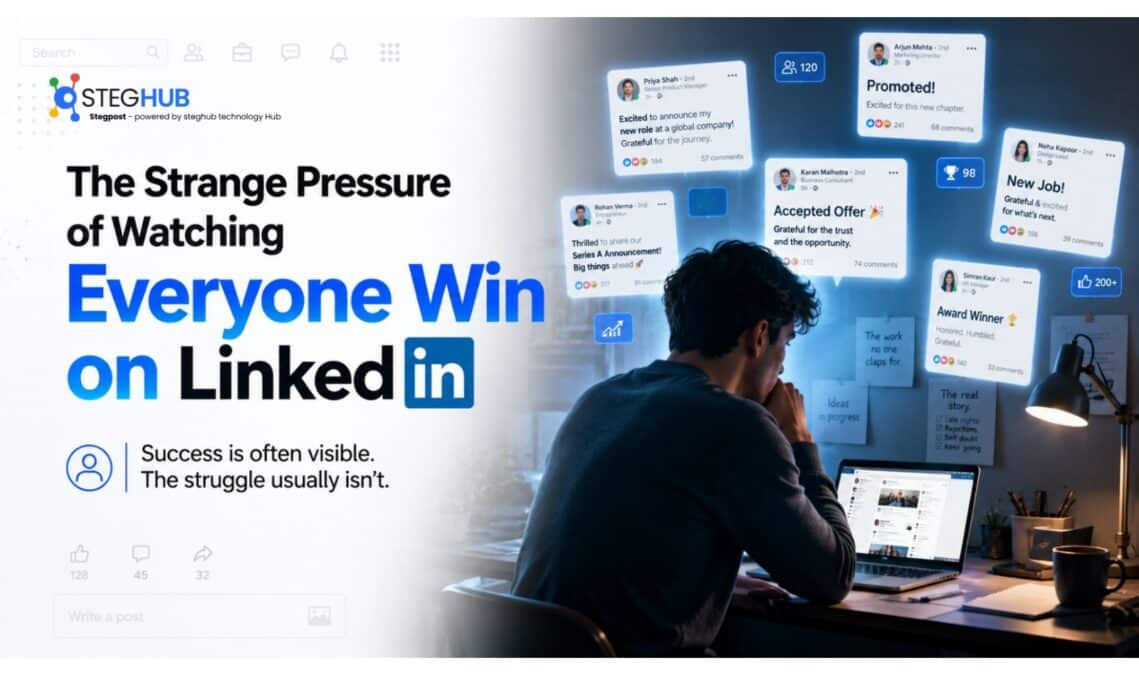
Let’s be honest.
LinkedIn can be inspiring.
It can also be exhausting.
You open the app hoping to check a message or see what’s happening in your industry, and within five minutes, you have seen:
- Someone announced a promotion.
- Someone landed a new role.
- Someone has completed another certification.
- Someone launch a startup.
- Someone celebrates a major career milestone.
And before you know it, you’re sitting there wondering:
“Am I the only one not moving forward?”
If you’ve ever felt that way, you’re not alone.
It Starts As Inspiration… Until It Doesn’t
Most people join LinkedIn for the right reasons.
To learn.
To connect.
To grow professionally.
But somewhere along the way, inspiration can quietly turn into comparison.
You see someone celebrating a new opportunity and suddenly you’re measuring your own progress against theirs.
Not because you’re jealous.
Just because you’re human.
[Image Prompt: A professional scrolling through LinkedIn on a laptop, seeing posts about promotions, new jobs, and achievements while quietly reflecting on their own journey. Realistic, relatable workplace setting.]
The Problem Isn’t Their Success
Here’s the important part.
The problem isn’t that other people are winning.
The problem is that you’re only seeing the highlights.
LinkedIn is a bit like a movie trailer.
You see the exciting moments.
The announcement.
The achievement.
The celebration.
What you don’t see are the months behind it.
The rejected applications.
The failed interviews.
The projects that didn’t work.
The late nights, wondering if anything was actually paying off.
You’re comparing your behind-the-scenes to someone else’s highlight reel.
And that’s never a fair comparison.
Everyone Looks Like They’re Moving Faster
Have you noticed how LinkedIn can make it feel like everyone is accelerating at the same time?
One person becomes a manager.
Another switches careers.
Another gets accepted into a prestigious program.
Another shares a huge business milestone.
Meanwhile, you’re still trying to finish your current project, complete your course, or figure out your next move.
It creates this strange pressure to constantly be achieving something.
As if standing still for a moment means falling behind.
Real Growth Is Usually Boring
This is the part people don’t post enough.
Growth is often repetitive.
It’s studying after work.
It’s practicing a skill nobody notices yet.
It’s applying for opportunities and hearing nothing back.
It’s showing up consistently when there isn’t much applause.
Example:
Imagine two people learning data analysis.
One posts every milestone online.
The other quietly spends six months practicing projects, improving their skills, and making mistakes.
Who is growing faster?
Honestly, it could be either one.
Visibility and progress are not always the same thing.
[Image Prompt: Split-scene illustration showing one professional posting achievements online while another quietly learns, studies, and practices behind the scenes. Both are progressing in different ways.]
Success Has Different Timelines
One of the biggest mistakes we make is assuming everybody should reach milestones at the same speed.
Life doesn’t work like that.
Some people get opportunities early.
Some people build slowly.
Some people change direction completely halfway through their careers.
And some people experience success much later than expected.
Think about it this way:
If you’re baking a cake, you don’t keep opening the oven every two minutes and comparing it to someone else’s.
Different ingredients.
Different temperatures.
Different timing.
Yet somehow, we do exactly that with our careers.
What You Don’t See Matters
The person celebrating a promotion might have spent years working toward it.
The person announcing a new role may have faced dozens of rejections before getting an offer.
The founder, celebrating growth, might have experienced months of uncertainty before things started working.
Success stories often begin long before they’re posted.
And that’s the part LinkedIn doesn’t always show.
[Image Prompt: Illustration showing a successful LinkedIn post above the surface, while beneath it is a larger hidden journey containing rejected applications, learning, setbacks, and persistence.]
How to Use LinkedIn Without Losing Your Mind
The goal isn’t to stop using LinkedIn.
It’s to use it differently.
When you see someone succeeding:
Instead of asking:
“Why am I not there yet?”
Try asking:
“What can I learn from this?”
That small shift changes everything.
Because now you’re using success as information, not as a measuring stick.
Your Progress Still Counts
Just because your achievement isn’t being celebrated publicly doesn’t mean it isn’t important.
Maybe you:
- Finished a difficult project.
- Learned a new skill.
- Improved your confidence.
- Became better at your job.
- Stayed consistent when it would have been easier to quit.
Those things matter.
Even if they never become a LinkedIn post.
Final Thoughts: You’re Seeing a Snapshot, Not the Full Story
The next time LinkedIn makes it feel like everyone is winning except you, remember this:
You’re looking at moments.
Not entire journeys.
Not struggles.
Not setbacks.
No doubts.
Just moments.
And moments rarely tell the full story.
Here’s Something Worth Remembering
Someone else’s success is not evidence of your failure.
Your timeline doesn’t need to look like theirs.
Keep learning.
Keep building.
Keep showing up.
One day, someone might look at your success story online and assume it happened overnight too.
And you’ll know just how much of the story they didn’t see.


