

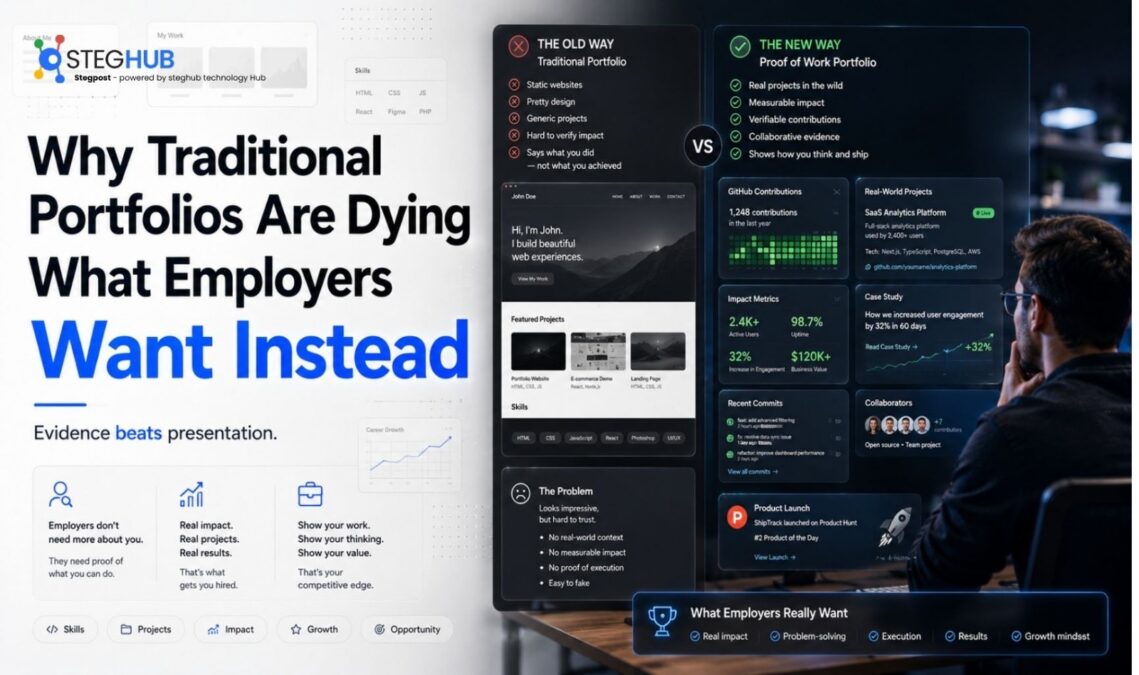
There was a time when building a portfolio was pretty straightforward.
You created a nice-looking website.
Added a few projects.
Wrote a short bio.
Included a contact form.
Then, I waited for opportunities to roll in.
And for a while, that worked.
Today?
Not so much.
The reality is that employers are becoming much harder to impress.
Not because they’re trying to be difficult.
But because they’ve seen thousands of portfolios that all look the same.
The polished homepage.
The generic “About Me” section.
The projects nobody can actually verify.
The claim that someone is “passionate about technology and innovation.”
Sound familiar?
The problem isn’t that portfolios are useless.
The problem is that traditional portfolios no longer tell the full story.
And employers know it.
The Internet Made It Easy to Look Impressive
Let’s be honest.
It’s never been easier to create a beautiful portfolio.
Templates are everywhere.
AI can help write descriptions.
Website builders can launch a professional-looking site in a few hours.
The result?
Everyone looks good on paper.
And when everyone looks good, employers start looking for different signals.
Think about online shopping.
If two products have similar descriptions, what do most people check next?
Reviews.
Proof.
Real experiences.
Hiring managers do something very similar.
They want evidence.
Not just presentation.
A Portfolio Says What You Did. Proof Shows What You Can Do
Imagine two candidates applying for the same role.
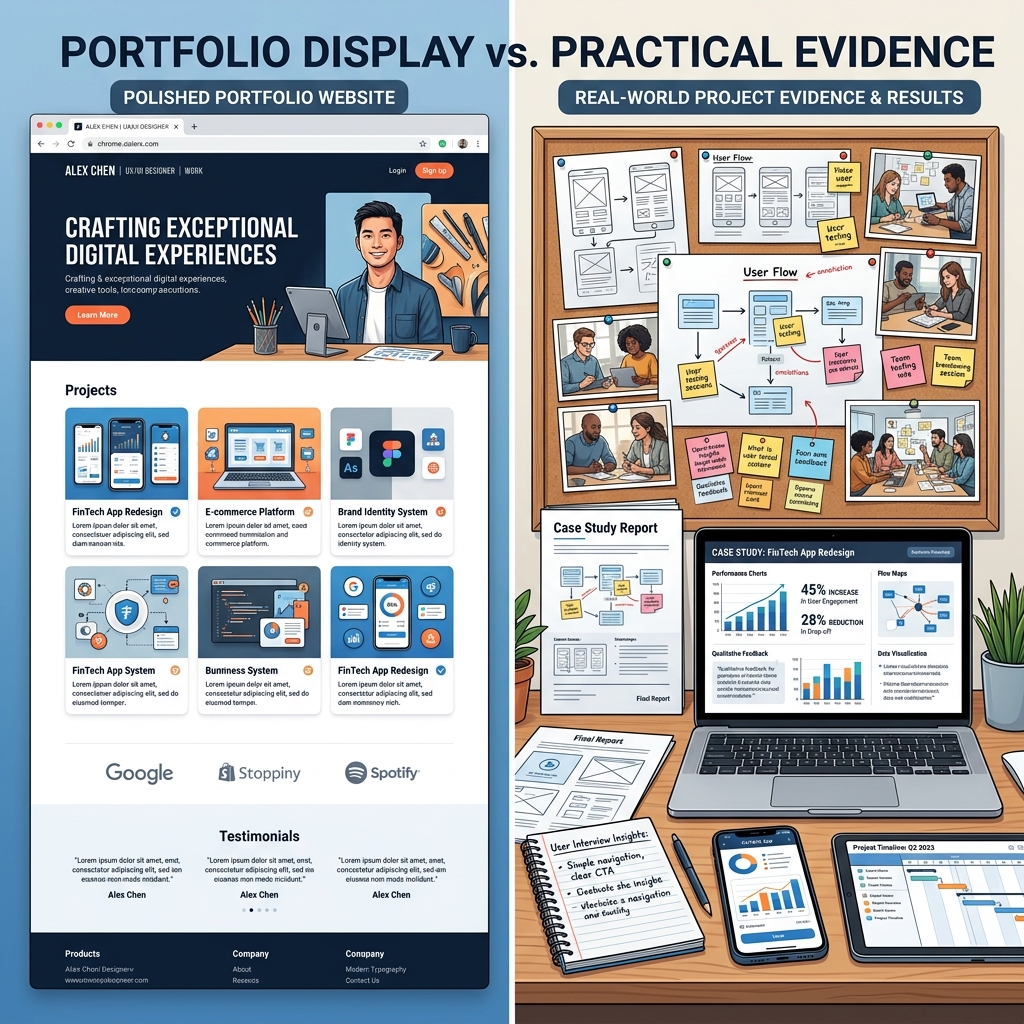
Candidate A has a beautiful portfolio.
The design is impressive.
Everything looks polished.
Candidate B has a simpler portfolio.
However, they also offer project walkthroughs, real-world case studies, public work, and evidence demonstrating how they have solved actual problems.
Who stands out more?
Usually Candidate B.
Because employers aren’t hiring websites.
They’re hiring people who can solve problems.
And problem-solving leaves evidence.
Employers Want To See Your Thinking
This is where many people miss the mark.
They show the final project.
But never explain the journey.
Imagine someone showing you a finished puzzle.
That’s nice.
But what’s more interesting is understanding how they put it together.
What challenges did they face?
What decisions did they make?
What mistakes did they correct?
What did they learn?
The same applies to hiring.
Employers want to understand how you think.
Because that’s what you’ll bring into the workplace every day.
Not just the final result.
The process behind it.
The Rise of “Proof of Work”
Over the last few years, something interesting has happened.
Employers have started paying more attention to what people publicly create.
Not just what they claim.
What they create.
A software engineer sharing projects on GitHub.
A product manager documenting product case studies.
A designer explaining design decisions.
A data analyst sharing dashboard projects.
A marketer breaking down campaign strategies.
These things tell a much richer story than a portfolio alone.
It’s what many people now call “proof of work.”
And it’s becoming increasingly valuable.
Your LinkedIn Might Be More Powerful Than Your Portfolio
This surprises a lot of people.
Many candidates spend months perfecting their portfolio.
Then completely ignore their LinkedIn profile.
Meanwhile, recruiters are actively checking LinkedIn every day.
They’re looking for:
- How you communicate
- What you’re learning
- Projects you’ve worked on
- Industry conversations you engage with
- Recommendations from others
- Evidence of growth over time
Think about it.
A portfolio is usually static.
LinkedIn is alive.
It shows progression.
And progression is something employers love to see.

The Best Portfolio Piece Might Be a Real Problem You Solved
Let’s say you’re learning data analysis.
Many beginners create dashboards using the same sample datasets everyone else uses.
There’s nothing wrong with that.
But imagine instead that you analyze data from a local business.
Or study customer trends from an online store.
Or build a dashboard that solves a real-world problem.
Suddenly, your project becomes memorable.
Why?
Because it reflects reality.
And reality is what employers work with every day.
The same principle applies across almost every field.
Real problems create stronger portfolios.
Documentation Is Becoming a Superpower
Here’s something employers quietly love.
People who can explain their work clearly.
You might build something amazing.
But if nobody understands it, its impact gets reduced.
That’s why documentation matters.
Case studies matter.
Project breakdowns matter.
Written explanations matter.
Imagine hiring two people with similar technical skills.
One can clearly explain their decisions.
The other cannot.
Who gets trusted faster?
Usually, the person who communicates well.
Because work doesn’t happen in isolation.
It happens with people.
What Employers Really Want in 2026
If we’re being honest, most employers aren’t looking for the perfect portfolio.
They’re looking for confidence that you can deliver value.
That confidence often comes from seeing:
- Real projects
- Problem-solving ability
- Communication skills
- Consistency
- Curiosity
- Initiative
- Proof of continuous learning
The portfolio is still useful.
It’s just no longer enough on its own.
Think of it as your introduction.
Not your entire story.

Final Thoughts: Stop Focusing on Looking Qualified
This might be the biggest takeaway from this article.
Many people spend so much time trying to look qualified that they forget to become qualified.
They have perfect layouts.
Choose fonts.
Adjust colors.
Rewrite bios.
Meanwhile, they could be building projects.
Sharing insights.
Documenting lessons.
Creating proof.
Because at the end of the day, employers aren’t hiring your portfolio.
They’re hiring your ability to create results.
So yes, build a portfolio.
But don’t stop there.
Show your work.
Share your process.
Document your growth.
Solve real problems.
Because in a world where everyone can create a beautiful portfolio, the people who stand out are the ones who can prove what they know.
And that’s exactly what employers want instead.

