


When was the last time your phone asked you to update an app?
Probably this week.
Maybe even today.
You tap “Update All,” wait a few minutes, and carry on with your day.
Most of us don’t think twice about it.
It’s become part of everyday life.
But have you ever stopped to wonder why apps need so many updates?
If the developers already built the app…
…shouldn’t they be done?
After all, when you buy a chair, the manufacturer doesn’t send you a new leg three months later.
When you buy a refrigerator, it doesn’t ask for a monthly update.
So why does software seem like it’s constantly changing?
The answer reveals something fascinating about how technology is built.
Unlike most things we buy, software is never truly finished.
Launch Day Isn’t the Finish Line
Imagine an author finally publishing a book.
People start reading it.
Some notice spelling mistakes.
Others point out confusing chapters.
A few readers suggest ideas that could make the story even better.
Now imagine the author can rewrite the book after every reader finishes it.
That’s essentially how modern software works.
Launching an app isn’t the end of the journey.
It’s the beginning of a conversation between the people who built it and the people who use it.
Every download brings new feedback.
Every click teaches developers something they didn’t know before.

Millions of People Will Always Find Something You Didn’t
No matter how talented a development team is, they can’t predict everything.
Before an app is released, it goes through testing.
Developers test it.
Quality assurance teams test it.
Sometimes, even a group of beta users tests it.
But here’s the challenge.
Testing with a few hundred people is very different from launching to millions.
Someone will use an older phone nobody considered.
Someone else will tap buttons in an unusual order.
Another person will discover a bug that only happens under very specific conditions.
It’s impossible to recreate every real-life situation before launch.
That’s why software continues to improve after people begin using it.
In a way, every user becomes part of the learning process.
The World Doesn’t Stop Changing
Even if an app were completely perfect today…
…the world around it wouldn’t stand still.
New phones are released.
Operating systems receive updates.
Internet browsers change.
New security threats emerge.
Payment systems evolve.
New laws and privacy regulations are introduced.
To keep working properly, software has to evolve alongside everything else.
It’s a little like maintaining a road.
Even if you build the perfect highway today, you’ll still need repairs, new signs, and additional lanes as traffic grows over the years.
Software works the same way.
Users Always Want More
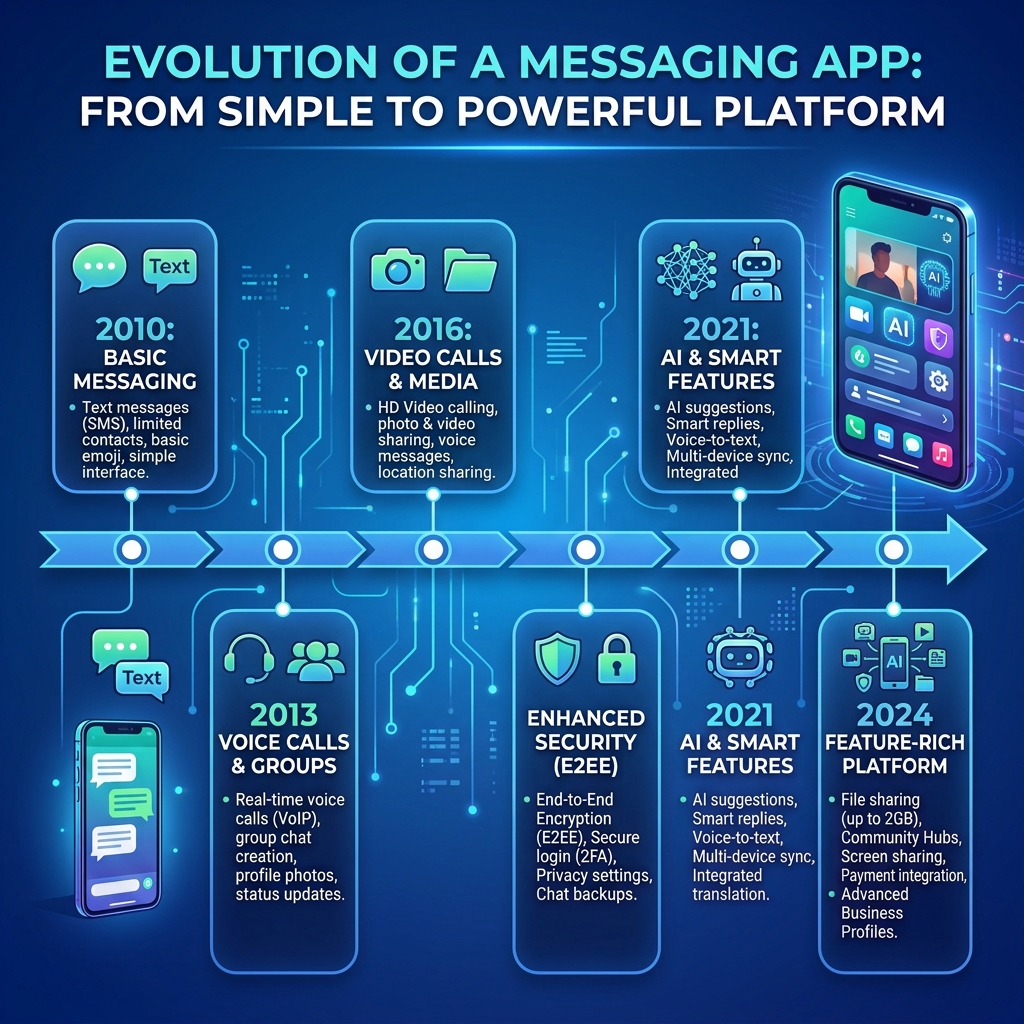
Think back to your favorite messaging app ten years ago.
It probably lets you send text messages.
That was enough.
Today, we expect so much more.
Voice notes.
Video calls.
File sharing.
Screen sharing.
Message reactions.
Communities.
AI assistants.
End-to-end encryption.
The expectations keep growing.
And every new feature means more design, more development, more testing, and eventually…
…another update.
Software isn’t just being fixed.
It’s constantly adapting to what users now expect.
Sometimes Updates Fix Problems You Never Even Notice
Not every update introduces exciting new features.
Many happen quietly.
A security vulnerability gets patched.
Battery usage is reduced.
Performance improves.
Loading times become faster.
Accessibility features are added.
Behind the scenes, developers are constantly solving problems most users never knew existed.
It’s a bit like maintaining an elevator in a busy office building.
If everything works perfectly, nobody notices.
But that smooth experience only exists because people are working behind the scenes to keep it that way.
Software Learns From Its Users
One of the biggest advantages software has over physical products is that it can learn.
Not by reading minds.
But by understanding how people actually use it.
Maybe developers discover that almost nobody uses a particular feature.
Maybe they notice everyone struggles to find an important button.
Maybe customers repeatedly request the same improvement.
That feedback shapes future versions of the product.
In many ways, users become co-creators.
Every suggestion, review, support ticket, and bug report helps influence what comes next.
Behind Every Update Is a Team You Never See
When you tap “Update,” it looks simple.
But behind that one button is an entire team working together.
Software engineers writing new code.
Designers improving the user experience.
Product managers deciding what gets built next.
Quality assurance teams are testing every change.
Cybersecurity specialists are protecting user data.
Customer support teams sharing feedback from real users.
One update can represent weeks—or even months—of collaboration.
What takes you thirty seconds to download may have taken hundreds of people thousands of hours to create

The Best Software Never Stops Improving
Think about some of the apps you use every day.
They look very different from how they did five years ago.
Not because the original versions failed.
But because they kept improving.
The most successful software isn’t the software that launches perfectly.
It’s the software that continues listening, adapting, and evolving long after launch day.
That’s what keeps it useful.
That’s what keeps people coming back.
Final Thoughts: Every Update Tells a Story
The next time your phone asks you to install an update, remember this:
That notification isn’t just about downloading a newer version of an app.
It’s the result of countless conversations between technology and the people who use it.
Every bug fixed.
Every security improvement.
Every performance boost.
Every new feature.
Every design change.
They’re all signs that the software is still growing.
Unlike a finished book or a completed building, software is alive in a unique way.
It evolves with technology.
It responds to people.
It adapts to the world around it.
And perhaps that’s what makes software so fascinating.
The day it’s released isn’t the day the work ends.
It’s the day the real journey begins.

