


You open your banking app.
You check your balance. You transfer money. A few seconds later, you receive a notification confirming that the transaction was successful.
It feels simple.
But behind that simple tap on your screen, several different systems have just communicated with one another.
Your phone spoke to the bank’s application. The application spoke to a server. The server checked your account information. Another system may have verified the transaction. A payment service may have processed it. Your bank then sent the result back to your phone.
You didn’t see any of this happening.
And that’s the point.
Modern technology depends on millions of conversations between systems that users never see. One application needs information from another. A website needs to process a payment. A mobile app needs to retrieve your profile. A company needs to connect its customer database to its accounting software.
These systems need a way to communicate.
That invisible language is often an API.
Imagine a Restaurant Where the Customer Never Enters the Kitchen
Imagine you’re sitting in a restaurant.
You look at the menu and decide what you want. You don’t walk into the kitchen, find the chef, explain your order, inspect the ingredients, and carry the finished meal back yourself.
Instead, you tell a waiter.
The waiter takes your request to the kitchen.
The kitchen prepares the food.
The waiter brings it back to you.
An API works in a surprisingly similar way.
The application you’re using is for the customer.
The backend system containing the information or functionality is the kitchen.
The API is the waiter carrying requests and responses between them.
When your weather app asks a weather service for today’s temperature, the app doesn’t need to understand how the weather service collects its data, where its servers are located, or how its database is structured.
It simply requests the API.
The service processes the request and sends back the information.
The app then displays it to you.
You see:
28°C. Partly cloudy.
What you don’t see is the conversation that made those words possible.
App: “What’s the current weather in Lagos?”
Weather service: “28°C, partly cloudy.”
That’s an API at work.

So, What Exactly Is an API?
API stands for Application Programming Interface.
The name may sound complicated, but the basic idea is straightforward.
An API is a defined way for one piece of software to request information or perform an action from another piece of software.
Think about the apps you use every day.
A shopping app may need a payment service.
A travel website may need a map service.
A fitness application may connect to a smartwatch.
A business dashboard may pull information from a company’s customer relationship management system.
A social media application may allow you to sign in using another platform.
All of these situations require software systems to communicate.
The API provides the rules for that communication.
It tells the systems things like:
- What information can be requested
- How the request should be structured
- Where the request should be sent
- What information will be returned
- What actions the system is allowed to perform
The important thing is that the two systems don’t need to know everything about each other.
They need to understand the agreed-upon rules.
And that’s what makes APIs so powerful.
The Magic Is in What You Don’t Have to Know
Consider a simple example.
You use an e-commerce website and click “Pay Now.”
The website doesn’t necessarily process your card payment itself.
Instead, it may communicate with a payment provider through an API.
The website sends something similar to:
“Please process this payment for this amount.”
The payment service handles the complicated parts.
It may communicate with banks, payment networks, fraud detection systems, authentication services, and other infrastructure.
Eventually, it sends a response.
Payment successful.
The shopping website can then update your order.
Notice something important here.
The shopping website doesn’t need to build an entire global payment network from scratch.
It doesn’t need to become a bank.
It simply connects to an existing service.
This is one of the reasons APIs have become such an important part of modern software development.
They allow companies to build on top of existing capabilities.
Instead of rebuilding everything, developers can connect systems.
APIs Are the Connectors Behind the Digital Economy
Imagine trying to build a modern application without APIs.
Want to accept payments?
Build your own payment infrastructure.
Want to send emails?
Build your own email delivery system.
Want to display maps?
Build your own mapping database.
Want users to upload files?
Build your own storage infrastructure.
Want to send text messages?
Build your own telecommunications system.
Want to authenticate users?
Build your own identity system.
It would be enormously expensive and time-consuming.
APIs changed the equation.
A developer can now take existing services and connect them to a new product.
This means a small team can create something surprisingly sophisticated.
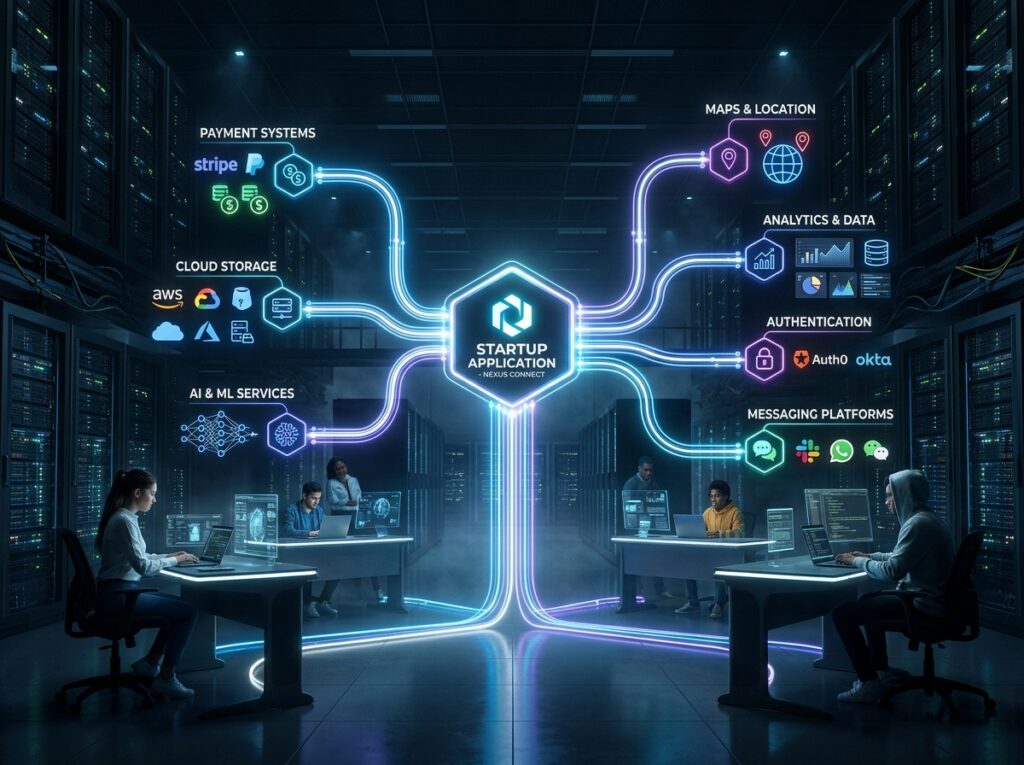
A startup with ten engineers can build an application that depends on dozens of external services.
One API might handle payments.
Another might handle authentication.
Another might provide maps.
Another might send notifications.
Another might provide analytics.
Another might connect the application to an AI model.
The final product feels like one seamless experience.
Underneath it, however, may be dozens of independent systems communicating constantly.
Your Mobile App Is Probably Having Conversations You Never See
Let’s take something as ordinary as ordering food through an app.
You open the application.
You search for restaurants.
You see menus.
You place an order.
You pay.
You track the delivery.
You receive notifications.
From your perspective, it’s one application.
From a technical perspective, it may be a collection of different systems working together.
The application might use one API to retrieve restaurant information.
Another API could process your payment.
Another could calculate delivery locations.
Another could provide maps and navigation.
Another could send push notifications.
Another system might manage your account.
The application is essentially acting as the visible front door to a much larger digital building.
APIs are the doors between the rooms.
Without those doors, the rooms would remain isolated.
There Isn’t Just One Kind of API
You may hear developers talk about REST APIs, GraphQL, SOAP, webhooks, and other approaches.
You don’t necessarily need to become a software engineer to understand the differences.
The broader idea is that developers have created different ways for systems to communicate depending on the problem they’re solving.
REST APIs, for example, are extremely common for web applications.
A system might expose an endpoint such as:
/users/123
A developer can request to retrieve information about user 123.
Another endpoint might allow an application to create an order, retrieve products, or update account information.
GraphQL takes a different approach by allowing applications to specify more precisely what data they need.
Webhooks work differently again.
Instead of constantly asking another system whether something has happened, a system can essentially say:
“When this event happens, tell me.”
For example, a payment system might notify an online store when a customer’s payment has been completed.
The technology differs.
The fundamental idea remains the same:
Systems need agreed ways to communicate.
APIs Are Also About Trust
There is another side of APIs that users rarely think about.
Communication between systems isn’t automatically safe.
Imagine giving a stranger unrestricted access to your house simply because they knocked on the door.
That’s obviously a bad idea.
APIs need similar protection.
Systems need to determine:
Who is making this request?
What are they allowed to access?
How often can they make requests?
What happens if they try to access something they shouldn’t?
This is where authentication, authorization, API keys, tokens, rate limiting, encryption, and other security mechanisms become important.
For example, a banking application shouldn’t be able to simply ask a bank’s system:
“Give me the account details of every customer.”
The API should enforce rules around what the requesting application or user is permitted to access.
This is why API design and API security are such important parts of modern technology.
The conversation between systems needs boundaries.
What Happens When an API Fails?
Here’s where things get interesting.
Have you ever tried using an application and received a message like:
“Something went wrong. Please try again.”
Sometimes, the problem isn’t the application itself.
One of the services it depends on may be unavailable.
Imagine an online store that relies on an external payment service.
The store is working perfectly.
The products load.
The website looks normal.
But the payment provider’s API is temporarily unavailable.
Suddenly, customers can’t complete purchases.
This reveals something important about modern software:
Connected systems create both opportunities and dependencies.
The more services an application connects to, the more powerful it can become.
But it also means the application depends on those services behaving correctly.
This is why software engineers spend significant time thinking about failures, backups, monitoring, retries, timeouts, and alternative systems.
The goal isn’t simply to build systems that work.
It’s to build systems that continue working when something inevitably goes wrong.
APIs Changed Who Can Build Technology
Perhaps the most interesting consequence of APIs isn’t technical.
It’s economic.
APIs have lowered the barrier to building sophisticated digital products.
A developer doesn’t need to own every piece of infrastructure required for an application.
They can assemble capabilities.
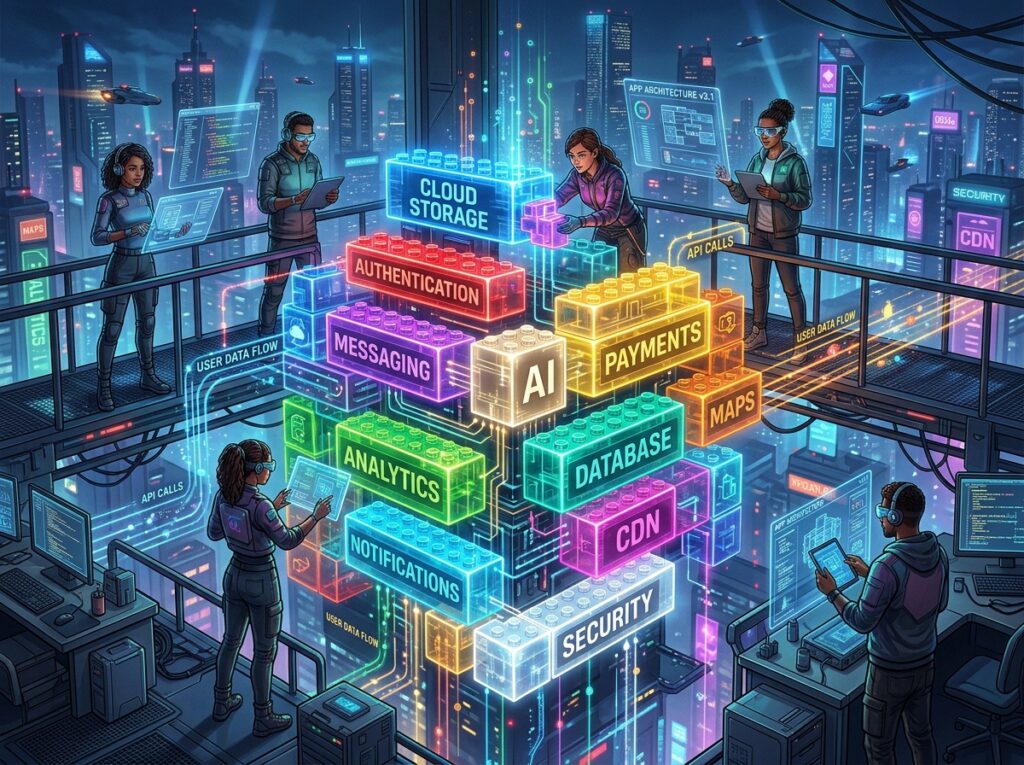
Think about building with LEGO.
You don’t manufacture every brick yourself.
You start with pieces that already exist and combine them into something new.
APIs provide similar building blocks for software.
A developer can take authentication from one service, payments from another, cloud storage from another, mapping from another, analytics from another, and combine them into a product that didn’t exist before.
This is one reason modern software development can move so quickly.
Developers aren’t always starting from zero.
They’re building on top of an enormous ecosystem of existing technology.
And APIs Are Becoming Even More Important With AI
The rise of AI is making APIs even more significant.
Consider an application that uses an AI model.
The application may not actually contain the AI model itself.
Instead, it sends a request to an AI service through an API.
The application might provide:
“Summarize this document.”
The AI service processes the request and returns a response.
The application then displays the result.
But the possibilities go much further.
An AI-powered business application could connect an AI model to:
- Customer databases
- Company documents
- Payment systems
- Inventory platforms
- Communication tools
- Analytics systems
- Internal business software
The AI becomes more useful because it can interact with other systems.
This is where APIs become particularly interesting.
The future of software isn’t simply about individual applications becoming smarter.
It’s increasingly about systems becoming connected enough to work together
The Bigger Picture: Software Is Becoming an Ecosystem
We often talk about applications as if they are independent products.
They’re not.
Modern software is more like an ecosystem.
Your banking application depends on infrastructure.
Your infrastructure depends on networks.
Your network communicates with other systems.
Your payment system communicates with banks.
Your e-commerce platform communicates with logistics providers.
Your AI application communicates with models and databases.
All of these systems interact through defined interfaces.
APIs make those interactions possible.
And that means APIs are not just a developer concern.
They influence how businesses operate, how products are built, how companies collaborate, and how quickly new ideas can reach customers.
A company that knows how to connect existing technologies effectively can sometimes build what would have required an enormous engineering team a decade ago.
That’s a significant shift.
What This Means for People Learning Technology
If you’re learning technology today, understanding APIs is worth your time even if you don’t plan to become a backend developer.
Why?
Because APIs sit at the intersection of many technology careers.
Software engineers use them.
DevOps engineers deploy and monitor the systems behind them.
Data analysts may consume APIs to retrieve datasets.
Cybersecurity professionals protect them.
Product managers decide how products should interact with other systems.
Cloud engineers build infrastructure that supports them.
Even business professionals increasingly encounter APIs when evaluating software integrations and digital products.
Understanding APIs gives you a better mental model of how the digital world actually works.
Instead of seeing an application as one mysterious piece of software, you begin to see the systems behind it.
You start asking better questions.
Where does this data come from?
What system processes this request?
What happens when that service goes down?
How does this application communicate with another platform?
Those questions are valuable far beyond software development.
Final Thoughts: The Conversations Behind the Screen
The next time you open an app, remember that you’re probably not interacting with one system.
You’re interacting with a network of systems.
Your screen may show one button.
Behind that button could be a chain of requests moving between databases, servers, payment platforms, authentication systems, cloud services, and external applications.
Most of those conversations happen in milliseconds.
You don’t see them.
You don’t hear them.
You simply see the result.
That is the beauty of APIs.
They allow technology to communicate without forcing users to understand the conversation happening underneath.
And as more of the world becomes connected, those invisible conversations will become even more important.
The digital world may look like millions of separate applications.
Underneath, they’re often speaking to one another.
APIs are the language that makes that conversation possible.

