


There was a time when technology had to wait for you to ask for something.
You searched for a song, and the computer found it.
You typed a question, and the search engine gave you an answer.
You opened a shopping website, and it showed you products.
Today, things work differently.
Your phone can suggest where you’re probably going next.
Your streaming app can recommend what you might enjoy tonight.
Your bank can recognize that a transaction doesn’t look like something you normally do.
Your email can separate important messages from the ones you probably don’t care about.
Your social media feed can become remarkably good at showing you things you didn’t even realize you were interested in.
And sometimes, it feels almost magical.
Other times, it feels a little uncomfortable.
Because underneath all that convenience is a simple reality:
Technology has to know something about you before it can personalize your experience.
The more a system learns about your habits, preferences, location, behavior, and interests, the better it can predict what you might want.
But the better technology gets at knowing us, the more important another question becomes:
How much should it know?
That is the quiet battle happening underneath much of the technology we use every day.
On one side is personalization—the promise that technology can become more useful, relevant, and convenient by understanding us better.
On the other hand, privacy is the expectation that we should still have some control over what technology knows about us and what happens to that information.
Neither side is completely wrong.
And that’s what makes the conversation complicated.
Why Does Technology Need to Know You at All?
Think about the first time you use a new streaming platform.
It knows almost nothing about you.
So it has to guess.
You might see a random collection of movies, shows, or music.
But after you’ve used the service for a while, things change.
You watch several documentaries.
You skip romantic comedies.
You finish three crime series.
You listen to jazz on Sunday mornings.
Eventually, the platform starts making better recommendations.
It has learned something about you.
That’s personalization.
The same principle appears everywhere.
A navigation application learns your common destinations.
An online store remembers the products you’ve viewed.
A news application learns the topics you tend to read.
A music service learns which artists you repeatedly listen to.
A fitness application learns your activity patterns.
None of this is necessarily sinister.
In many cases, it’s exactly why the technology is useful.
The problem begins when we stop thinking about what the technology needs to know and start accepting the idea that it should simply know everything.

Personalization Is the Reason Your Apps Feel So Convenient
Imagine using a music app that knew absolutely nothing about your listening habits.
Every time you opened it, you’d have to search manually for something to play.
It wouldn’t know your favorite artists.
It wouldn’t know that you tend to listen to certain genres while working.
It couldn’t create a playlist based on what you’ve enjoyed before.
The experience would be much less convenient.
Personalization solves this problem.
Instead of treating every user exactly the same, technology can adapt.
That’s why personalization has become such a valuable part of digital products.
It can help a customer find what they’re looking for faster.
It can help a business understand what its customers need.
It can help an application remove unnecessary information and highlight what matters.
It can even improve safety.
Your bank, for example, may know that you normally make transactions from one location and suddenly notice a purchase from somewhere completely unexpected.
The system can flag it.
In that situation, the technology knowing something about you is useful.
It protects you.
So the question isn’t really:
“Is personalization bad?”
It isn’t.
The more interesting question is:
“Where should personalization stop?”
The Strange Thing About Your Digital Footprint
Most people don’t sit down one morning and decide to create a detailed digital profile of themselves.
It happens gradually.
You create an account.
You download an application.
You accept a permission request.
You search for something.
You click a link.
You watch a video.
You buy something online.
You enable location services.
You interact with a recommendation.
You repeat the process tomorrow.
And the next day.
And the next year.
Each individual action feels insignificant.
But technology is very good at connecting small pieces of information.
One search doesn’t tell a company much.
Hundreds of searches can reveal interests.
One location doesn’t reveal much.
Months of location patterns can reveal routines.
One purchase says little.
Years of purchasing behavior can reveal preferences.
This is the power of data.
It isn’t always the individual piece of information that matters.
Sometimes it’s the pattern created by thousands of small pieces.
You Don’t Have to Be Famous to Be Interesting
There’s a common misconception about privacy:
“Why would anyone care about my data? I’m not important.”
But personalization doesn’t require you to be important.
It requires you to be predictable.
A technology company may not care about your identity in the traditional sense.
It may care about what your behavior suggests.
If thousands of people who behave like you tend to purchase a particular product, respond to a particular advertisement, or enjoy a particular type of content, a system can use that pattern to make predictions about you.
The system doesn’t necessarily need to know your entire life story.
It just needs enough information to make a useful prediction.
And modern algorithms are becoming remarkably good at this.
That’s what makes personal data so valuable.
It’s not just a record of what you’ve done. It can become a tool for predicting what you might do next.
When Convenience Starts Feeling Creepy
There’s a moment many people have experienced.
You talk about something.
You search for it later.
Suddenly, related content begins appearing everywhere.
Or you look at a product once and suddenly see it repeatedly across different websites.
Your first reaction might be:
“They’re listening to me.”
Sometimes that’s not what happened at all.
The system may have simply connected several pieces of information.
Maybe you searched for the product.
Maybe you visited related websites.
Maybe you clicked an advertisement.
Maybe your browsing behavior resembled that of thousands of people who were interested in the same thing.
The result can still feel strange.
And that’s an important part of the privacy conversation.
Privacy isn’t only about whether something technically happened.
It’s also about whether people understand what is happening to their information.
When technology becomes so good at predicting us that it feels like mind-reading, transparency becomes increasingly important.
Privacy Isn’t About Having Something to Hide
One of the most common arguments in privacy conversations is:
“I have nothing to hide.”
But privacy isn’t really about hiding wrongdoing.
Think about your home.
You probably don’t want strangers walking through every room, opening drawers, reading your messages, and watching your daily routines.
That doesn’t mean you’re hiding anything.
It means you understand that some parts of your life belong under your control.
Digital privacy works in much the same way.
You may have nothing to hide and still want to decide:
Who gets your location?
Who can access your photos?
Which companies can track your activity?
How long should your information be stored?
Can your information be used for purposes you didn’t expect?
Can you change your mind later?
These are questions of control, not secrecy.
The Real Trade-Off Is More Complicated Than “Free vs. Private”
We often hear that people exchange their data for free services.
But the reality is more complicated.
Sometimes you’re knowingly giving information in exchange for something useful.
You give a navigation app your location because you want accurate directions.
You give a food delivery platform your address because you want your food delivered.
You give a bank information about your transactions because you need banking services.
That’s a reasonable exchange.
The difficulty is when the user doesn’t clearly understand the terms of that exchange.
If an application asks for permission to access something unrelated to the service it provides, that’s different.
If information collected for one purpose is later used for another purpose, that’s different.
If the user has no practical way to understand or control what happens next, that’s different.
The issue isn’t simply data collection.
It’s data collection without meaningful understanding or control.
And Then Algorithms Decide What You See
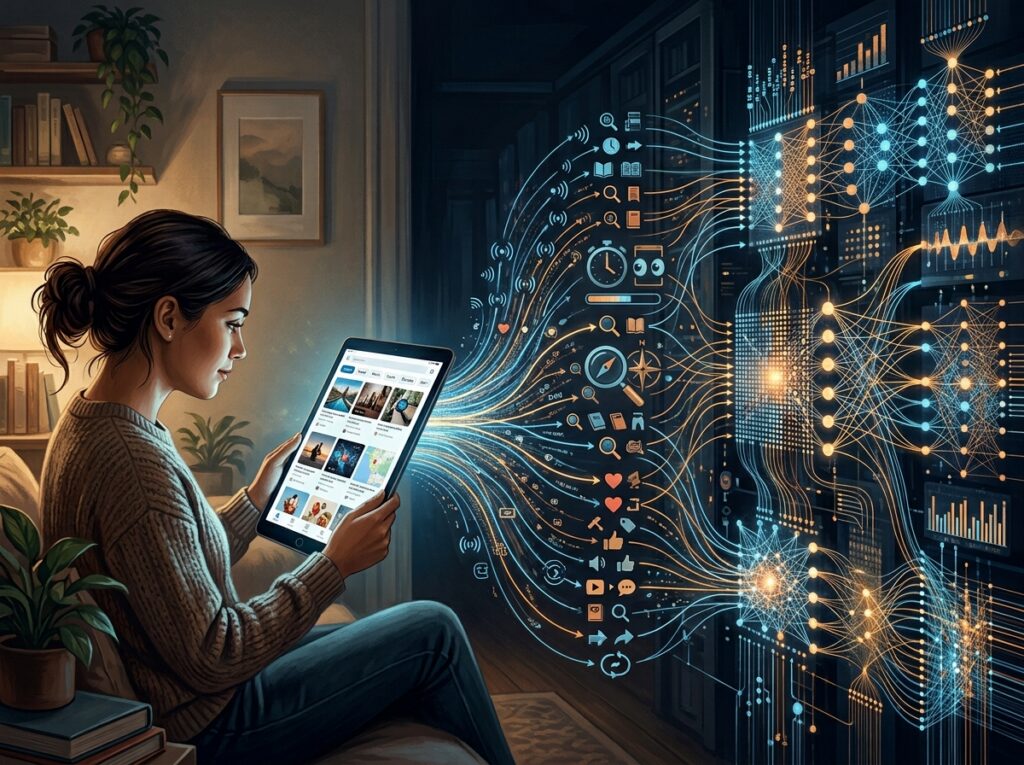
Personalization becomes even more powerful when recommendation algorithms enter the picture.
Consider your social media feed.
There is far more content available than you could possibly consume.
So the platform has to decide what appears in front of you.
It studies signals.
What do you click?
What do you watch?
What do you ignore?
What do you share?
What do you spend time reading?
What makes you return?
Then it uses those signals to predict what you might want to see next.
This can make the experience incredibly relevant.
But it also creates a deeper question.
If an algorithm gets better at predicting what keeps your attention, is it necessarily getting better at serving your interests?
Those two things aren’t always the same.
Something can be extremely engaging without being particularly useful.
And something can be useful without being especially engaging.
That tension is becoming increasingly important as algorithms influence more of what we see online.
The Privacy Settings We Rarely Read
There’s another uncomfortable reality.
Most digital services give us privacy controls.
But many of us don’t understand them.
Open almost any application’s settings and you’ll find options about:
Location.
Cookies.
Tracking.
Advertising.
Analytics.
Activity history.
Personalized recommendations.
Third-party access.
Data sharing.
Permissions.
The controls are there.
But having a control and understanding a control are two different things.
If someone has to understand technical terminology before they can make an informed decision about their own information, the system isn’t exactly user-friendly.
This is why privacy isn’t just a cybersecurity problem.
It’s also a design problem.
Technology companies have to think about how clearly they communicate data practices to ordinary people.
A privacy policy that nobody reads may technically provide information.
But meaningful privacy requires people to actually understand their choices.
Privacy Is Becoming a Technology Problem, Too
For years, privacy was often treated as something handled by lawyers and compliance teams.
But that’s changing.
The way a product is designed can determine how much information it collects.
The way a database is structured can determine who can access that information.
The way an API is secured can determine what data another application can retrieve.
The way cloud infrastructure is configured can determine whether sensitive information remains protected.
The way an AI model is trained can raise questions about what information it has learned from.
Privacy is therefore becoming part of the work of developers, DevOps engineers, cloud professionals, cybersecurity specialists, data analysts, product managers, and business leaders.
The question isn’t simply:
“Can we collect this data?”
Technology professionals increasingly have to ask:
“Do we need to collect it?”
And:
“What happens if we get it wrong?”
The Future May Be About Better Personalization, Not More Data
Here’s an interesting possibility.
Perhaps the future of personalization doesn’t require technology to collect everything about us.
Better technology could mean systems that can personalize experiences while minimizing the amount of personal information they retain.
Some information could be processed directly on a user’s device.
Some data could be anonymized.
Some information could be deleted once it is no longer needed.
Users could have clearer controls over what is collected.
Companies could design products around collecting the minimum information necessary rather than treating every available piece of data as an opportunity.
That would change the relationship between personalization and privacy.
Instead of asking:
“How much information can we collect?”
we might start asking:
“How little information can we use while still delivering a great experience?”
That’s a much more interesting technological challenge.
The People Building Technology Will Have to Make These Decisions
This debate isn’t going to disappear.
AI will make personalization more powerful.
Connected devices will generate more data.
Businesses will find new ways to understand customers.
Recommendation systems will become more sophisticated.
And technology will become increasingly capable of predicting our behavior.
That means the people building these systems will have choices to make.
They will have to decide what information to collect.
How long to keep it.
Who can access it.
How transparent to be.
What happens when a user says no.
And what happens when the technology can technically do something that it probably shouldn’t do.
These aren’t questions that can be answered by algorithms alone.
They require judgment.
Final Thoughts: How Much Should Technology Know About You?
Personalization has made technology feel remarkably intelligent.
It remembers our preferences.
Predicts our needs.
Filters information.
Recommends content.
Detects unusual activity.
Saves us time.
And, in many cases, genuinely improves our lives.
But there is a trade-off hiding underneath that convenience.
For technology to become more personal, it usually needs to learn more about us.
The challenge is making sure that convenience doesn’t quietly become a loss of control.
We don’t need technology to know nothing about us.
And we probably don’t want technology to know everything.
The real goal should be something in between:
Technology that knows enough to be useful, but not so much that we lose control of ourselves.
Because the future of privacy may not be about disappearing from the digital world.
It may be about having a meaningful say in what the digital world is allowed to know about us.

