


A robot can be incredibly impressive when everything around it is predictable.
Put it in a factory.
Give it the same task.
Keep the objects in the same place.
Control the lighting.
Control the environment.
Tell it exactly what to do.
It can repeat that task thousands of times without getting tired.
But now take that same robot outside.
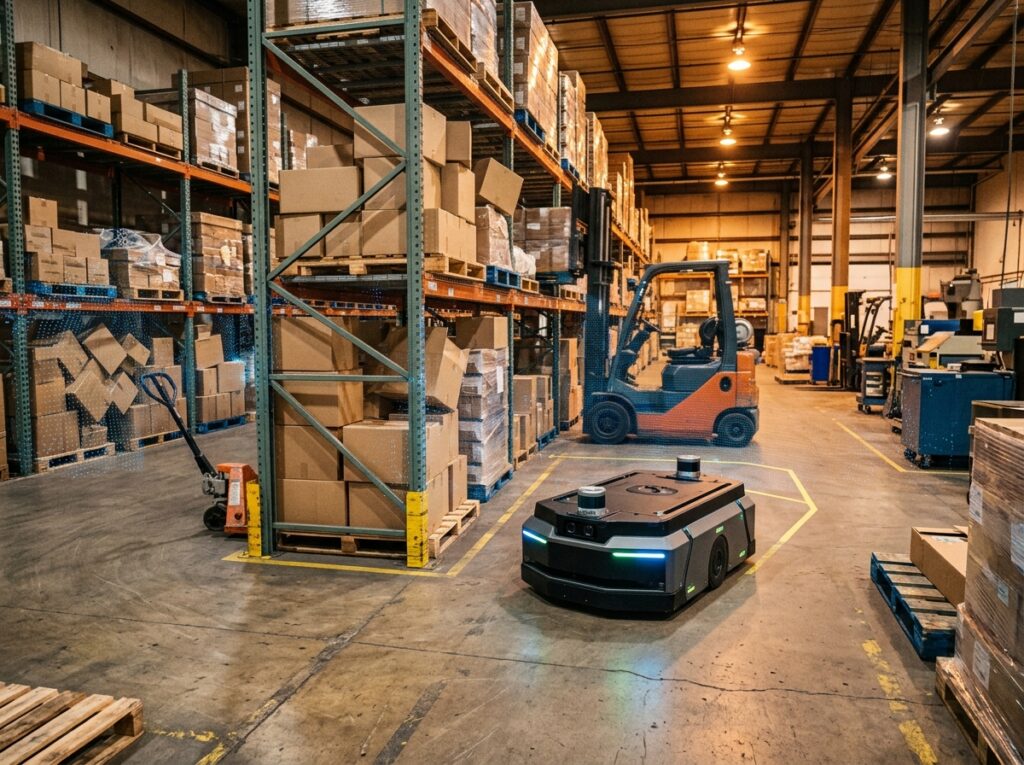
Put it in a warehouse where boxes are stacked differently every morning.
Give it an object it has never seen before.
Place a person in its path.
Move something slightly out of position.
Change the lighting.
Add a wet floor.
Suddenly, the problem becomes much harder.
This is one of the biggest challenges in robotics today.
Making robots useful in the real world is very different from making robots work in a controlled environment.
And as robots move beyond carefully designed factories and into warehouses, hospitals, farms, homes, construction sites, and public spaces, they are being forced to learn something humans have been doing all their lives:
How to deal with the unexpected.
A Factory Is Easier Than a Kitchen
Imagine teaching someone how to pick up a bottle.
In a factory, you could place the bottle in exactly the same position every time.
You could use the same bottle.
The same table.
The same lighting.
The same distance.
The person would quickly become very good at the task.
Now move that person into a kitchen.
There are bottles of different shapes.
Some are empty.
Some are full.
One might be behind a plate.
Another might be partially covered by a towel.
The surface could be wet.
Someone could suddenly walk past.
The object could slip.
The difference is enormous.
The real world is full of variation.
Humans handle that variation almost automatically.
Robots have to learn how to handle it.
Robots Are Good at Repetition
Traditional industrial robots have already transformed manufacturing.
They weld.
Paint.
Assemble.
Move heavy components.
Package products.
Perform highly repetitive tasks.
And they can do these jobs with remarkable consistency.
But these systems usually operate within environments designed specifically for them.
The factory itself becomes part of the solution.
Objects are positioned predictably.
Machines communicate with one another.
Work areas are carefully organized.
Safety zones are established.
The robot knows what to expect.
That’s why a robot can perform the same movement thousands of times without needing to “understand” the world in the same way a human does.
But increasingly, companies want robots to operate in environments that weren’t designed around robots.
That’s where things get interesting.
The Real World Doesn’t Follow Instructions
A warehouse worker might be asked to pick up a package.
It sounds simple.
But the worker has to answer dozens of questions almost instantly.
Which package?
Where exactly is it?
Can I reach it?
Is something blocking it?
How heavy is it?
Is it fragile?
Where should I put it?
Is someone walking behind me?
A human doesn’t consciously calculate all of these things.
We simply observe and react.
For robots, each of those decisions can become a technical problem involving sensors, computer vision, machine learning, motion planning, and control systems.
The robot has to turn information from the physical world into an action.
See something.
Interpret it.
Decide what to do.
Move.
Observe the result.
Adjust.
And continue.
That is far more complicated than simply following a pre-programmed sequence.
Seeing Is Not the Same as Understanding
A camera can show a robot what’s in front of it.
But seeing an object and understanding what to do with it are different problems.
Imagine a robot sees a cup.
It needs to determine:
Is it a cup?
Where exactly is it?
Can I pick it up?
Which part should I grab?
Is it empty?
Is it fragile?
Is there enough space to move it?
What happens if I drop it?
Humans are extremely good at making these judgments because we’ve spent our entire lives interacting with physical objects.
A child learns that a glass can break.
A person learns that a wet floor can be slippery.
A warehouse worker learns that a badly stacked box might fall.
Robots need systems that allow them to build similar understanding from sensors, data, demonstrations, and experience.
This is one reason AI has become so important to modern robotics.
Robots Need More Than a Brain
It’s tempting to think of a robot as an AI system with arms and legs.
But robotics is a combination of several different technologies.
There is perception: understanding what’s around the robot.
There is AI and machine learning: helping the system interpret information and make decisions.
There is motion planning: figuring out how to move safely.
There are sensors that detect objects, distance, force, temperature, and movement.
There are control systems that translate decisions into physical movement.
And there is the physical hardware itself.
Motors.
Joints.
Cameras.
Grippers.
Wheels.
Batteries.
Processors.
A robot can have an impressive AI model and still fail because its physical hardware cannot execute the required movement.
The intelligence and the body have to work together.
Learning From Experience
One of the most interesting changes in robotics is the growing use of learning rather than purely explicit programming.
Instead of telling a robot exactly how to perform every possible situation, engineers can increasingly train systems using demonstrations, simulations, and large amounts of data.
Think about learning to catch a ball.
You weren’t given a mathematical formula for every possible trajectory.
You practiced.
You watched.
You adjusted.
You made mistakes.
Eventually, your brain became better at predicting where the ball would be.
Robotics researchers are exploring similar ideas.
A robot can experience many different scenarios in simulation or through real-world training and gradually improve its ability to perform tasks.
The goal is not to program every possible situation.
That would be impossible.
The goal is to build systems that can generalize.
Simulation Gives Robots Somewhere to Practice
Here’s where another technology becomes important.
Before putting a robot into a warehouse, engineers can create virtual environments where the robot can practice.
It can encounter thousands of different scenarios.
Boxes in different positions.
People moving unpredictably.
Obstacles appearing suddenly.
Different lighting.
Different surfaces.
The robot can make mistakes without damaging expensive equipment.
This is one reason simulation has become so important to robotics development.
The physical world is expensive to experiment with.
The virtual world is much easier to reset.
And when the two worlds are connected properly, robots can use simulated experience to improve their behavior in reality.
Why Humanoid Robots Are So Interesting
There’s a reason humanoid robots attract so much attention.
A human-shaped robot can potentially operate in environments already designed for humans.
Doors are designed around human proportions.
Stairs.
Shelves.
Tools.
Workstations.
Vehicles.
Homes.
Factories.
If the robot can navigate these environments effectively, companies don’t necessarily have to redesign everything around the machine.
But being shaped like a human doesn’t make a robot behave like one.
Walking is difficult.
Balance is difficult.
Manipulating objects is difficult.
Understanding human movement is difficult.
And safely working around people is even more difficult.
The human body may make these actions look effortless.
From an engineering perspective, they are extraordinary.
The Hardest Part May Be Trust
Imagine working beside a robot.
You don’t want to constantly think:
“Is this machine going to hit me?”
You need to trust it.
You need to know that it will stop when you step into its path.
You need to know that it won’t grab something it shouldn’t.
You need to know what happens if a sensor fails.
This makes safety a fundamental part of robotics.
A robot working around humans needs more than intelligence.
It needs predictable behavior.
It needs safeguards.
It needs monitoring.
It needs emergency controls.
And organizations need procedures for what happens when the system behaves unexpectedly.
The better robots become at working alongside people, the more important this relationship becomes.
Where Will These Robots Actually Work?
The answer is likely to be broader than factories.
Warehouses are an obvious area.
Robots can move goods, sort packages, and perform repetitive tasks.
Healthcare could benefit from robots assisting with logistics, supplies, and certain physical tasks.
Agriculture can use machines for monitoring crops, harvesting, and navigating fields.
Construction robots could operate in dangerous environments.
Hospitals could use robots to transport equipment and supplies.
Mining operations could use autonomous systems in hazardous areas.
And eventually, some robots may become useful in ordinary homes.
But the transition won’t happen overnight.
The real challenge isn’t demonstrating that a robot can perform a task once.
It’s proving that it can perform that task reliably, safely, and economically thousands of times.
The Jobs Conversation Is More Complicated Than “Robots Will Replace Everyone”
Robots will change jobs.
That’s almost certain.
But the effect won’t necessarily be as simple as one robot replacing one human.
A robot may remove certain repetitive tasks.
It may allow workers to focus on supervision, maintenance, quality control, planning, customer interaction, or more complex work.
It will also create demand for people who build and maintain robotic systems.
Software engineers.
Robotics engineers.
Data professionals.
Cloud engineers.
Cybersecurity specialists.
Technicians.
AI specialists.
Operations professionals.
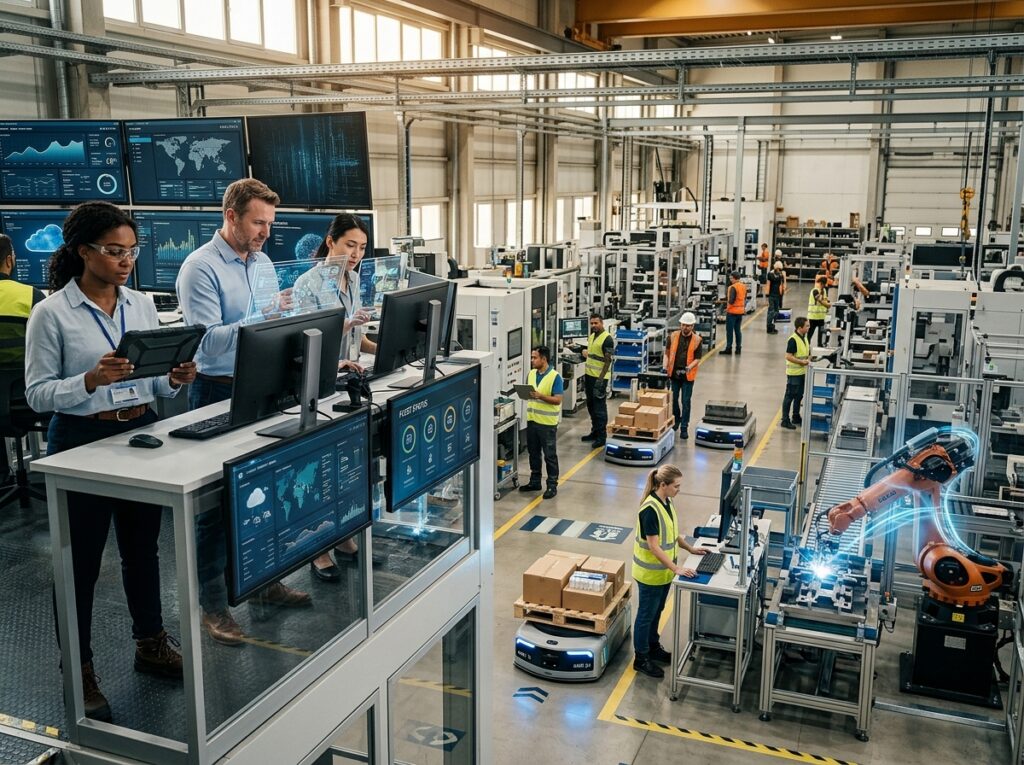
The more robots become connected systems, the more important software becomes.
A modern robot isn’t just a machine.
It’s increasingly a networked computing system that happens to have a body.
The Robot Revolution Is Really a Software Revolution Too
This may be the most important point.
A robot’s physical body matters.
But increasingly, its ability to operate in the world depends on software.
Software interprets sensor data.
Software plans movement.
Software manages communication.
Software monitors performance.
Software can receive updates.
Software can connect robots to cloud systems.
Software can collect data from thousands of machines.
And AI can help robots make decisions in environments that aren’t perfectly predictable.
This means the future of robotics won’t be built only by people who understand mechanical engineering.
It will also require people who understand software engineering, AI, data, cloud infrastructure, cybersecurity, and systems engineering.
The robot may be physical.
But much of its intelligence is digital.
Final Thoughts: Teaching Machines to Live in Our World
For decades, we built machines that worked in environments we carefully controlled.
Now we’re asking machines to enter ours.
And our world is messy.
People move unpredictably.
Objects break.
Weather changes.
Spaces become crowded.
Instructions are incomplete.
Things happen that nobody planned for.
That’s what makes real-world robotics so difficult.
The goal isn’t simply to build a machine that can move.
It’s to build one that can understand enough of its surroundings to act safely and usefully.
The most impressive robot may not be the one that performs the most complicated movement.
It may be the one that knows what to do when everything goes slightly wrong.
Because the real test of a robot isn’t whether it can follow instructions. It’s whether it can function when the real world refuses to follow them.

