


Imagine you’re about to build a factory worth millions of dollars.
Before the first machine is installed, you want to know:
Where should everything go?
Will the production line work efficiently?
What happens if one machine stops?
Where will workers move?
Can the equipment fit?
How much energy will the factory consume?
What happens when production increases?
Traditionally, answering some of these questions required building things physically and discovering problems along the way.
That can be expensive.
Very expensive.
But what if you could build the factory first without actually building it?
Not a drawing.
Not a basic 3D model.
A living digital representation that behaves like the real thing.
A virtual version that receives data from the physical system and can be used to test what might happen before making changes in the real world.
That’s the idea behind a digital twin.
And it is changing the way engineers, manufacturers, cities, and other organizations think about physical systems.
A Model Isn’t Necessarily a Digital Twin
Here’s an easy way to understand the difference.
Suppose an architect creates a 3D model of a building.
You can look at it from different angles.
You can see where the rooms are.
You can understand the structure.
That’s useful.
But a digital twin goes further.
It can represent how the real building behaves.
What happens to temperature throughout the day?
How much energy does the building consume?
Which systems are operating?
What happens when occupancy changes?
How does the HVAC system respond?
The digital twin can be connected to real-world data from sensors and systems.
Instead of simply representing what something looks like, it can help represent how it behaves.
That’s the important distinction.
Think of It as a Flight Simulator for Physical Systems
Pilots don’t learn to fly only by taking a real aircraft into the sky and experimenting.
They use simulators.
A simulator can reproduce many conditions without putting the aircraft—and the pilot—in actual danger.
Digital twins can provide a similar capability for physical systems.
Want to know what happens if production increases by 20%?
Test it virtually.
Want to see what happens if a machine stops working?
Simulate it.
Want to test a new layout?
Try it digitally.
Want to understand how a building will respond to changing conditions?
Model it.
The virtual environment becomes a place where organizations can experiment before committing to expensive physical changes.
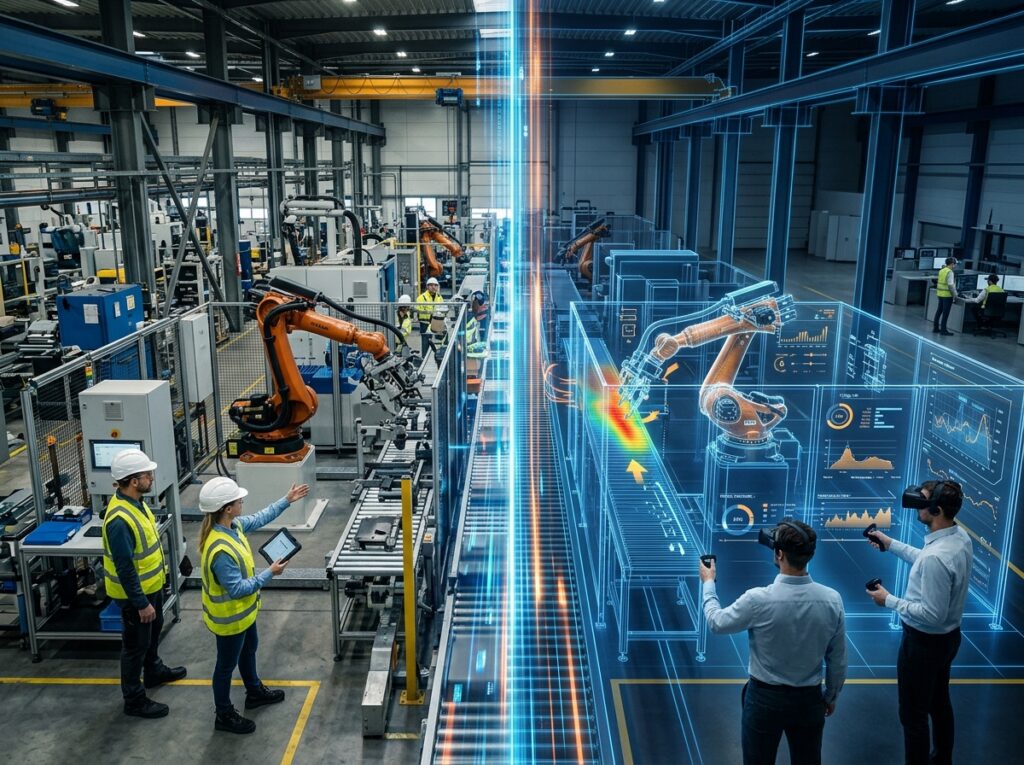
Where Does the Data Come From?
A digital twin becomes much more useful when it can receive information from the physical world.
That’s where sensors come in.
A machine might report its temperature.
A motor might report vibration.
A building might report energy consumption.
A vehicle might report location and speed.
A turbine might report pressure.
A production line might report output.
These signals can be collected and fed into digital systems.
The digital twin uses that information to maintain a representation of the physical object or environment.
It’s almost like having a digital version that is constantly receiving updates from its real-world counterpart.
The physical system changes.
The digital representation changes.
And that creates an opportunity to analyze what is happening.
Why Would Anyone Need a Digital Copy?
Because physical experimentation can be expensive.
Imagine a manufacturing company that wants to change its production line.
Moving machines is not like rearranging icons on a computer screen.
It takes time.
Workers.
Equipment.
Planning.
Downtime.
Money.
And if the new arrangement doesn’t work, the company may have to reverse the changes.
With a digital twin, engineers can test multiple layouts virtually.
They can compare scenarios.
They can identify bottlenecks.
They can estimate performance.
Then they can make the physical change with more information.
The digital environment doesn’t eliminate the need for real-world testing.
But it can reduce the number of expensive surprises.
Digital Twins Can Help Predict Problems
One of the most interesting applications is maintenance.
Imagine a large industrial machine.
It is operating normally.
But sensors begin detecting a subtle change in vibration.
A human operator might not immediately notice anything unusual.
A digital twin connected to historical data may be able to identify that the machine’s behavior is beginning to differ from its normal pattern.
That could allow engineers to investigate before the equipment fails.
This is sometimes described as predictive maintenance.
Instead of waiting for:
“The machine has broken.”
The goal becomes:
“The machine is showing signs that something may be wrong.”
That difference can save time and money.
In industries where equipment failure can stop an entire operation, the value can be enormous
A Digital Twin Can Be Bigger Than a Machine
The idea doesn’t stop at individual equipment.
You can have a digital twin of a machine.
A factory.
A building.
A vehicle.
A wind turbine.
An aircraft.
A power plant.
A logistics network.
And increasingly, parts of entire cities.
Imagine a city with a digital environment containing information about roads, buildings, traffic, energy use, public infrastructure, and other systems.
Planners could potentially test scenarios digitally.
What happens if a new road is introduced?
What happens if traffic patterns change?
What happens if population density increases?
What happens if energy demand rises?
The city still exists physically.
But the digital environment becomes a place for testing decisions before implementing them.
The Twin Doesn’t Predict the Future Perfectly
It’s important not to misunderstand the technology.
A digital twin isn’t a crystal ball.
The real world is too complicated for that.
If the data is incomplete, the model can be wrong.
If sensors fail, the digital representation can become inaccurate.
If assumptions are incorrect, simulations can produce misleading results.
And human behavior can be difficult to predict.
The value of a digital twin therefore depends heavily on the quality of the underlying data, models, sensors, and assumptions.
A beautiful digital model built on bad information is still a bad model.
This is where data engineering becomes extremely important
The Technology Stack Behind a Digital Twin
A digital twin isn’t a single piece of software.
It is usually an ecosystem.
Sensors collect information.
Devices transmit it.
Networks move it.
Cloud or edge systems process it.
Databases store it.
Analytics systems interpret it.
Simulation engines model behavior.
Visualization tools help humans understand what’s happening.
AI may detect patterns or make predictions.
And software connects everything together.
This is why digital twins sit at the intersection of several technology fields.
IoT.
Cloud computing.
Data engineering.
AI.
Software development.
Cybersecurity.
Analytics.
Systems engineering.
The “virtual copy” may be what people see.
But the infrastructure underneath is what makes it useful.
What Happens When the Physical and Digital Worlds Start Talking?
This is where things get particularly powerful.
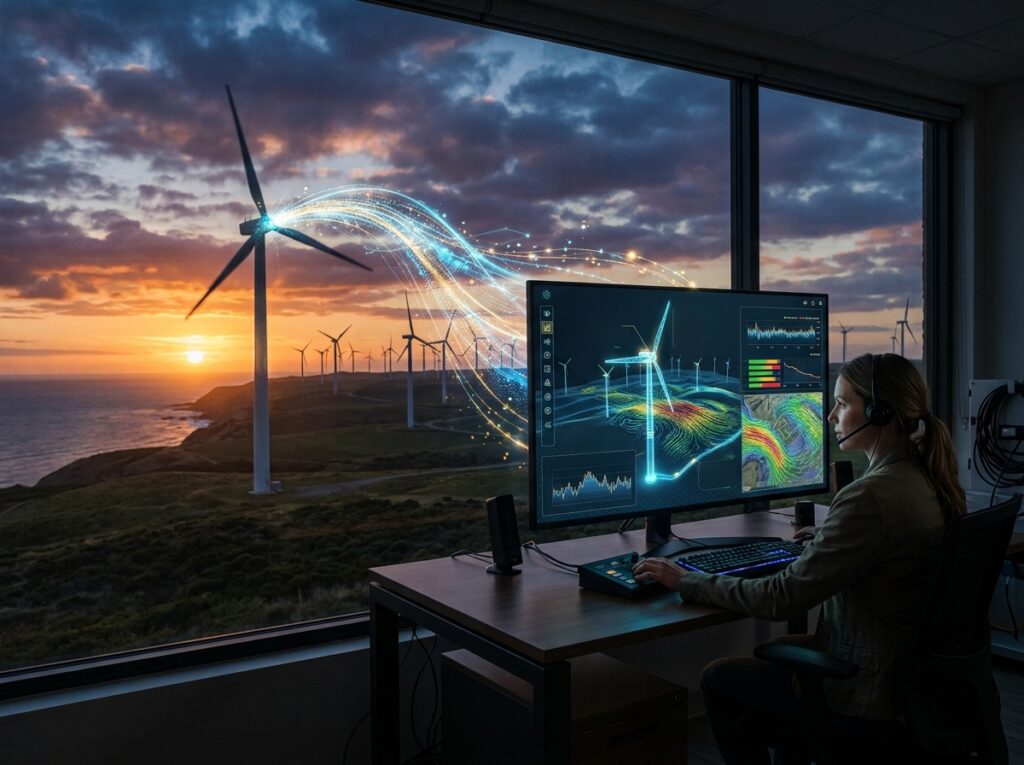
Imagine a wind turbine operating in the real world.
Sensors collect information about wind speed, temperature, vibration, and performance.
That information feeds into its digital twin.
The twin analyzes the data.
The system detects that the turbine is behaving differently from normal.
Engineers receive an alert.
They investigate.
A maintenance team is scheduled.
The physical machine is serviced before a major failure occurs.
The digital and physical systems are now working together.
The digital twin isn’t replacing the physical machine.
It’s helping people understand the physical machine better.
Digital Twins Could Change How Products Are Designed
There’s another possibility.
What if the digital twin exists before the physical product?
Engineers can create a virtual representation of a product.
Test how it behaves.
Modify the design.
Test again.
Analyze performance.
Then manufacture the physical version.
This could shorten development cycles.
It could reduce the number of physical prototypes required.
It could allow engineers to explore more possibilities before committing to production.
For complex products cars, aircraft, industrial equipment, medical devices—the ability to test digitally can be extremely valuable.
The physical product still matters.
But the digital version becomes part of the engineering process
And This Is Where AI Enters the Picture
AI can make digital twins more useful by helping analyze enormous amounts of data.
Imagine a factory generating millions of sensor readings.
Humans can’t manually examine every data point.
Machine learning systems can search for patterns.
They can compare current behavior with historical behavior.
They can identify anomalies.
They can help estimate what might happen next.
This doesn’t mean AI automatically understands the entire physical system.
But it can give engineers another tool for finding patterns that would otherwise be difficult to detect.
Digital twins provide the environment.
Sensors provide the information.
AI can help interpret it.
Humans still make the decisions.
The Cybersecurity Problem
There’s an important side to digital twins that isn’t as exciting.
If a digital twin is connected to a real physical system, the information flowing between the two needs protection.
Imagine a digital representation of a power plant.
Or a hospital.
Or a manufacturing facility.
Or a transportation network.
If attackers gain access to sensitive information or connected control systems, the consequences could be serious.
The more physical infrastructure becomes connected to digital systems, the more cybersecurity matters.
Digital twins, therefore, aren’t simply a visualization technology.
They can become part of an organization’s critical infrastructure.
That means authentication, encryption, access controls, monitoring, and security architecture all matter.
Who Actually Builds These Systems?
Digital twin projects require people from different backgrounds.
Engineers understand the physical system.
Software developers build applications.
Data engineers manage information pipelines.
Cloud professionals build infrastructure.
Data analysts interpret information.
AI specialists build predictive models.
Cybersecurity professionals protect the environment.
Project managers coordinate implementation.
And domain experts ensure that the digital model actually represents reality.
This is a good example of how modern technology projects increasingly require collaboration between different disciplines.
No single technology exists in isolation.
The Future May Be Built Twice
There is something fascinating about the direction we’re heading.
For a long time, physical systems came first.
Build the factory.
Build the machine.
Build the road.
Then use software to monitor it.
Digital twins begin to reverse part of that process.
Model the system.
Simulate it.
Test different possibilities.
Optimize the design.
Then build.
The digital version doesn’t replace the physical version.
It becomes a companion.
A place where the organization can experiment, analyze, and understand.
That could change how expensive infrastructure is designed and maintained.
Final Thoughts: Test It Before You Build It
The idea behind a digital twin is surprisingly simple.
Before changing something in the real world, create a digital environment where you can understand what might happen.
The technology behind that idea is anything but simple.
It requires sensors, data, software, cloud infrastructure, simulation, analytics, AI, and secure connections between physical and digital systems.
But the goal is straightforward.
Make better decisions.
Catch problems earlier.
Reduce unnecessary costs.
Test possibilities.
Understand complex systems.
The most interesting part may be that we’re no longer simply building digital versions of physical things for visualization.
We’re building digital versions so we can learn from them.
And as the technology improves, the question may shift from:
“What should we build?”
to:
“What can we learn before we build it?”

