

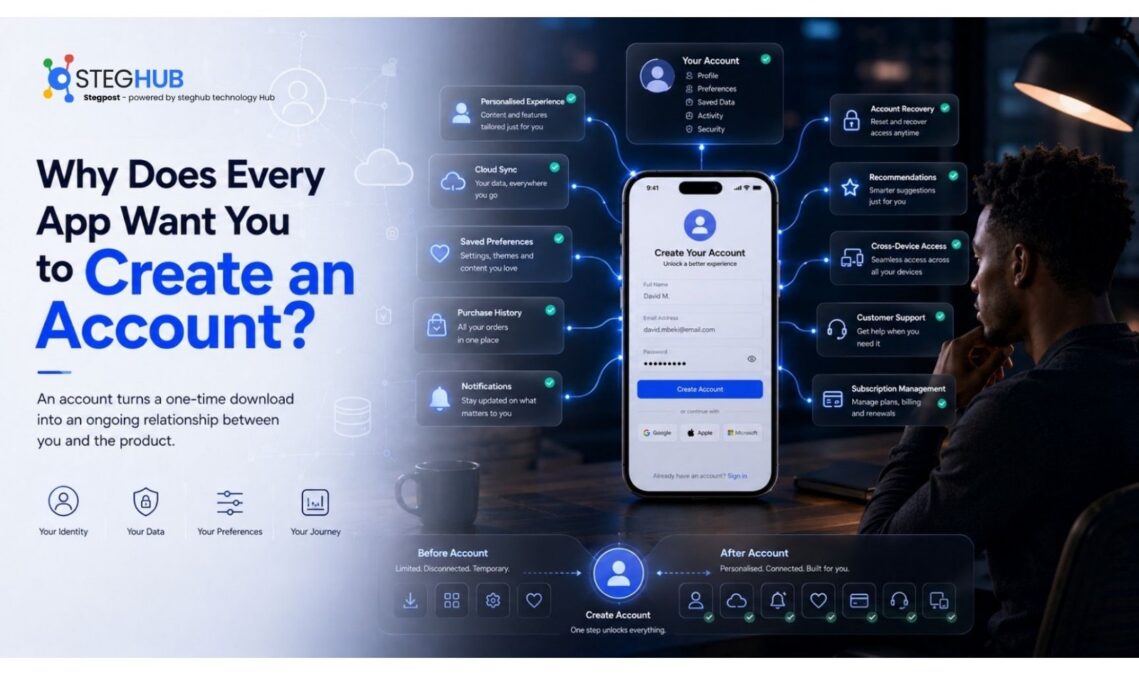
You download an app because you want to do one simple thing.
Maybe you want to check the price of something.
Maybe you want to read an article.
Maybe you want to try a new tool.
Maybe you just want to see what the app does.
Then, before you can do anything:
“Create an account to continue.”
You enter your email.
Create a password.
Confirm your email address.
Accept a few terms and conditions you probably won’t read.
Finally, you’re allowed in.
And sometimes you can’t help but wonder:
Why do they need all this information just for me to use an app?
It’s a reasonable question.
After all, if you only wanted to perform one simple action, why should the company need to know who you are?
The answer is more interesting than simply saying, “Because they want your data.”
An account can give a company something much more valuable than an email address.
It gives them the ability to recognize you.
And once a company can recognize you, it can remember you, personalize your experience, measure your behavior, communicate with you, and potentially turn a one-time visitor into a long-term customer.
That little “Sign Up” button is doing much more work than it appears to.
Before Accounts, the Internet Was Much More Anonymous
Imagine walking into a library.
You pick up a book.
You read a few pages.
You put it back.
You leave.
The library doesn’t necessarily know exactly who you are or what pages you read.
Now imagine a library that remembers everything.
It knows which books you picked up.
How long you read them.
Which pages you stopped at.
What you searched for.
What you almost borrowed.
And what you came back to the next day.
That is much closer to what happens when you create an account on a digital platform.
An account gives a service a persistent identity to associate with your activity.
Without an account, a website may see you as a visitor.
With an account, the system can say:
“This is the same person who was here yesterday.”
That distinction is enormously important.
An Account Gives Technology a Memory
Think about using a music streaming application without an account.
Every time you opened it, the service would have to start from scratch.
It wouldn’t know your favorite artists.
It wouldn’t know which songs you listened to yesterday.
It couldn’t remember your playlists.
It couldn’t synchronize your preferences between devices.
Your phone, laptop, and television would effectively be three separate experiences.
An account changes that.
Once you sign in, the service can associate your activity with a persistent profile.
You listen to a song on your phone.
Later, you open the application on your laptop.
Your playlist is still there.
You switch to your television.
Your recommendations are still there.
The technology recognizes that all three devices belong to the same user.
This is one of the most useful things accounts provide:
continuity.
Your digital experience follows you.
The account becomes a bridge between you and the service.

But Companies Also Need to Know Who Is Using Their Product
There’s another reason accounts matter.
Imagine running an online store where nobody had an account.
Thousands of people visit.
Some buy things.
Some browse.
Some return several times.
Some abandon their shopping carts.
But the store has no reliable way to connect those activities to individual customers.
That makes it harder to build relationships.
An account changes the picture.
The company can recognize that a customer has returned.
It can see previous orders.
It can make relevant recommendations.
It can provide customer support based on purchase history.
It can send notifications.
It can offer loyalty programs.
It can make checkout faster.
The account transforms a visitor into something the business can understand over time.
This is particularly important because most businesses don’t just want a transaction.
They want a relationship.
Your Email Address Is More Than a Login
When an app asks for your email address, it can feel like a simple technical requirement.
Sometimes it is.
But an email address can also become one of the most valuable pieces of information in a company’s relationship with you.
It gives the business a way to communicate with you.
You can receive:
Password reset instructions.
Order confirmations.
Product updates.
Newsletters.
Promotions.
Security alerts.
Subscription reminders.
And sometimes, more marketing than you ever asked for.
From the company’s perspective, this is powerful.
A person who visits a website once is difficult to reach again.
A person who creates an account can potentially be contacted tomorrow, next month, or next year.
That’s why companies work so hard to turn anonymous visitors into registered users.
The account creates a channel between the business and the customer.
The Moment You Create an Account, the Experience Changes
Have you ever noticed that an application becomes noticeably more personal after you sign in?
Before signing in, you might see:
“Welcome.”
After signing in:
“Welcome back.”
Your name appears.
Your previous activity is remembered.
Your preferences are loaded.
Your recommendations become more specific.
Your saved items are waiting.
The interface may even change based on what the system knows about you.
That’s because the account gives the software something it can use as a reference point.
Instead of asking:
“Who is this visitor?”
The system can ask:
“What do we already know about this user?”
That is the foundation of personalization.
This Is Where Data Enters the Picture
Now we get to the part people usually think about when they hear the word “account.”
Data.
Once a platform can recognize you over time, it can potentially associate different interactions with your profile.
What are you searching? for.
What you buy.
What you click.
What you save.
What you watch.
What you ignore.
How frequently do you use the service.
Which features do you use?
How long do you spend on certain pages?
Not every company collects all of these things, and not every piece of information is necessarily used in the same way.
But technically, an account makes it much easier to connect activity over time.
That’s valuable because individual actions often reveal very little.
Patterns reveal much more.
If you visit a website once, the company knows you visited.
If you return every day, repeatedly use certain features, and consistently interact with particular products, the company starts to understand your behavior.
The account helps make those patterns visible.
Why Can’t They Just Let You Use the App Without an Account?
Sometimes they can.
And some services do.
But there are practical reasons companies may require accounts.
Consider a banking application.
It obviously needs to know who you are.
A workplace collaboration platform needs to know which organization you belong to.
A cloud storage service needs to know which files belong to you.
An e-commerce platform needs to know where to associate your orders.
A learning platform needs to remember your courses and progress.
In these cases, the account isn’t just a marketing tool.
It’s part of how the service works.
But there are also situations where an account is less obviously necessary.
That’s when users naturally start asking questions.
Do you actually need to know who I am to provide this service?
And that’s a useful question to ask.
Authentication: The Digital Doorman
There’s another important technical reason accounts exist.
Security.
Imagine an apartment building where anyone could walk into any apartment.
It wouldn’t matter who they were.
Obviously, that wouldn’t work.
Digital systems have a similar problem.
A service needs a way to determine:
Who are you?
Are you really who you claim to be?
What are you allowed to access?
That’s where authentication and authorization come in.
Your username and password are one form of authentication.
Multi-factor authentication adds another layer.
Biometrics can provide another.
Once the system knows who you are, authorization determines what you’re allowed to do.
You may be allowed to view your files but not someone else’s.
You may be able to edit your own profile but not another customer’s.
You may be an employee with access to certain company systems but not others.
The account provides the identity around which these permissions can be built.

Then There Is the Business Side Nobody Talks About
Here’s an uncomfortable truth.
Some companies don’t want you to create an account purely because it improves your experience.
They want you to become a customer they can retain.
There’s a huge difference between:
“Someone visited our website.”
and:
“We have 500,000 registered users.”
Registered users can be measured.
They can be segmented.
They can be contacted.
They can be offered subscriptions.
They can be encouraged to return.
They can be introduced to new products.
They can be included in loyalty programs.
From a business perspective, an account represents an opportunity for a longer relationship.
This is why the sign-up process is so important to digital businesses.
The account is not the end of the customer journey.
In many cases, it’s the beginning.
The “Free” App Still Has a Business Model
This becomes especially interesting when the application costs you nothing.
You might think:
“If I’m not paying, why do they care so much about getting me to sign up?”
Because money isn’t the only thing that can create value.
A registered user can generate engagement.
Engagement can generate advertising opportunities.
User activity can help improve products.
Subscriptions can be promoted.
Premium features can be introduced.
Customers can be encouraged to purchase other services.
The business model differs from company to company.
But the principle remains:
A user who can be recognized is generally more valuable to a digital business than an anonymous visitor.
That’s why some platforms make account creation feel almost unavoidable.
Why “Continue With Google” Became So Popular
You’ve probably seen it.
Instead of creating a new username and password, you get:
Continue with Google
Continue with Apple
Continue with Microsoft
It takes seconds.
You click.
Confirm.
You’re in.
This is convenient because users don’t have to create and remember another password.
But technically, something interesting is happening.
You’re allowing one identity provider to help another service establish who you are.
This is part of a broader ecosystem of digital identity and authentication.
The application doesn’t necessarily need to manage your password itself.
Instead, it can rely on an established identity provider.
For users, the experience feels simple.
Behind the scenes, sophisticated authentication systems are communicating with one another.
That’s another example of how modern technology hides enormous complexity behind a single button.
The Problem With Having an Account Everywhere
Of course, there’s a downside.
If every service knows who you are, your digital identity becomes fragmented across dozens—or hundreds—of platforms.
You may have accounts for:
Shopping.
Banking.
Education.
Work.
Entertainment.
Social media.
Cloud storage.
Transportation.
Healthcare.
News.
Food delivery.
And countless other services.
Every account creates another place where your information exists.
Another password.
Another database.
Another company responsible for protecting your information.
Another privacy policy.
Another potential security risk.
Convenience comes with complexity.
And the more digital our lives become, the more important it becomes to understand where our identities live.
Maybe the Better Question Isn’t “Why Do They Want My Account?”
The next time an application asks you to create an account, don’t automatically assume it’s suspicious.
But don’t automatically accept it either.
Ask:
What does the account allow me to do?
What information am I being asked to provide?
Does the service actually need this information?
What will the company use my information for?
Can I use the service without an account?
What happens to my information if I delete the account?
These questions don’t require you to be a cybersecurity expert.
They simply require you to be conscious of the exchange.
Because an account isn’t just a login.
It’s an identity.
And in the digital world, identity has value.
Final Thoughts: The Little Button That Changes Everything
“Create an account” looks like a small step.
Usually, it takes less than a minute.
But technically and commercially, it can change the relationship between you and a digital service completely.
Before the account, you’re a visitor.
After the account, you’re a known user.
The system can remember you.
Your activity can be connected over time.
Your experience can become personalized.
The company can communicate with you.
Security systems can determine what you’re allowed to access.
And the business can begin building a longer relationship with you.
That’s why almost every app wants you to sign up.
Sometimes it’s because the service genuinely needs an identity to function.
Sometimes it’s because an account makes the experience better.
And sometimes, it’s because knowing who you are is valuable to the business.
The next time an app asks you to create an account, take a second before clicking “Continue.”
You might be signing up for more than just the app.
You might be giving the technology a way to remember you.

