

Spend a few minutes online and you’ll probably see headlines like these:
- AI wrote a book
- AI designed a website
- AI created a marketing campaign
- AI replaced an entire workflow
- AI can now do what humans do
The message often sounds the same:
Artificial intelligence is becoming fully autonomous.
It’s easy to imagine a future where powerful AI systems operate almost entirely on their own, creating products, solving problems, and making decisions with little or no human involvement.
But here’s a reality that rarely makes the headlines:
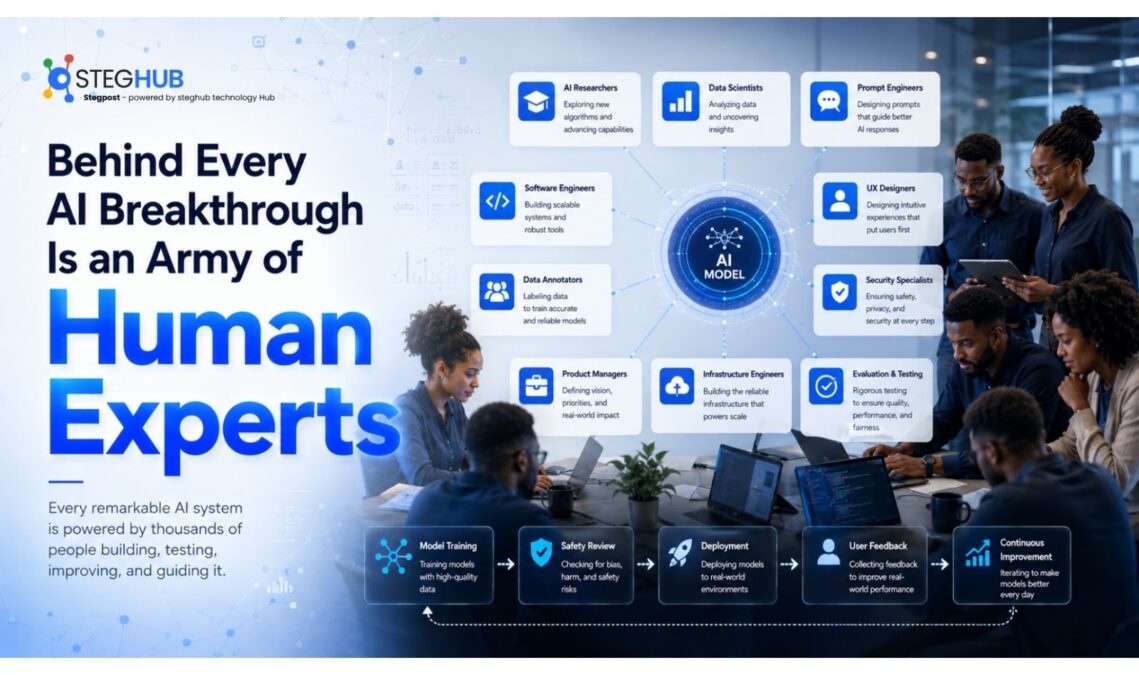
Behind every impressive AI breakthrough is an enormous amount of human expertise.
The AI you see is only the visible tip of a much larger iceberg.
Beneath the surface are researchers, engineers, designers, data specialists, security teams, product managers, and many other professionals working together to make those systems possible.
AI is powerful.
But AI is not appearing out of thin air.
Imagine Watching a Magic Show
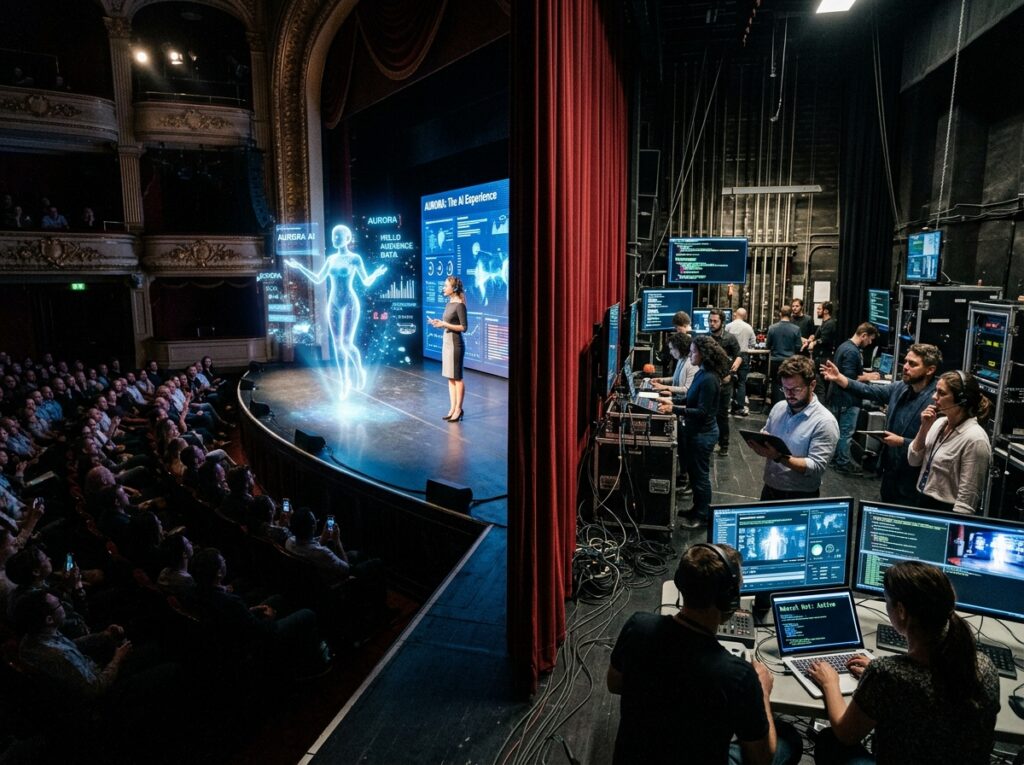
Think about a professional magician performing on stage.
The audience sees the final trick.
A card disappears.
A coin appears from nowhere.
A person seems to float in the air.
For a moment, it feels like magic.
What the audience doesn’t see are the hours of rehearsal, the carefully designed props, the lighting, the timing, the assistants, and the people working behind the curtains.
AI often creates a similar illusion.
We interact with a polished chatbot, image generator, or recommendation system and see only the final result.
The vast amount of human work behind that experience remains largely invisible.
Someone Had to Teach the AI First
One of the biggest misconceptions about AI is that it simply “knows everything.”
In reality, AI systems learn from data created, collected, organized, and prepared by humans.
For example, if an AI can recognize objects in photos, people had to provide millions of labeled images.
If it can answer questions, humans had to create, review, and structure enormous amounts of text.
If it can translate languages, humans had to produce high-quality examples of those languages.
Think of it like training a new employee.
You don’t hire someone on Monday and expect them to understand your entire business by Tuesday.
They need examples, guidance, corrections, and feedback.
AI systems require the same thing, just at a much larger scale.
Data Engineers: The People Building the Foundation
Before an AI model can be trained, the data has to be gathered and prepared.
This is where data engineers play a critical role.
They build pipelines that collect information from different sources, clean corrupted or duplicate data, organize it into usable formats, and ensure that the training data is reliable and accessible.
Imagine trying to cook a five-star meal with ingredients scattered across ten different markets, some spoiled, some mislabeled, and some missing entirely.
Data engineers are the people who organize the kitchen before the chefs can begin cooking.
Without clean, well-structured data, even the most advanced AI model will produce poor results.
Researchers Spend Years on What Looks Instant
When a new AI model is released, it often appears suddenly.
One day it doesn’t exist.
The next day, everyone is talking about it.
What we don’t see are the years of research that came before the launch.
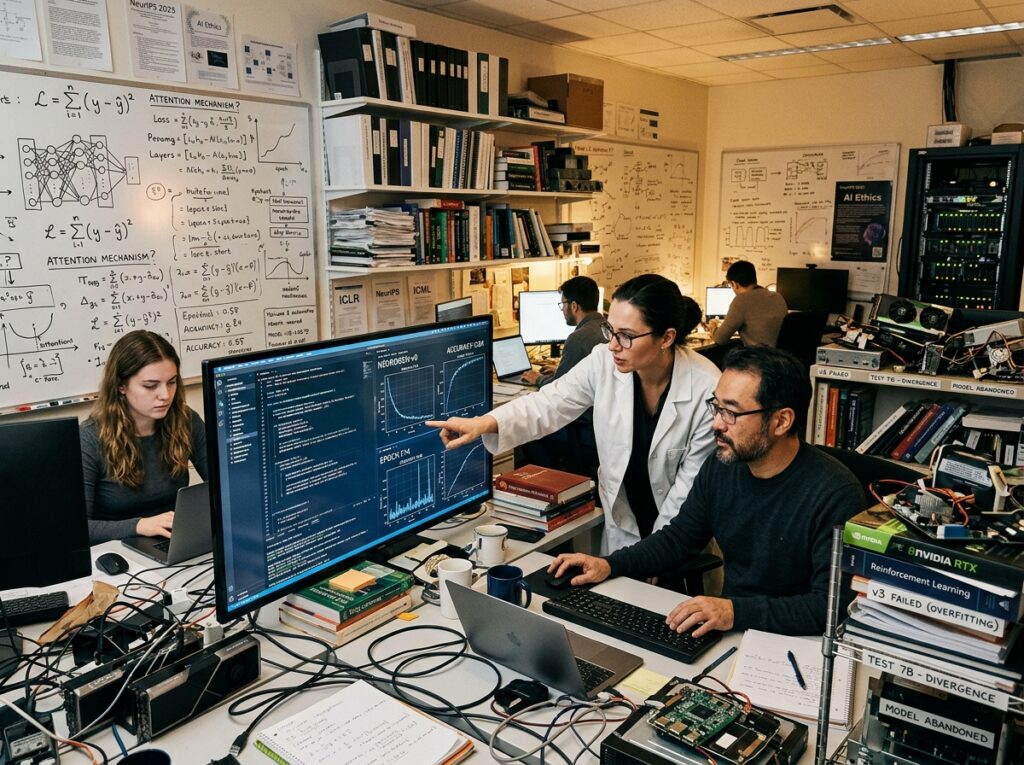
Researchers experiment with new algorithms, test different training methods, analyze failures, compare results, write scientific papers, and repeat this process countless times before a breakthrough becomes visible to the public.
The “overnight success” of many AI systems is usually the result of thousands of days of invisible experimentation.
Infrastructure Teams Keep the AI Alive
Running modern AI systems requires enormous computing power.
Behind every chatbot response, image generation request, or AI-powered search is a massive infrastructure involving:
- Data centers
- GPUs and specialized processors
- Cloud platforms
- Networking systems
- Storage clusters
- Monitoring and reliability tools
This infrastructure doesn’t manage itself.
Cloud engineers, DevOps engineers, site reliability engineers, and infrastructure specialists work constantly to ensure these systems remain available, scalable, and secure.
In many cases, the infrastructure supporting an AI product is as complex as the AI model itself.
Human Reviewers Still Matter More Than People Think
Another hidden layer of AI development involves human reviewers and evaluators.
AI systems are often tested by people who check whether the responses are accurate, helpful, safe, unbiased, and understandable.
When an AI gives a poor answer, humans analyze what went wrong and provide feedback that helps improve future versions.
This process is especially important for systems used in areas such as healthcare, finance, education, and customer support, where mistakes can have serious consequences.
AI may generate the response.
Humans often help determine whether that response should be trusted.
Product Teams Decide What AI Should Actually Do
Here’s something that surprises many people:
A powerful AI model is not automatically a useful product.
Someone has to decide:
- What problem are we solving?
- Who are the users?
- What features matter most?
- How should the interface work?
- What happens when the AI is uncertain?
- How do we explain limitations to users?
These decisions are typically made by product managers, UX designers, researchers, and business teams working alongside engineers.
The success of an AI product often depends as much on human-centered design as on the underlying model itself.

The Bigger Picture: AI Is a Team Sport
When people ask,
“Will AI replace humans?”
They often imagine a direct competition between one person and one machine.
Reality is much more nuanced.
Modern AI systems are the result of large-scale human collaboration across many specialties:
- Researchers create the algorithms.
- Data engineers prepare the data.
- Infrastructure teams provide the computing power.
- Security specialists protect the systems.
- Product teams shape the user experience.
- Reviewers evaluate quality and safety.
- Support and operations teams keep everything running smoothly.
AI is not replacing the need for human expertise.
In many cases, it is changing the kinds of expertise that become most valuable.
Final Thoughts: The Humans Behind the Headlines
The next time you see an impressive AI-generated image, a remarkably helpful chatbot response, or a headline announcing the latest AI breakthrough, remember that you’re seeing the final performance, not the entire production.
Behind that moment are countless hours of research, engineering, data preparation, infrastructure management, testing, design, and human judgment.
AI is undoubtedly one of the most transformative technologies of our time.
But perhaps the most important thing to understand is this:
Artificial intelligence is not a replacement for human intelligence, appearing from nowhere. It is a powerful tool built, guided, maintained, and continuously improved by large communities of human experts.
The headlines may celebrate the AI.
The real story is often the thousands of people working behind the scenes to make that AI useful, reliable, and safe for everyone else.
And that is why behind every AI breakthrough is not a lone machine…
But an army of human experts is quietly making the breakthrough possible.

