

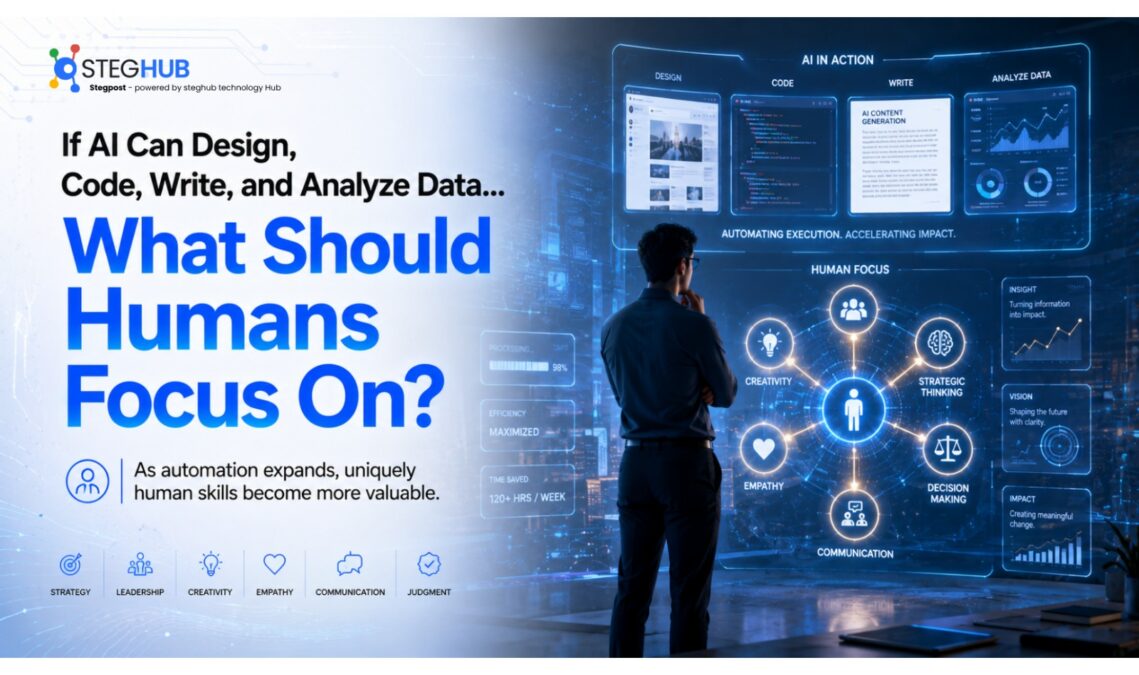
A few months ago, if someone told you that a single AI tool could design a flyer, write a blog post, build a website mockup, summarize a meeting, generate a marketing plan, and analyze a spreadsheet…
You’d probably think they were exaggerating.
Today?
That’s just a normal Tuesday.
Every week, a new AI tool seems to appear with another impressive capability. One day, it’s generating stunning product branding. The next day, it’s building websites from simple prompts. Then it’s writing code, analyzing customer data, or creating presentations in minutes.
It’s exciting.
It’s also making a lot of people nervous.
Because if AI can do all these things, where does that leave the rest of us?
It’s a fair question.
But it might not have the answer people expect.
The Wrong Question
A lot of people are asking:
“What can AI do?”
The more useful question is:
“What should humans focus on now?”
Because throughout history, technology has always changed the way work gets done.
The calculator changed accounting.
Email changed communication.
The internet changed information.
None of those things eliminated human value.
They shifted it.
And that’s exactly what’s happening again.
Having a Hammer Doesn’t Build a House
Let’s use a simple example.
Imagine giving the world’s best construction tools to someone who’s never built anything before.
Will they suddenly become an architect?
Probably not.
The tools help.
But the thinking still matters.
The planning still matters.
The vision still matters.
AI is similar.
It can generate options.
It can speed things up.
It can automate repetitive tasks.

The Real Skill Is Knowing What Problem You are Solving
One of the biggest misconceptions about AI is that it’s replacing expertise.
In reality, it’s exposing weak thinking.
Here’s what I mean.
Imagine two people using the same AI tool.
The first person says:
“Create a marketing strategy.”
The second person says:
“Our customer retention dropped by 18% over the last three months. Create a marketing strategy focused on re-engaging existing customers without increasing advertising spend.”
Who gets the better result?
The difference isn’t the tool.
It’s the quality of the thinking behind the request.
And that’s a human skill.
Creativity Is Becoming More Valuable, Not Less
This surprises a lot of people.
When AI started generating images, many assumed creativity would become less important.
The opposite is happening.
Because now everyone has access to the same tools.
The difference comes down to ideas.
Think about it.
Thousands of people can use the same image generator.
Yet some create unforgettable campaigns while others create forgettable content.
Why?
Because creativity was never about clicking buttons.
It was about seeing possibilities that others miss.

Communication Is Becoming a Superpower
Have you noticed something interesting?
The people getting the best results from AI are often the people who communicate clearly.
Whether they’re writing prompts, leading teams, presenting ideas, or explaining problems, communication matters.
A lot.
Because even the smartest tool can’t help much if it doesn’t understand what you’re trying to achieve.
Think about work in general.
Projects fail less often because of technical problems and more often because people misunderstand each other.
That’s why communication isn’t becoming less important.
It’s becoming one of the most valuable skills you can have.
Judgment Is Still Human Territory
AI can provide ten answers.
Sometimes fifty.
Sometimes hundreds.
But it can’t fully understand your context.
It doesn’t know your customers personally.
It doesn’t know your team’s dynamics.
It doesn’t know the history behind every business decision.
That’s where judgment comes in.
For example:
An AI tool might recommend laying off employees to reduce costs.
The numbers may support it.
But a leader has to consider morale, culture, long-term impact, and human consequences.
Data helps.
Judgment decides.
The Future Belongs to People Who Can Connect the Dots
Something interesting is happening in workplaces right now.
The most valuable people aren’t necessarily the ones doing every task manually.
They’re the ones connecting information.
They’re asking:
- What does this data mean?
- What problem are we actually solving?
- What should we do next?
- How does this decision affect customers?
- How do different teams work together?
Those questions don’t disappear because AI exists.
If anything, they become more important.

So What Should Humans Focus On?
If AI continues improving—and it probably will—these are the skills worth investing in:
- Critical thinking
- Communication
- Creativity
- Leadership
- Problem-solving
- Decision-making
- Emotional intelligence
- Collaboration
Notice something?
Most of them aren’t technical.
They’re human.
And that’s exactly why they matter.
Final Thoughts: The Future Isn’t Human vs AI
A lot of conversations frame this as a competition.
Humans versus machines.
People versus AI.
But that’s probably the wrong way to look at it.
The future isn’t about replacing people.
It’s about changing how people create value.
AI can help you design faster.
Write faster.
Code faster.
Analyze faster.
But knowing what matters, what deserves attention, and what direction to take?
That’s still your job.
Here’s Something Worth Thinking About
Twenty years ago, knowing how to use the internet became an advantage.
Today, it’s a basic expectation.
AI is likely heading in the same direction.
The question isn’t whether AI will become part of work.
The question is what you’ll choose to do with the time, speed, and opportunities it creates.
Because in a world where everyone has access to powerful tools, the people who stand out won’t be the ones with the best technology.
They’ll be the ones with the best thinking.


