

A few years ago, the career advice was simple.
Pick one thing.
Master it.
Become the expert.
Stay in your lane.
And for a long time, that worked.
If you were a developer, you focused on coding.
If you were a designer, you would focus on design.
If you were a marketer, you would focus on marketing.
Everyone had their corner.
Everyone stayed there.
But something interesting has been happening in the tech industry lately.
The people creating the biggest impact aren’t always the ones who know the most about one thing.
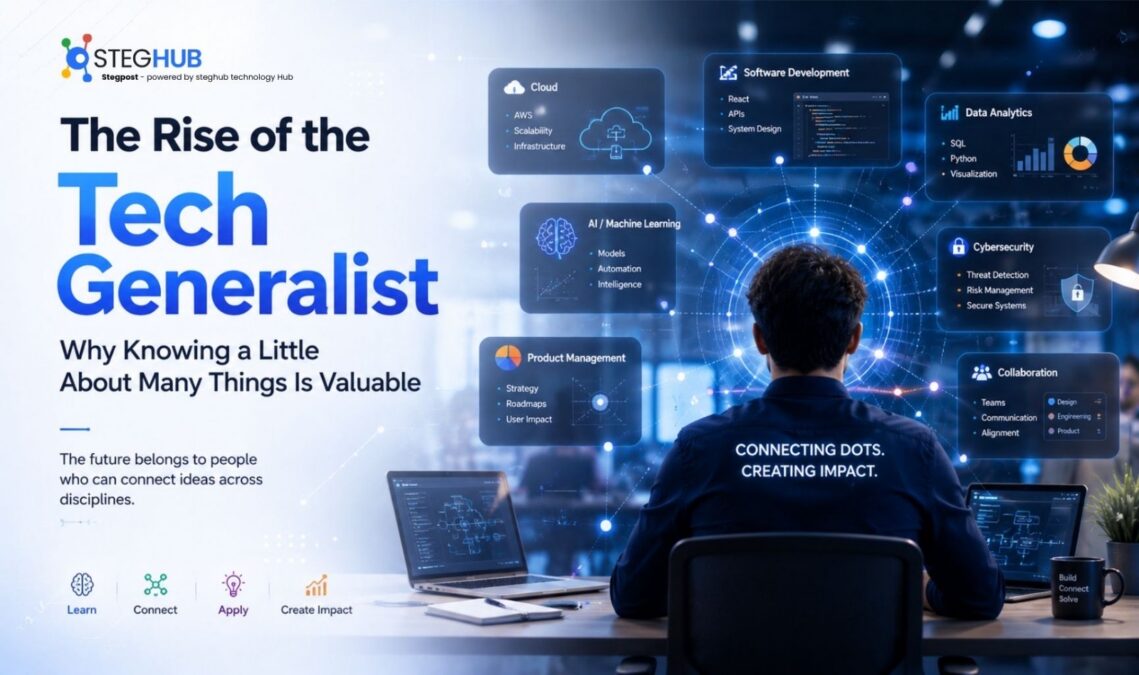
They’re often the people who understand enough about several things to connect the dots.
Welcome to the rise of the tech generalist.
The Specialist Isn’t Disappearing
Before anyone panics, let’s clear something up.
This isn’t a “specialists are no longer important” article.
We still need cybersecurity experts.
We still need cloud engineers.
We still need software architects.
We still need data scientists.
Deep expertise will always matter.
The difference is that today’s workplace often rewards people who can work across disciplines, not just within one.
Think of a football team.
You still need strikers.
You still need defenders.
But the players who understand how the entire game works often become the most valuable on the field.
Technology is becoming similar.
The Best Conversations Are Happening Between Different Worlds
Imagine a software developer who understands a bit of product management.
Or a product manager who understands data analytics.
Or a designer who understands user psychology and business strategy.
Something interesting happens.
Communication becomes easier.
Problems get solved faster.
Teams collaborate better.
Because they’re no longer speaking completely different languages.
They understand enough about each other’s work to work together effectively.
In today’s tech environment, that’s a significant advantage.

Companies Are Looking for Problem Solvers, Not Just Job Titles
Let’s say a startup hires two people.
The first person is incredibly skilled in one area but struggles whenever work moves outside their specialty.
The second person is strong in their main role but also understands customer experience, basic data analysis, automation tools, and business goals.
Who becomes more valuable as the company grows?
In many cases, it’s the second person.
Because businesses don’t wake up thinking:
“We need more job titles today.”
They wake up thinking:
“We need someone who can help solve this problem.”
And problems rarely fit neatly into one department.
Technology Is Moving Too Fast for Silos
Think about how quickly things have changed in the last few years.
AI exploded.
Automation became mainstream.
Cloud adoption accelerated.
No-code tools have improved dramatically.
Entire job descriptions have evolved.
Someone who focuses solely on a single aspect of technology may eventually struggle to see the broader picture.
Meanwhile, professionals who continuously learn adjacent skills can adapt more easily.
They’re not starting from scratch every time the industry changes.
They’re building on existing knowledge.
And that flexibility matters.
A lot.
A Real Example Most People Can Relate To
Let’s imagine two aspiring product managers.
The first person only studies product management frameworks.
The second person studies product management but also learns basic UX principles, understands analytics dashboards, and knows how developers typically work.
When both enter a product meeting, who do you think can contribute more effectively?
The second person.
Not because they’re smarter.
Because they can connect ideas across different areas.
That’s the power of becoming a tech generalist.
You start seeing the entire puzzle instead of just one piece.

The Goal Isn’t Knowing Everything
Here’s where people get confused.
When they hear “generalist,” they assume they need to learn everything.
That’s impossible.
Technology is far too broad.
The goal isn’t to know everything.
The goal is to understand enough.
Enough to ask better questions.
Enough to communicate effectively.
Enough to collaborate with experts.
Enough to understand how your work affects everyone else’s.
Think of it like traveling.
You don’t need to be fluent in ten languages.
But knowing a few phrases in each can make your journey much easier.
Why AI Is Making Generalists Even More Valuable
This might surprise some people.
AI is actually increasing the value of tech generalists.
Why?
Because AI tools can help bridge technical gaps.
Today, someone with strong business knowledge can use AI to understand technical concepts faster.
A designer can explore coding concepts.
A marketer can analyze data.
A product manager can create prototypes.
The barriers between disciplines are getting smaller.
As a result, people who can combine multiple skills are becoming increasingly effective.
The future may not belong solely to specialists or generalists.
It may belong to people who know one area deeply and several others broadly.
How to Become a Tech Generalist Without Getting Overwhelmed
You don’t need another 15 courses.
You don’t need to learn every technology trend.
Start small.
If you’re a developer, learn some product thinking.
If you’re a designer, learn basic analytics.
If you’re a marketer, explore automation tools.
If you’re a data analyst, understand how business decisions are made.
Build outward from your foundation.
One skill at a time.
The goal isn’t reinvention.
It’s an expansion.

Final Thoughts: The Future Belongs to Connectors
The tech industry doesn’t have a shortage of information.
It has a shortage of people who can connect information.
People who can bridge teams.
Translate ideas.
Understand different perspectives.
And bring solutions together.
That’s what makes tech generalists so valuable.
Not because they know everything.
But because they understand how different pieces fit together.
So if you’ve been feeling pressured to stay inside one box forever, here’s some good news:
You don’t have to.
Keep your expertise.
But stay curious.
Explore nearby skills.
Learn how other teams think.
Because in a world where technology keeps evolving, the people who can connect the dots may end up being the ones who create the biggest impact.

