

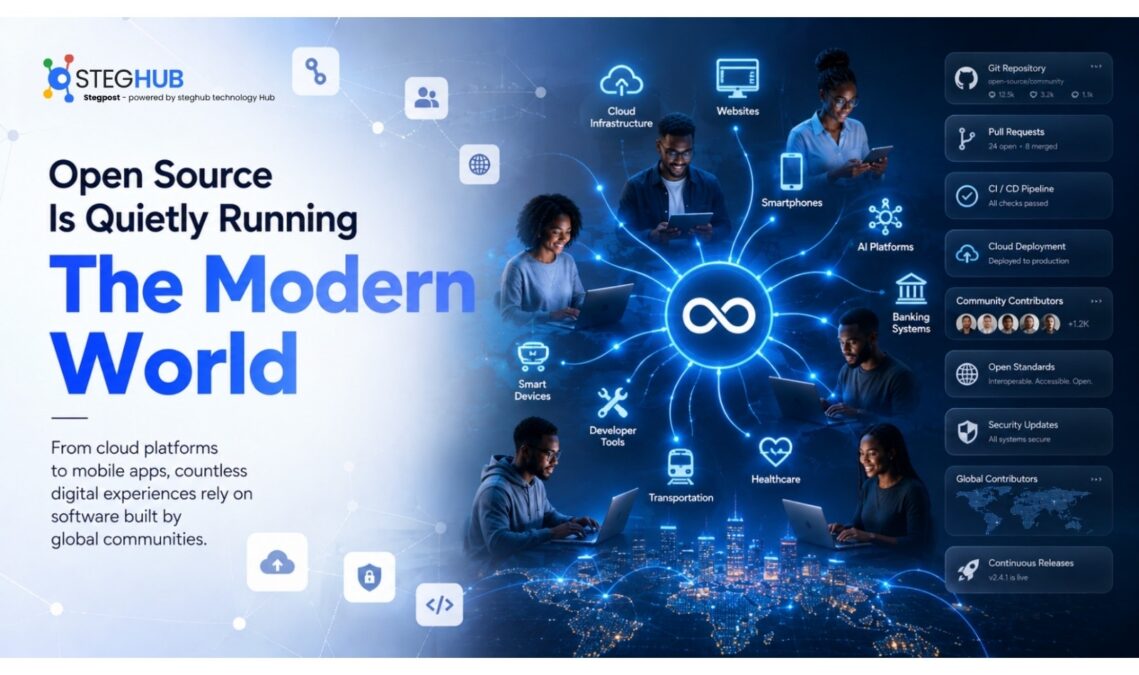
If you asked the average person what powers the internet, they’d probably mention companies like Google, Microsoft, Amazon, Apple, or Meta.
Those companies are incredibly important.
But here’s something surprising:
A huge portion of the technology that keeps websites online, runs cloud platforms, powers smartphones, supports AI systems, and operates enterprise infrastructure was not built by a single company behind closed doors.
It was built by communities of developers around the world, often working together across different countries, time zones, and organizations.
That world is called open source.
And most people are using it every single day without realizing it.
The Technology You Can’t See
Imagine walking into a modern city.
You admire the skyscrapers, shopping malls, restaurants, and office buildings.
What you usually don’t think about are the roads, water pipes, electrical cables, and drainage systems hidden underneath the city.
Those invisible systems are what make everything above ground possible.
Open source plays a very similar role in technology.
When you visit a website, stream a movie, send a message, use cloud storage, or interact with an AI tool, there’s a good chance open-source software is involved somewhere in the process.
The apps you see are often just the visible layer.
Beneath them is an enormous foundation of shared technology.
What Exactly Is Open Source?
In simple terms, open-source software is software whose source code is publicly available for anyone to view, study, improve, and sometimes redistribute.
Think of it like a community cookbook.
Instead of one chef keeping the recipe secret, the recipe is shared openly.
Anyone can:
- Read it
- Learn from it
- Suggest improvements
- Fix mistakes
- Create their own version
This doesn’t mean open-source software is automatically free of cost or free of rules.
It means the development process is transparent and collaborative, allowing many people and organizations to contribute to the same project.
You Probably Use Open Source Every Day
Here are a few examples that might surprise you:
- Linux powers much of the world’s servers, cloud infrastructure, and supercomputers.
- Android is built on top of the Linux kernel.
- WordPress powers a large percentage of websites on the internet.
- Python, one of the most popular programming languages for AI and data science, is open source.
- PostgreSQL and MySQL, widely used databases, are open source.
- Kubernetes, which helps companies manage cloud applications at scale, is open source.
- Many tools used by developers, data analysts, DevOps engineers, and cybersecurity professionals are open source.
In other words, even if you’ve never downloaded an open-source project yourself, there’s a very good chance that the services you rely on every day are built on top of open-source technology.
Why Do Companies Use Software They Didn’t Create?
This is one of the most common questions people ask.
Imagine every company had to build its own operating system, database, web server, networking tools, and security libraries from scratch before creating a single product.
Progress would be painfully slow.
Open source allows companies to build on top of proven foundations rather than reinventing the wheel every time.
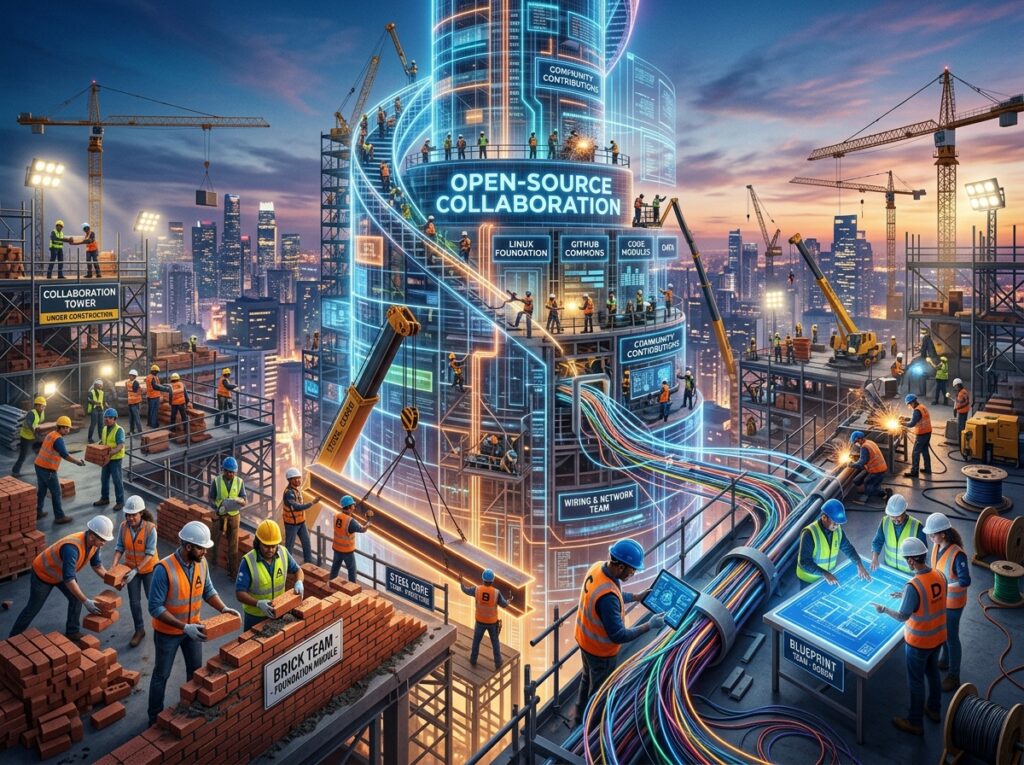
It’s similar to construction.
A company building a new office doesn’t manufacture its own cement, steel, glass, and electrical wiring from raw materials.
It uses existing infrastructure and focuses on creating something valuable on top of it.
Technology companies do the same thing with open-source software.
The Hidden Superpower: Thousands of Eyes
One of the biggest advantages of open source is that many people can examine the code.
If a bug exists, developers from different organizations may notice it.
If a security vulnerability appears, experts around the world can help identify and fix it.
This doesn’t make open-source software perfect—nothing in technology is perfect.
But it creates a powerful model where improvement is not limited to the employees of a single company.
Sometimes a university researcher, an independent developer, a cloud engineer in another country, or a large enterprise can all contribute to making the same tool better for everyone.
Open Source Also Changed Careers
Here’s something especially important for people entering the tech industry.
Open source has become one of the greatest learning resources ever created.
In the past, aspiring developers often had to rely heavily on textbooks or expensive training materials.
Today, they can study real-world projects used by millions of people.
They can see how experienced engineers structure code, solve problems, write documentation, and collaborate with others.
Many professionals have built their careers by:
- Contributing to open-source projects
- Fixing small bugs
- Improving documentation
- Reporting issues
- Building extensions or plugins
- Participating in community discussions
Open source doesn’t just produce software.
It produces learning opportunities and professional networks.
The Companies You Know Depend on It Too
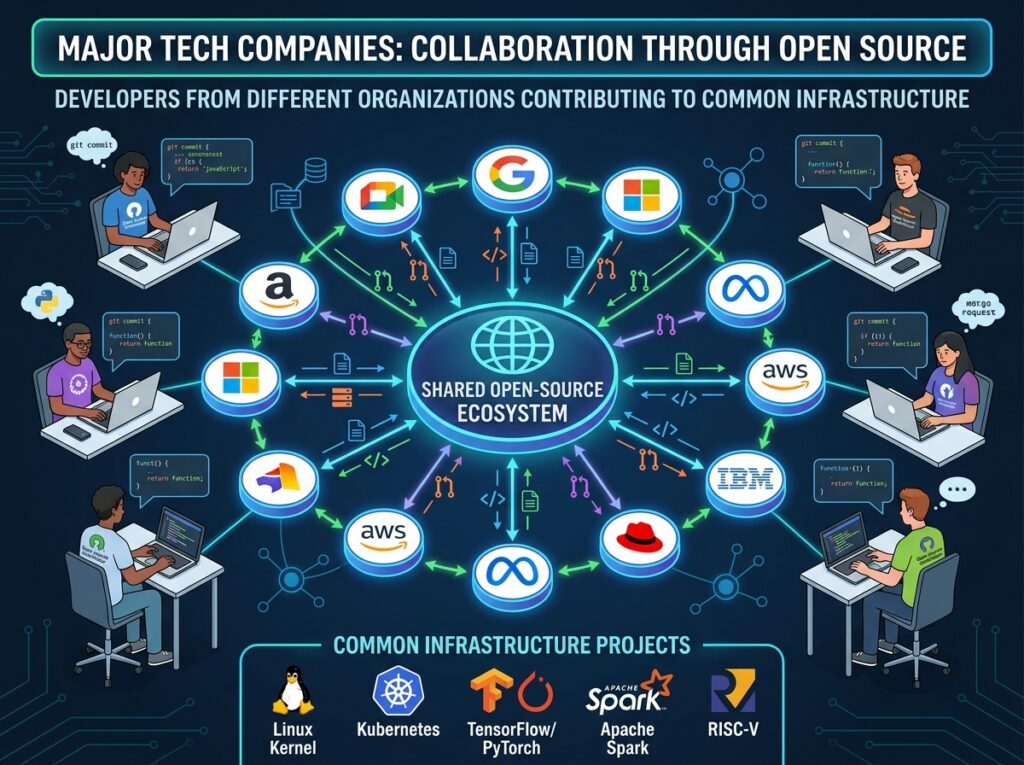
Another surprising fact is that many major technology companies are not just users of open source—they are also contributors.
Companies like Google, Microsoft, Meta, Amazon, Netflix, and many others contribute to open-source projects because they benefit from a healthy shared ecosystem.
This creates an interesting relationship.
Competitors may fight fiercely in the marketplace while still collaborating on foundational technologies that benefit the entire industry.
It’s a reminder that modern technology is often more interconnected than it appears from the outside.

Why Most People Never Hear About It
Open source has an unusual problem:
When it works well, it becomes invisible.
People notice social media apps.
They notice streaming platforms.
They notice AI assistants and online marketplaces.
They rarely notice the database storing the information, the server software delivering the webpage, or the orchestration platform managing the cloud infrastructure behind the scenes.
The most important technologies are often the ones that quietly do their job without demanding attention.
The Bigger Picture: A Global Collaboration Experiment
Perhaps the most fascinating thing about open source is that it represents one of the largest collaborative experiments in human history.
Millions of people who have never met each other contribute to shared digital infrastructure used by billions of users worldwide.
A developer in Nigeria might improve a feature that helps a company in Germany serve customers in Brazil using servers hosted in Singapore.
That level of global collaboration would have been almost unimaginable a few decades ago.
Open source demonstrates that some of the most important technological advances happen not through isolated competition, but through shared knowledge and collective improvement.
Final Thoughts: The Quiet Engine Behind the Internet
The next time you stream a movie, search the web, use a banking app, store a file in the cloud, or interact with an AI system, remember that there is a good chance open-source software is helping make that experience possible.
It may not have a famous logo on the screen.
It may never appear in a commercial.
Most users will never know its name.
But behind much of the modern digital world is a vast ecosystem of shared code, collaborative communities, and contributors working together to build the infrastructure that everyone else depends on.
The internet is often associated with the biggest technology companies in the world.
Yet beneath those companies lies something even more remarkable:
a global community quietly building the foundations of the modern digital age.
And that is why open source is quietly running the modern world.

